Search

GEOGRAPHY EDUCATION

Supporting geography educators everywhere with current digital resources.

Category

Uncategorized

Ukraine: To Face Europe or Russia?

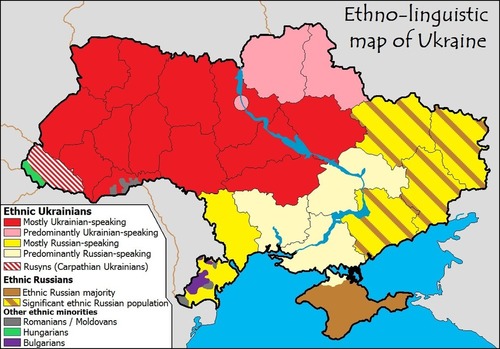
“This map illustrates the country’s deep division – and why the protests might not be what you think. Ukraine has been wracked by protests for two-plus weeks over President Viktor Yanukovych’s decision to reject a deal for closer integration with the European Union. Russian President Vladimir Putin had been pressuring Yanukovych to quit the EU deal and join with a Moscow-led trade union of former Soviet states instead. Will Ukraine’s future be with Russia or with Europe?”

Seth Dixon‘s insight:

The country of Ukraine is both ethnically and linguistically divided and since the fall of the Soviet Union, the partisan politics have mirrored these divisions.  The northwestern portion of the country is primarily ethnic Ukrainian and with the majority speaking Ukrainian.  This section of the country that is hoping to strengthen economic and political ties with the EU and face Europe; those that aren’t as bullish on the EU here at least want to explore other options so they aren’t overpowered by Moscow’s shadow.  The southeastern portion of Ukraine primarily speaks Russian with sizeable ethnic Russian populations (although many ethnic Ukrainians speak Russian here); not surprisingly, this is the part of the country that  would rather join in a economic union with Russia and other former Soviet Republics, or at least not turn their backs on Moscow. 


Questions to Ponder: Why are language and ethnicity often tied to political orientation?  Why might trading with all economic partners not be as viable an option?

See on www.washingtonpost.com

Is the World Empty? Or Overcrowded? It’s Both


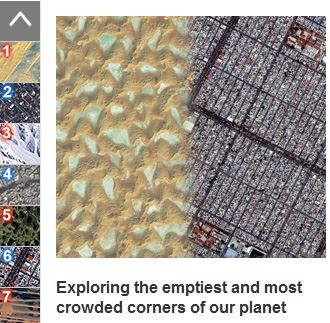
“For city dwellers, it may seem like the world is packed full with people. But not everywhere is so densely populated; in fact, many places in the world are seemingly void of life.There are over 7 billion people on the planet, a massive number that paints an image of human life sprawling densely over the planet…humans are unevenly distributed across the planet, leaving some areas that are densely populated and others that are largely void of life.”

Seth Dixon‘s insight:

This is a great interactive map that show the tremendous variability in human settlement patterns around the globe.  Why are some places so densely settled when others are so empty?  What geographic factors account for these patterns?  Is the world overcrowded?  What concepts need to be consider besided population density to answer that question? 

Tags: density, GIS, ESRI, cartography, mapping.

See on www.smithsonianmag.com

CrowdedSmithsonian

Safe drinking water disappearing fast in Bangladesh

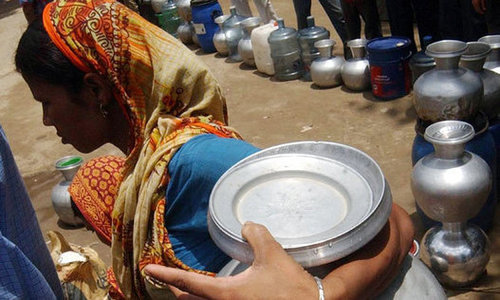
Extreme weather increases salinity of water in coastal areas while excessive demand in Dhaka leaves dwindling supply


Seth Dixon‘s insight:

In what ways is access to safe drinking water both a physical geography and human geography issue?  How do changes in one factor influence the others? 


Tags: Bangladesh, water, development.

See on www.theguardian.com

Missing Girls…

“In India, China and many other parts of the world today, girls are killed, aborted and abandoned simply because they are girls. The United Nations estimates as many as 200 million girls are missing in the world today because of this so-called ‘gendercide’ or femicide.”

Seth Dixon‘s insight:

Part of me hates to bring up this issue since it is so disturbing, but silence itself is a part of the problem.  Just know that I don’t bring this up lightly and I wouldn’t share this with students of all ages.  Read more on in the this topic in the accompanying article here.  The filmmaker has explained why he was motivated to produce this, but not everyone thinks the message of the full documentary is fair and balanced.

Questions to Ponder (with a heavy heart): what cultural, political and demographic factors create the conditions where a situation like this can occur?  What should and can be done?

Tags: gender, development, India, China,

See on www.youtube.com

Muslims masquerade as Hindus for India jobs

Facing religious discrimination in the Hindu-dominated job market, many are forced to assume fake identities.

Seth Dixon‘s insight:

This is not that uncommon in India unfortunately.  As the articles states, a government commission was appointed in 2005 to investigate the degree to which Muslims were disadvantaged in social, economic and educational terms.  The commission concluded the socio-economic condition of most Muslims was as bad as that of the Dalits, who are at the bottom rung of the Hindu-caste hierarchy, also referred to as the “untouchables.” 


Tags: labor, industry, economic, poverty, India.

See on www.aljazeera.com

Watch The World Grow Older In 4 GIFs

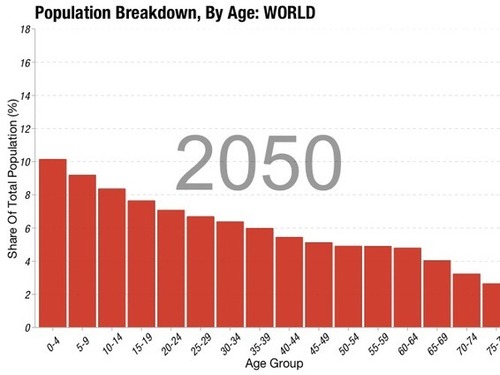
Some countries are getting old. Others are staying young — and getting much bigger.

Seth Dixon‘s insight:

These time-lapse demographic charts help to visualize the impacts of the demographic transition principles on a society.  In the GIFs of the United States and Japan for example, you can clearly see the baby boomer generation and the ‘greying’ processes respectively. 

Tags: population, demographic transition model, declining population, population, demographics, models.

See on www.npr.org

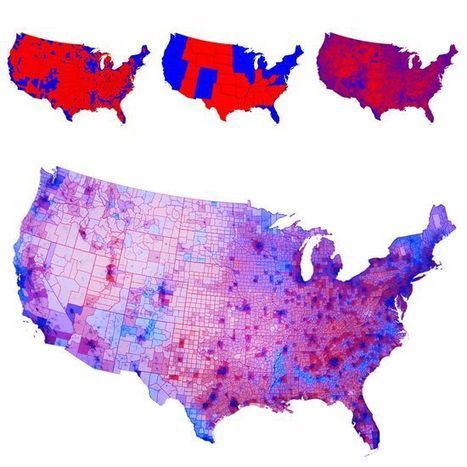
Most Americans live in Purple America, not Red or Blue America

“We’re far less politically divided by geography than it may seem….Of course, it’s true that Americans aren’t of one mind on many political issues.  But it is important that we not look at these maps and infer that we are so politically polarized by geography.  In fact, most Americans live in places that are at least somewhat politically and ideologically diverse — even if that’s not reflected in how congressional district boundaries are drawn.   In terms of the most important driver of political choices — partisanship — most of us live in a purple America, not a red or blue America.”

See on www.washingtonpost.com

Cultural Syncretism

ShalomYa'll

Seth Dixon‘s insight:

I found this image on social media from a great geography teacher (link to his site–looking for APHG group activities?  Try this).  This picture taken at the Jewish Community Center (JCC) in Memphis, TN shows an intrguing linguistic combination that I had never imagined before.  This is referred to as cultural syncretism, where two or more cultures or cultural traits combine together to make something new.  Globalization and migration are making more cultural combinations than we’ve ever seen before in this human mosaic we call home.

See on houstonhs.scsk12.org


Pipeline On Wheels: Trains Are Winning Big Off U.S. Oil

The railroad industry is eager to be the go-to oil shipper, but some worry it’s moving too fast.

Seth Dixon‘s insight:

Many hoping to stop environmental degradation of Canada’s Tar Sands and the Dakotas “Kuwait on the Prairie” have opposed the construction of the Keystone XL pipeline.  It’s been decades since crude oil has been shipped by rail in the United States but fracking technologies have opened up areas without oil pipelines to become major producers.  As demonstrated in this NPR podcast, the railroad industry has seized on this vacuum and since 2009 has been supplying the oil industry the means to get their product to the market.   

Tags:  transportation, industry, economic, energy, resources, environment, environment modify, ecology.

See on www.npr.org

Create a free website or blog at WordPress.com.

Up ↑