From the world’s largest seas to islands and coastlines, will you sink or swim in this challenging geography quiz? Dive into our selection of sea based trivia now!
Seth Dixon, Ph.D.‘s insight:
See on www.quizfortune.com
From the world’s largest seas to islands and coastlines, will you sink or swim in this challenging geography quiz? Dive into our selection of sea based trivia now!
See on www.quizfortune.com
I’ve posted on this previously, but this imgur gallery puts the images in a stunning new format for sharing. This gallery portrays 20 families from around world together with their weeks food. The differences in agricultural, development and cultural patterns are plainly manifest. For more context on this photographic project (as well as the details of the families and their food), it is chronicled in the book Hungry Planet. or an abbreviated version online.
Tags: food, agriculture, worldwide, consumption, culture, development.
See on imgur.com
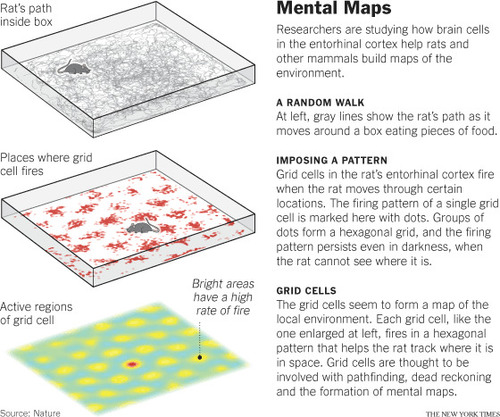
May-Britt and Edvard I. Moser are exploring the way the brain records and remembers movement in space, which they speculate may be the basis of all memory.
This is more neuroscience than it is geography, but it is incredibly relevant to geographers and spatial analysis. These Norwegian neuroscientists are charting the brain to understand how we remember where we have been, where we are and how we navigate through space. They are primarily mapping out the brains of rats, but much of what they’ve discovered appears to hold for all mammals. There are certain cells that are only active when you are in certain places. These cells interact as a network in a grid pattern, forming a very regular hexagonal pattern (central place theory!?!). These ‘place cells’ or ‘grid cells’ store information about distances and directions and are crucial to navigation. Read more about it in this article or watch this 6-minute video.
Tags: spatial, mental maps.
See on www.nytimes.com
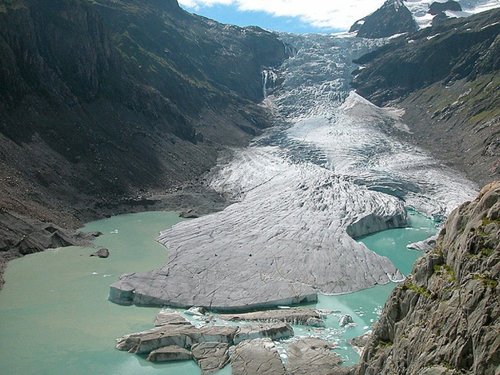
Climate change is dramatically altering the Swiss Alps, where hundreds of bodies of water are being created by melting glaciers. Though the lakes can attract tourists and even generate electricity, local residents also fear catastrophic tidal waves.
Earth systems are inherently dynamic; however a change to system such as climate change can upset the system dramatically.
Tags: climate change, water, physical, geomorphology, landforms.
See on www.spiegel.de
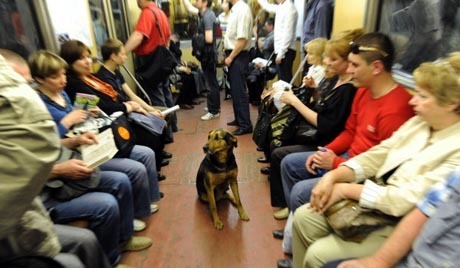
“Every so often, if you ride Moscow’s crowded subways, you may notice that the commuters around you include a dog – a stray dog, on its own, just using the handy underground Metro to beat the traffic and get from A to B. Yes, some of Moscow’s stray dogs have figured out how to use the city’s immense and complex subway system, getting on and off at their regular stops.”
Even if only a small fraction of strays have figured out how to navigate the subway system, it represents another example of how animals have adapted to the urban ecosystem in a way that human did not intend. The dogs get on the subway in the morning and go downtown searching for food and return to the suburbs to sleep. This has been circulating on social media sites, and I find it endlessly fascinating.
Tags: urban ecology, Russia, environment adapt, biogeography.
See on abcnews.go.com
I wish I had seen this video from the Washington Post when I was preparing last week’s Geography of Chechnya post.
See on www.youtube.com
What to Expect When No One’s Expecting: America’s Coming Demographic Disaster [Jonathan V. Last] on Amazon.com. *FREE* super saver shipping on qualifying offers. Look around you and think for a minute: Is America too crowded?
I have yet to read this book, but the title alone says that it could be an intriguing supplemental text for a unit on population. For those that have read the book, please comment below.
Tags: USA, declining population, population, demographics, models.
See on http://www.amazon.com

Map lovers wanting to customize your phone cover, this is for you. Read the full blog post here from maps.com.
See on www.youtube.com

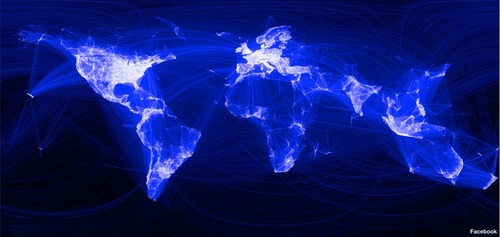
Facebook intern Paul Butler has created a detailed map of the world by mapping connections between people using the social network living in different cities.
The disconnected portions of the this map tell us as much about the world we live in as the highly illuminated ones. Might this be a version of the “Black Marble” image that would reasonate more with today’s teenagers? For the methods behind the creation of this map as well as a high resolution version of the map, see this post.
Tags: social media, map, visualization, cartography.
See on www.bbc.co.uk