Search

GEOGRAPHY EDUCATION

Supporting geography educators everywhere with current digital resources.

Category

Uncategorized

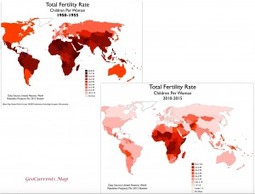
Total Fertility Rates, 1950 and 2015

It is quite significant that extremely high fertility figures are now mostly confined to tropical Africa, with only a few exceptions (such as Afghanistan and East Timor).

Source: www.geocurrents.info

In the decades after 1950, less developed countries were characterized as having very high fertility rates and that was (by and large) an accurate statement.  While the highest birth rates are still in less developed economies, it is important to note that the subjective scale is changing; while over 8 was once uncommonly high, now over 5 is as comparably uncommon a fertility rate as 8 used to be.  This still signals global population growth, but the idea that the ‘less developed world’ hasn’t adopted birth control or other measures to slow population growth is outdated.   


Tag: declining populationspopulation, demographics, unit 2 population.

If The World Were 100 People

If the population of the world was only 100 people, what would society look like? How many people would have shelter? Clean water? Education?

Source: www.youtube.com

Reminicent of the picture book, “If the World were a Village” by David Smith, this video attempts to make large statistics more meaningful to to a broader audience. The concept is simple, but the impact is profound.


Tagsstatisticsdevelopment, perspective.

Doreen Massey on Space

In honor of the late Doreen Massey, an eminent geographer who died Friday at age 72, we repost her Social Science Bites podcast, which has long been one of our most popular. In this interview, Massey asked us to rethink our assumptions about space — and explained why.

Source: www.socialsciencespace.com

If you’ve wanted to see how an academic geographer approaches space, politics, and power, this podcast is a good entry point.  It is also a nice intellectual tribute to a giant social theorist who contribute greatly within the discipline and beyond.


Tagsspace, spatial, political, governance, culturecultural norms, perspective.

Your Backyard is Bigger Than What You Can See

“Geography is linked to the environment,” says Connie Wyatt Anderson, of Canadian Geographic Education. “In the Lake Winnipeg watershed, what you throw into the Bow River in Calgary eventually ends up in Hudson Bay.”

Source: www.ijc.org

More than anything I love the idea of using watersheds to connect students to their location environment and to think about places that are beyond the backyard, but are connected to them.  If they see themselves as more intimately connected to these places, it can only increase their spatial awareness, geo-literacy and hopefully their commitment to protect their expanded backyard.   This is an effective way to help students ‘jump scale’ in a way that will still keep things relevant to their lives. 


Questions to Ponder: What watershed do you live in?  Where does your drinking water come from?  When you flush the toilet, where does it go? How are places in your watershed linked?  


TagsCanada, environment, resources, water, environment depend, spatial, scale

Soda Pop Stop

John Nese is the proprietor of Galcos Soda Pop Stop in LA. His father ran it as a grocery store, and when the time came for John to take charge, he decided to convert it into the ultimate soda-lovers destination. About 500 pops line the shelves, sourced lovingly by John from around the world. John has made it his mission to keep small soda-makers afloat and help them find their consumers. Galcos also acts as a distributor for restaurants and bars along the West Coast, spreading the gospel of soda made with cane sugar (no high-fructose corn syrup if John can avoid it).

Source: www.youtube.com

Hearing this man talk about his business is a pure delight; even if you are not a soda afficionado, his passion will win you over (and yes I call it soda, not pop or coke).  What I find so striking is how few businesses like his exist in a way that modern consumers know about it–he is the underground indie band of soda vendors.  He has found a niche by zigging when economies of scale demand that everyone else zag.  


Questions to Ponder: If a store like this was close to you, would you shop there?  How come?  Why are there so few stores with this type of business model? 


Tags: industry, economic, scale.

These Charts Show How Globalization Has Gone Digital

“Yes, globalization. For many people, that word conjures up, at best, images of container ships moving manufactured goods from far-flung factories. At worst, it harkens back to acrid debates about trade deficits, currency wars and jobs moving to China. In fact, since the Great Recession of 2008, the global flow of goods and services has flattened, and cross-border capital flows have declined sharply. But globalization overall isn’t on the wane. Like so much in our world today, it has reinvented itself by going digital.”


Tags: technology, globalization, diffusion, industry, economic.

Source: www.huffingtonpost.com

What Computer Games Taught Me About Urban Planning

“By enticing thousands and thousands of people to plan commercial, industrial, and residential districts for their virtual towns, the creators of SimCity have probably done more than anyone in the history of the world to introduce basic principles of zoning to the public.  Even though it’s just a computer game, Cities: Skylines has a lot to teach us about the unstated premises of our urban-planning conversations, and demonstrates how those premises profoundly shape what our cities can look like. When we assume the necessity of a given way of regulating cities, assume away the messiness of people and their relationships, assume away politics, and ignore major costs, we miss an awful lot of what urban-planning debates should be.”

Tags: urban, transportation, planning.

Source: www.theatlantic.com

xkcd: United States Map

Source: www.xkcd.com

The U.S. Is Pumping All This Oil, So Where Are The Benefits?

America has joined Saudi Arabia and Russia as one of the world’s leading oil producers. Forecasters predicted this would usher in a golden age. It hasn’t worked out that way.


Tags: environment, resources, economic.

Source: www.npr.org

Blog at WordPress.com.

Up ↑