Search

GEOGRAPHY EDUCATION

Supporting geography educators everywhere with current digital resources.

Geopolitics and the New World Order

Geography increasingly fuels endless chaos and old-school conflicts in the 21st Century.

Seth Dixon‘s insight:

I know that many academic geographers weren’t pleased with the environmental determinism in Robert Kaplan’s book The Revenge of Geography and the attention that in received in mainstream media outlets like the New York Times (mainly for it’s reduction of geography to physical geography and it’s acceptance of maps as pure truth).   In this article in TIME by Robert Kaplan, he highlights how geographic context is vital to understanding global politics…that is something we all can agree on even if we don’t like the particulars of his analysis. 

See on time.com
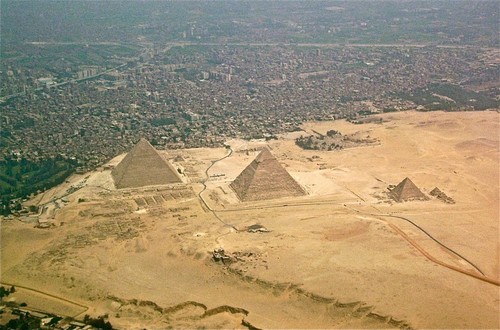
Seeing Landmarks From Far Away Might Shatter Your Perception Of Them

Wow. I guess it’s true when they say not everything is as it appears…

Seth Dixon‘s insight:

A new perspective can change our perception of reality, as demonstrated by this delightful photo gallery. 

See on distractify.com

Geo-Educator Community

“Join Us at http://Geo-Education.org“

The Geo-Educator Community will bring together educators and thought-leaders from different disciplines, age groups, and educational settings, who share a commitment to preparing young people to be successful and responsible citizens of an interconnected world.
If you are passionate about helping your students understand our interconnected world, then you are a geo-educator. National Geographic is currently working alongside other geo-educators to create the Geo-Educator Community.

Join the conversation online: The Geo-Educator Community currently lives on Edmodo. Edmodo is a free and secure educator website which hosts over 28 million teachers and students worldwide.

See on www.youtube.com

Trans-Dniester pleads to join Russia

Pro-Russian politicians and activists in Moldova’s breakaway Trans-Dniester region have asked the Russian parliament to draft a law that would allow their territory to join Russia.

Seth Dixon‘s insight:

Transnistria (or the Trans-Dniester region) is one of my favorite examples to use in the classroom when discussing territories that function as a state, but is not internationally recognized.  After the fall of the Soviet Union, ethnic Russians in the former Soviet Republic of Moldova, wanted to remain politically tied to Russia rather than part of an independent Moldova.  Now that Crimea (also an area with many ethnic Russians that were politically separated from Russia after the collapse of the Soviet Union) appears to be reuniting with Russia, many in Transnistria are hopeful that this could be a political opportunity for them to likewise rejoin with Russia.  The Crimean situation has upset the status quo in the region.       

Tags: political, sovereignty, territoriality, states, unit 4 political.

See on www.bbc.com

T-Mobile’s tech chief: I want to decimate Verizon’s map ad campaign

In an interview with CNET, T-Mobile’s Neville Ray talks about the carrier’s plan to fill out its coverage and why it’s picking a fight with Verizon. Read this article by Roger Cheng on CNET News.

Seth Dixon‘s insight:

Maps are not innocent reflections of the truth; and if you do think that they are read some JB Harley.  Maps can be used to cleverly conceal the truth or to accentuate a particular perspective. 

See on news.cnet.com

Equality of Opportunity

“Is America the “Land of Opportunity”? In two recent studies, we find that: (1) Upward income mobility varies substantially within the U.S. [summary][paper] Areas with greater mobility tend to have five characteristics: less segregation, less income inequality, better schools, greater social capital, and more stable families. (2) Contrary to popular perception, economic mobility has not changed significantly over time; however, it is consistently lower in the U.S. than in most developed countries [summary][paper]. “

See on www.equality-of-opportunity.org

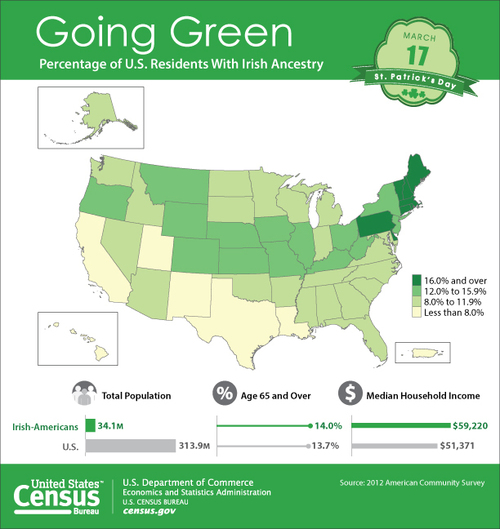
Facts for Features: Irish-American Heritage Month (March) and St. Patrick’s Day

“Originally a religious holiday to honor St. Patrick, who introduced Christianity to Ireland in the fifth century, St. Patrick’s Day has evolved into a celebration for all things Irish. The world’s first St. Patrick’s Day parade occurred on March 17, 1762, in New York City, featuring Irish soldiers serving in the English military. This parade became an annual event, with President Truman attending in 1948. Congress proclaimed March as Irish-American Heritage Month in 1995, and the President issues a proclamation commemorating the occasion each year.”

See on www.census.gov

Go West, Young People! And East!

Every college in America should make it a requirement to study abroad. Why study Spanish in a classroom in Indiana when you could learn it in Bolivia?

Seth Dixon‘s insight:

This NY Times article by Nicholas Kristof highlights of the several reasons why I’m a proponent of study abroad programs as a way to help students to globalize their educational experiences.  At Rhode Island College I’m proud to work on the Shinn Study Abroad Committee  which is dedicated to giving more students the opportunities to make the world their campus. 

See on www.nytimes.com

Exit polls show Crimea votes for secession

Russian media says exit polls show 93 percent of voters elected to join Russia, in a move the West deems illegal.

See on www.aljazeera.com

Blog at WordPress.com.

Up ↑