Search

GEOGRAPHY EDUCATION

Supporting geography educators everywhere with current digital resources.

At Seattle Mariners games, grasshoppers are a favorite snack

“Chapulines [grasshoppers] have become a snack favorite among baseball fans in Seattle. Follow their path from Oaxaca, Mexico, to Safeco Field. To many, the insect might be a novelty – a quirky highlight for an Instagram story from a day at the ballpark. To those in Mexico consuming them for centuries, they are a building block of nutrition.”

Source: www.espn.com

Eating insects is incredibly nutritious; raising them is cost effective and environmentally sustainable. And yet, the cultural taboos against entomophagy in the West are barriers to the cultural diffusion of the practice.  At some baseball games and high-end restaurants, grasshoppers are sold as a novelty item.  What I especially enjoy about this ESPN article is that it covers the cultural production of the chapulines in Mexico and follows the story to the consumption of the grasshoppers in the United States.  


Tags: sport, popular culturediffusion, culturecultural norms, foodMexico, economic, agriculture.

2018 APHG Reading Professional Development

"This has been my first year as Chief Reader of the AP Human Geography reading and it is amazing to watch all the moving parts come together.  It couldn’t happen without such dedicated, professional, and passionate geography educators all working together.  I was delighted to have Dr. Marie Price, President of the American Geographical Society, be our professional development night speaker and she was outstanding.  Her talk, MIGRATION AS A CROSSCUTTING THEME IN HUMAN GEOGRAPHY,  proved that her geographic expertise is only matched by her teaching prowess; the audience was riveted (PDF of slides here)."

Source: geographyeducation.org

NIGHT OF THE ROUND TABLES: Thursday evening, June 7th we had our annual “Night of the Round Tables” event. This event was designed to create a place to share new ideas, pick up lesson plans, discover new resources, and develop strategies for teaching geography. Presenters had 15 minutes to present. Here you can find the digital copies of the presentations given. 

Tags: APHG, teacher training, geography education.

Why does the misperception that slavery only happened in the southern United States exist?

//cdn.embedly.com/widgets/media.html?src=https%3A%2F%2Fplayer.vimeo.com%2Fvideo%2F217064279&dntp=1&wmode=opaque&src_secure=1&url=https%3A%2F%2Fvimeo.com%2F217064279&image=https%3A%2F%2Fi.vimeocdn.com%2Fvideo%2F636139782_1280.jpg&key=25394e42b38f11e0ae3f4040d3dc5c07&type=text%2Fhtml&schema=vimeo

“Christy Clark-Pujara research focuses on the experiences of black people in British and French North America in the seventeenth, eighteenth and early nineteenth centuries. She examines how the business of slavery—the buying and selling of people, food, and goods—shaped the experience of slavery, the process of emancipation, and the realities of black freedom in Rhode Island from the colonial period through the American Civil War.”

Source: vimeo.com

This is one of the many videos produced by the Choices Program about slavery in the New England (especially Rhode Island).  Featured in the videos is Dr. Christy Clark-Pujara, who wrote “Dark Work: The Business of Slavery in Rhode Island.”  There is a reason to what we learn in history, and there are also reasons to the histories that are rarely told.  More than any other of the original thirteen colonies and states along the Eastern Seaboard, Rhode Island plied the triangle trade transporting more slaves to the Americas than all the other states combined.


Some Rhode Island slavery facts:

  • In 1776, Rhode Island had the largest proportion of slave population of any of the New England colonies.
  • During the antebellum period Rhode Islanders were the leading producers of “negro cloth,” a coarse wool-cotton material made especially for enslaved blacks in the American South.
  • More than 60 percent of all the slave ships that left North America left from Rhode Island.


Tags: raceRhode Island, slavery, labor, economic, historical.

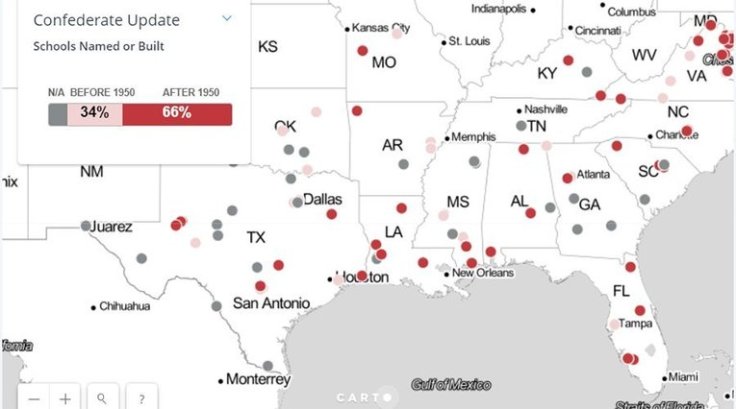
Map: Where Are Confederate-Named Schools?

Most schools with names tied to the Confederacy are in the South, were built or named after 1950, and have a student body that is majority non-white.

Source: www.edweek.org

The maps (and the charts) created from this national database is quite revealing.  At least 36 ‘Confederate-themed’ schools have changed their names since 2015 and I suspect that number will continue to grow in the coming years.    


Tags: race, racism, landscape, historicalthe South.

Five ways China’s past has shaped its present

“The country is perhaps more aware of its own history than any other major society on earth. That remembering is certainly partial – events like Mao’s Cultural Revolution are still very difficult to discuss within China itself. But it is striking how many echoes of the past can be found in its present.”

Source: www.bbc.com

This is a very interesting article…one can make too much of a country’s history as a casual factors, and yet make too little of historical patterns at your own peril.  “To understand China’s approach today to trade, foreign policy or censorship, consider its history.”  This article considers a few of  China’s current policies that may seem peculiar today but that make much more sense with a longer and deeper history.  Some of the topics considered include:

  • trade
  • trouble with neighbors
  • Information flow
  • Religious freedoms
  • Technology


Tags: China, East Asia, historical.

The World’s Most Economically Powerful Cities

“The newest ranking of the world’s most economically powerful cities put together by Martin Prosperity Institute (MPI) research team finds New York to be the clear winner [over London]. Our Global City Economic Power Index  is based on five core metrics: Overall Economic Clout, Financial Power, Global Competitiveness,

Equity and Quality of Life.” 

Source: www.citylab.com

100 years ago, the biggest trends in urbanization showed that the biggest cities in the world were also the most economically powerful cities in the world in core areas.  In the last 50 years, the most obvious change has been the remarkable growth in of the world’s largest cities in the developing world.   

Questions to Ponder: Why has there been such spectacular growth of megacities, especially in the developing world?  How is this map ranking global cities different from a list of the world’s largest cities?  What regional patterns do exist in the 25 most economically powerful cities in the world?  What are the implications of these patterns?    


Tags: urban, megacities, regions.

Too Many Men

“Nothing like this has happened in human history. A combination of cultural preferences, government decree and modern medical technology in the world’s two largest countries has created a gender imbalance on a continental scale. Men outnumber women by 70 million in China and India.”

Source: www.washingtonpost.com

There are far-reaching consequences to the gender imbalances in India and China.  The fantastically rich article covers four major impacts: 

Village life and mental health. Among men, loneliness and depression are widespread. Villages are emptying out. Men are learning to cook and perform other chores long relegated to women.

Housing prices and savings rates. Bachelors are furiously building houses in China to attract wives, and prices are soaring. But otherwise they are not spending, and that in turn fuels China’s huge trade surplus. In India, there is the opposite effect: Because brides are scarce, families are under less pressure to save for expensive dowries. 

Human trafficking. Trafficking of brides is on the rise. Foreign women are being recruited and lured to China, effectively creating similar imbalances in China’s neighbors.

Public safety. With the increase in men has come a surge in sexual crime in India and concerns about a rise in other crimes in both countries. Harassment of schoolgirls in India has in some towns sparked an effort to push back — but at a cost of restricting them to more protected lives.


Tags: gender, ChinaIndia, culture, population.

Nicaragua on the Brink, Once Again

Jon Lee Anderson on protests in Nicaragua over proposed social-security reforms that are threatening the stability of the government of President Daniel Ortega.

Source: www.newyorker.com

The status quo of the Nicaraguan political system threats to be completely upended and this article is a good primer for getting a handle on the situation. 


Tags: Nicaragua, political.

The Population Bomb Has Been Defused

Some of the most spectacularly wrong predictions in history have been made by those who claim that overpopulation is going to swamp the planet. Thomas Malthus, a British economist writing in the late 1700s, is the most famous of these. Extrapolating past trends into the future, he predicted that population growth would inevitably swamp available food resources, leading to mass starvation. That didn’t happen — we continued to develop new technologies that let us stay ahead of the reaper.


In 1968, Stanford biologist Paul Ehrlich wrote “The Population Bomb,” warning that unchecked population growth would lead to mass starvation in the 1970s. He was just as wrong as Malthus. Global population did surge, but food production managed to keep up.


So far, the prophets of overpopulation have been defeated by technology. But human ingenuity alone can never deliver a final victory in the battle to feed the world — eventually, population growth will overwhelm the Earth’s ability to provide calories. That’s why in order to put Malthus and Ehrlich finally to rest, a second component is needed — lower fertility rates. To save both the environment and themselves, humans must have fewer kids.


Fortunately, this is happening. During the lifetimes of Malthus and Ehrlich, humans still tended to have large families, with each woman bearing an average of five children over her lifetime. But shortly after Ehrlich’s book, that began to change.

Source: www.bloomberg.com

Mathusian ideas are incredibly controversial; there are articles that will proclaim that he was right and others that will point to how he got it all wrong.   The critics of Malthus see that Earth and humanity will survive as fertility rates fall almost everywhere but the Neo-Malthusians see that while fertility rates are dropping, the total population of the world continues to climb.  This article has many great fertility rate charts.  


Questions to Ponder: What did Malthus get right?  What did he get wrong? 


Tags: Malthus, op-ed, demographics, population, APHG, unit 2 population

Blog at WordPress.com.

Up ↑