Seth Dixon‘s insight:
We take for granted that a map is an accurate representation of the Earth, but we cannot forget that every map at a global scales has some distortions.
Tags: map projections.
We take for granted that a map is an accurate representation of the Earth, but we cannot forget that every map at a global scales has some distortions.
Tags: map projections.
This lesson plan from the Choices Program will:
See on www.choices.edu
” The Smithsonian Magazine recently dipped into David Rumsey‘s collection of over 150,000 maps to find some of the best representations of American cities over the past couple hundred years. With some simple programming, they were able to overlay images of vintage maps of some major cities onto satellite images from today. The results are fascinating.”
The ‘spyglass’ feature gives these gorgeous vintage maps a modern facelift. The cities that are in this set of interactive maps are:
Tags: cartography, mapping, visualization, urban, historical.
See on gizmodo.com

Where did your T-Shirt come from? Where did the food your parents bought at the grocery store come from? What’s the origin of the components in your cell phone? These questions all allude to what geographers call a commodity chain analysis. Analyzing where the consumer goods that we use every day came from can make global issues hit a little closer to home and reinforce concepts such as globalization. The website Follow the Things is a great resource for teaching students about commodity chains and mapping out your own personal geographies.
Tags: industry, economic, globalization, consumption.
How many of these 107 regional slang words do you use? This week on Mental Floss’ YouTube information session, author and vlogger John Green explains 107 slang words specific to certain regions.
See on now.msn.com
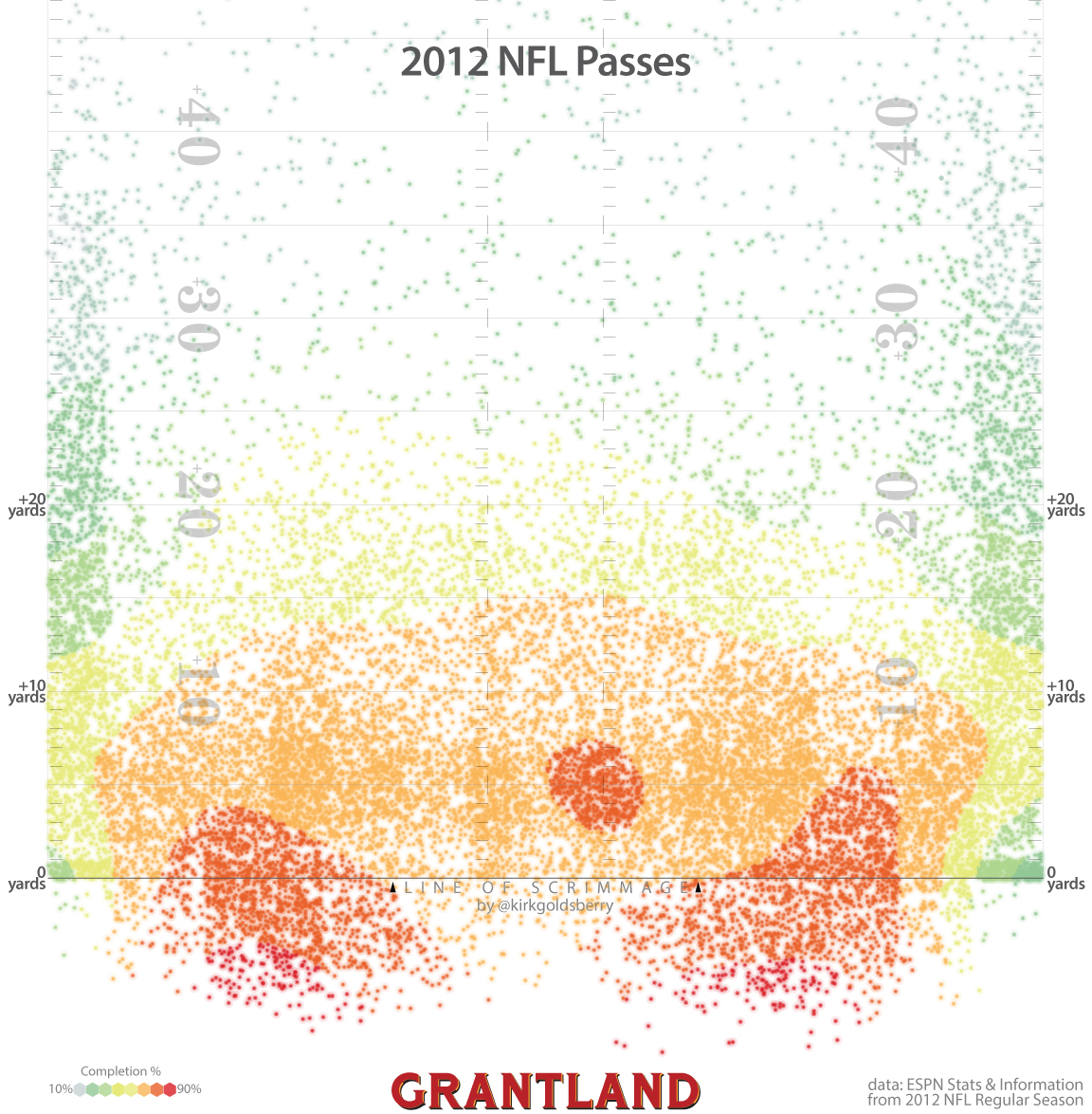
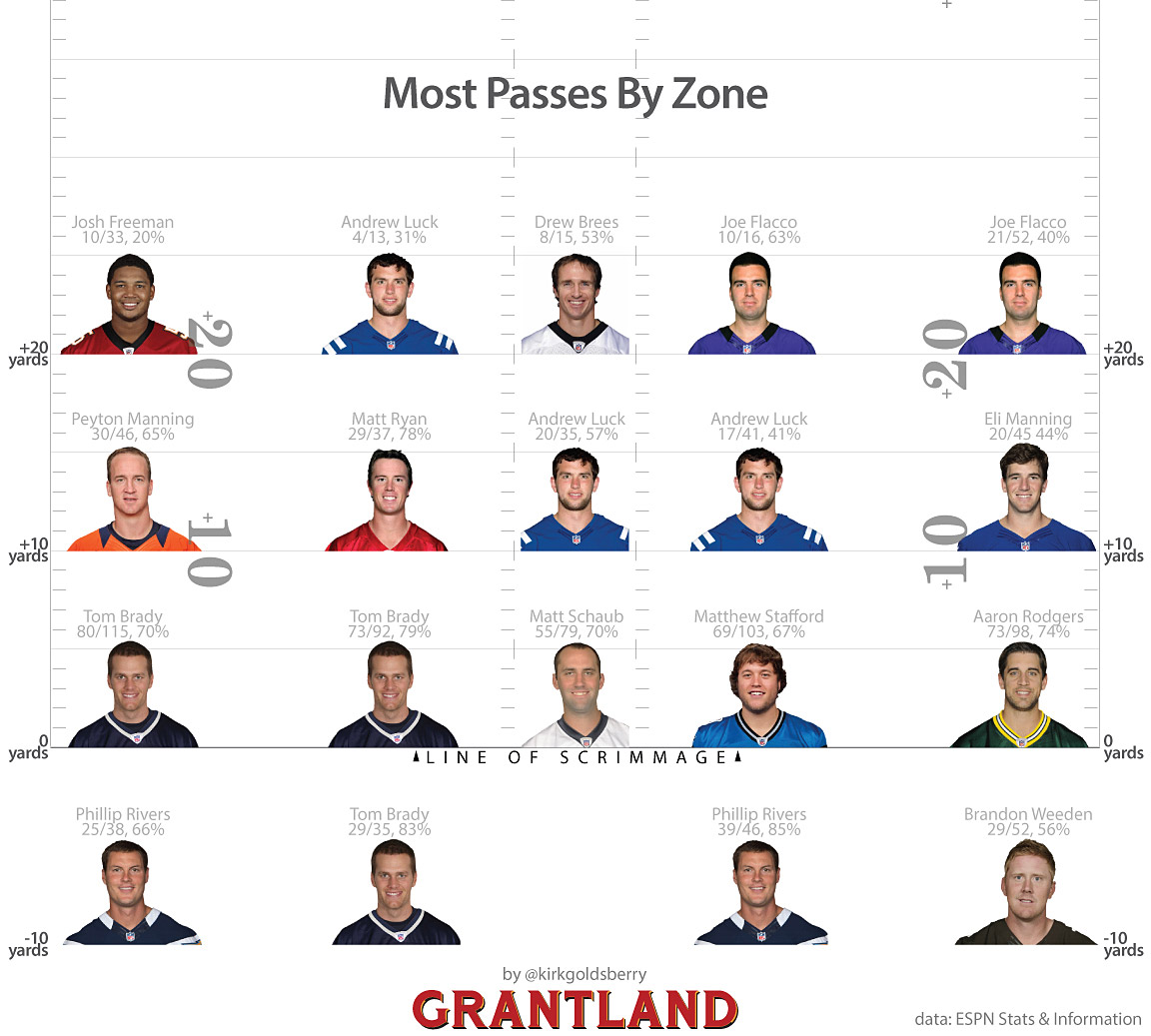
“Football’s analytics are evolving quickly. Thanks to new forms of data and emerging kinds of analyses, teams, media, and fans are gaining new insights into on-field performances.”
The more advanced metrics in sports are now spatial: analyzing where on the field a particular play is more likely to be successful. Conversely, scouting out opponents relies on detecting if a player has spatial tendencies on the court or field that might be exploited (for example, where is LeBron’s sweet spot on the court?). This ESPN article shows how different teams and quarterbacks use the field in their offense schemes. Increasingly, many professions are embracing the power of spatial data and spatial thinking.
See on www.grantland.com
“Whenever I am living abroad, people always say the same thing, insisting that I am très Américain. Sometimes it’s the words I use, or the way I talk. But back in America, a strange thing happens. People say I have a British accent; they insist I have a European quality.”
For those who have lived abroad, the sense of belonging to one place is elusive. This article is a great look at personal geographies and how individuals negotiate belonging to multiple communities. Increasingly, people live in many places throughout their lives; some cultures are intensely connected to particular places but some are highly mobile.
Questions to Ponder: What does it mean to belong in a place? What are some barriers to belonging? Are some places easier to belong to?
See on www.csmonitor.com
“Water is an essential theme in social studies, science, and geography. Whether teaching about natural or human systems, water is part of the story. This course, framed around California’s Education and the Environment Initiative (EEI), focuses on ocean and freshwater topics and strategies for teaching environmental topics in Grades 4-8. Resources and support are provided for how to use EEI to implement Common Core State Standards for English Language Arts and Literacy.”
This new MOOC on water resources in California is project supported by National Geographic Education and Annenberg Learner. This is a course is designed to span the disciplines and create an awareness in students about environmental issues that impact them.
Tags: consumption, California, water, environment, resources, environment depend.
See on www.youtube.com
“Introducing Geography News Network. Global culture, science, history and political stories have become a key component of Maps101 through weekly stories and associated lesson plans. This year sees the addition of 5 brand new authors bringing engaging stories from a range of perspectives.”
I am delighted to announce that I will be one of the new authors that will be writing for Maps 101’s newest educational platform: the Geography News Network. Many schools and districts across the country have subscriptions to this online service that provides thousands of supplemental materials and lesson plans for geography, earth science, history and social studies teachers. If your school district does not currently have a subscription, you can sign up for a free trial subscription.
See on www.maps.com