Search

GEOGRAPHY EDUCATION

Supporting geography educators everywhere with current digital resources.

St Patrick’s Day celebrated around the world – in pictures

From Moscow to New York via Vilnius and the pyramids of Egypt, St Patrick’s Day is celebrated with parades and a lot of green face paint

Seth Dixon, Ph.D.‘s insight:

Being in Chicago on Saint Patrick’s Day one year was the highlight of my trip.  Seeing the river green was truly an impressive sight and the pictures don’t quite do it justice. 

See on www.guardian.co.uk

After boom and bust, Sun Belt cities see glimmers again

WASHINGTON — With their economies and housing markets gaining strength, some of the nation’s biggest boom-to-bust cities in the Sun Belt are starting to become magnets again, attracting a growing number of people primarily from the northern part…

Seth Dixon, Ph.D.‘s insight:

See on www.latimes.com

APHUG Films Presents…

Promotional video for AP Human Geography enrollment

Seth Dixon, Ph.D.‘s insight:

This is video is a great tool to drum up interest in an AP Human Geography course produced by David Burton.  Similar videos and things designed to promote the discipline and it’s study can be found under the tag, “geo-inspiration.” 

Tags: APHG, geo-inspiration.

See on www.youtube.com

#deextinction

This video appeared on National Geographic’s Magazine’s Twitter feed. It said: : Can the American passenger pigeon be resurrected? See how it could be done: http://on.natgeo.com/15OUp1i 

De-extinction is a new term for to me but this week a TEDx conference hosted by National Geographic focused completely on this concept on the possibility of reviving formerly extinct species. Just because we think we can bring back a lost species, does that mean we should?  What would be the benefits?  Disadvantages? 

I’ve read enough about passenger pigeons to know that beyond overhunting, the species went extinct as large swaths of North American forests became fragmented and modified.  While we may be able to theoretically bring back a species, we cannot rewind the clock and bring all the essential ingredients to their former ecosystem that allowed them to thrive in the first place.  De-extinction would NOT be repairing the world so that it was as if the extinction never happened, since other species in the ecosystem have adapted to their absence. Given the length of their absence, could these be considered “invasive species?”     

Tags: biogeography, environment, National Geographic, environment modify, ecology, historical, TED.

See on twitter.com

Google Lit Trips


Seth Dixon, Ph.D.‘s insight:

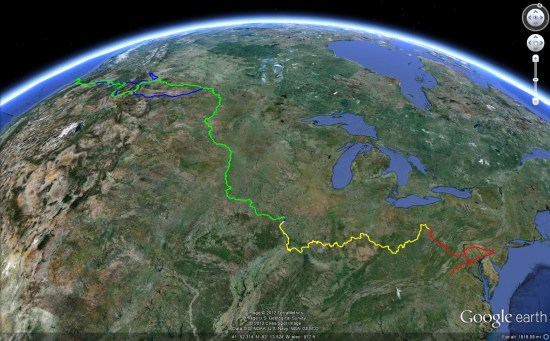
Google Earth is a great teaching tool for geographers, but it is also a way to bring geography and spatial thinking to other disciplines.  Google Lit Trips makes the journeys that take place in literature (both fiction and non-fiction) all the more real by mapping out the movements as a KML file that can be viewed in Google Earth.  By embedding pictures, websites, videos and text into the path, this becomes an incredibly interactive resource for teachers of all levels. 

Tags: google, virtual tours, English, edtech.

See on vimeo.com

State Shape Necklaces

So much of who we are stems from where we came from. Each southern state’s culture is proudly unique…just like its natives. These beautiful brass State Shape Necklaces are the perfect bold, yet subtle, way to wear your state pride.

Seth Dixon, Ph.D.‘s insight:

This doesn’t cover every state, and it may even offend some with how they’ve drawn the south.  Some southern states (in this northerner’s mind) are not included.  Which state would you add to the list?  Any you’d remove?

See on www.bourbonandboots.com

These apartments are so small they can only be photographed from the ceiling

Hong Kong is one of the most densely populated areas in the world. Seven million people living in 423 square miles (1,096 sq km).

Seth Dixon, Ph.D.‘s insight:

Massive urbanization with limited space means that real estate is at a premium and many laborers will not be able to afford large living spaces.  Hong Kong is an extreme example of this and it brings new meaning to the term “high-density housing.” 

Tagshousing, urban, planning, density, urbanism, unit 7 cities.

See on qz.com

Population 7 Billion

“Just 200 years ago, there were only 1 billion people on the planet, and over the next 150 years, that number grew to 3 billion. But in the past 50 years, the global population has more than doubled, and the UN projects that it could possibly grow to 15 billion by the year 2100. As the international organization points out, this increasing rate of change brings with it enormous challenges.”

Seth Dixon, Ph.D.‘s insight:

This is a compilation of 42 photos that highlight ideas of  population growth, urbanization and sustainability.  Pictured above is the favela Joaquim de Queiros, a hillside neighborhood of Rio de Janeiro. 


Tags: population, images, unit 2 population.

See on www.theatlantic.com

Ten Years After the Invasion of Iraq: The Human Cost

Seth Dixon, Ph.D.‘s insight:

The effects of war can be staggering and far-reaching.  Often the costs are much higher than anticipated at the beginning.  Read this press release for more details on the recent findings regarding the actual costs of the Iraq War, which are estimated to have cost over 190,000 lives and $2.2 trillion. 

Tags: Iraq, conflict, K12, political, MiddleEast, war.

See on vimeo.com

Iraq

Blog at WordPress.com.

Up ↑