Search

GEOGRAPHY EDUCATION

Supporting geography educators everywhere with current digital resources.

Interactive Earth at Night

Seth Dixon, Ph.D.‘s insight:

You’ve seen the this image as a static map, as a video and as an adjusted cartogram here before.  This link is especially intriguing because this same data has been added to Google Maps so a user can interactively explore this layer and compare it to daytime satellite imagery or a standard map (it can also be seen on an interactive globe on http://www.geteach.com/). 

The first impulse of most students is to note when analyzing this image is to note that the map will show us where people live, where the cities are or some other comment that speaks to the magnitude of the population in the white areas.  Let them analyze this for more time, and they’ll notice that population isn’t the whole story of this image.  A place like India shines, but less brightly than the eastern part of the United States.  I like to point out that South Korea appears to be an island (because North Korea is literally blacked out).  Politics, development, affluence and population information are all embedded in this image.  As with all maps, the more information you have about the place in question (in this case, Earth), the more meaningful information you can extract out of the map.

Tags: remote sensing, images, mapping, cartography, geospatial, edtech, geography education, unit 1 GeoPrinciples.

See on earthbuilder.google.com

EarthLights

How The States Got Their Shapes

Amazon.com: How The States Got Their Shapes: Season 1, Episode 10 “Mouthing Off”: Amazon Instant Video

Seth Dixon, Ph.D.‘s insight:

Many have raved about the TV show airing on the History Channel “How the States got their Shapes.”  For Amazon Prime users, season 1 is free to stream. 

See on www.amazon.com

Impacts of the Demographic Transition

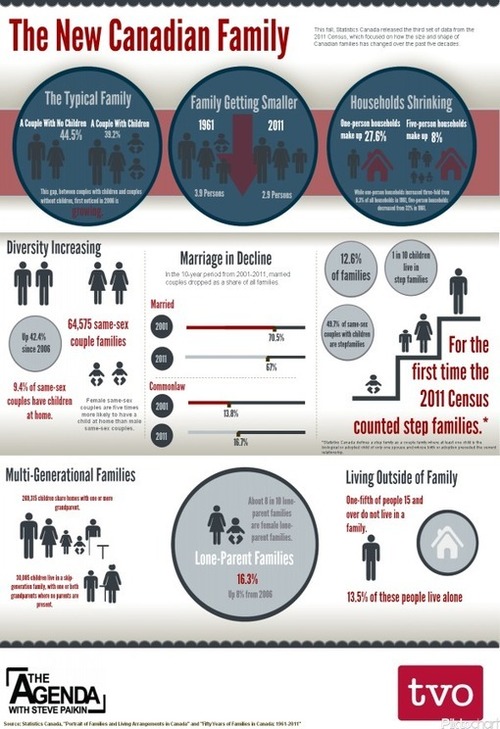
A look at how the notion of family is evolving in this country.

Seth Dixon, Ph.D.‘s insight:

The traditional family is declining in social prominence in many developed societies (this is hardly a phenomenon unique to Canada) as fewer young people are choosing to marry and have children.  How does this impact individuals, families, communities and countries?

Tags: Canadadeclining population, population, demographics, unit 2 population.

See on theagenda.tvo.org

Pop culture in the Arab world

TED Talks At TEDGlobal University, Shereen El Feki shows how some Arab cultures are borrowing trademarks of Western pop culture — music videos, comics, even Barbie — and adding a culturally appropriate twist.

Seth Dixon, Ph.D.‘s insight:

This TED talk cleverly discusses the cultural processes of globalization by examining two examples from the Islamic world.  In the examples of the TV station 4Shbab and the comic book series The 99 show that all global cultural interactions don’t have to result in a homogenous “melting pot.”  Local cultural forces can tap into the powers of globalized culture that can create dynamic local cultures that are both intensely local and global. 

Questions to Ponder: What does the speaker mean when she by refers to cultural interactions as a mesh (as a opposed to a clash or mash) of civilizations?  What other examples of cultural meshes can you see that show these processes? 

Tags: religion, culture, Islam, globalization, popular culture, unit 3 culture.

See on www.ted.com

Barbie

Somalia: A failed state is back from the dead

Eighteen months ago, central Mogadishu was like an African Stalingrad.

Seth Dixon, Ph.D.‘s insight:

Somalia’s political troubles are not over, but it is no longer the drought-ridden country overrun by Islamist extremist that it was two years ago.  For years it held the dubious title of “the world’s most failed state.”  Al Shabbab, the militant group linked to Al Qaeda, left the capital of Mogadishu in 2011 and in 2012 lost their last stronghold.  Piracy still exists off the Somali coast, but it has lessened as a semblance of political order is being restored to the Horn of Africa.


Tags: Somalia, Africa, political, conflict, war.

See on www.independent.co.uk

Hope during Economic Crisis

Flashmob en Madrid (España) organizado por el programa de radio CARNE CRUDA 2.0 Martes y jueves, 16:00, http://www.carnecruda20.es Lunes, miércoles y viernes…

Seth Dixon, Ph.D.‘s insight:

I have previously posted on how successful flashmobs use public places in a way that symbolically merges the meaning of that space with the message of the that place.  This is a fabulous example of that, especially given the economic woes of southern Europe.

As Jordan Weismmann said about this flashmob in the Atlantic, “I’m not sure if this video is more heartbreaking or heartwarming, but it pretty well captures what’s going on in Europe’s economy right now. While the day-to-day drama of the continent’s debt crisis has subsided, painful austerity measures have helped leave huge swaths of the population jobless. In Spain, unemployment is at 25 percent.”

See on www.youtube.com

Migration and Geography

National Geographic posed one simple question on Twitter, with a link to the resources to answer it: Why should we learn about human migration? ow.ly/gCai8

See on twitter.com

Boontling: A Lost American Language

Watch the video Boontling: A Lost American Language on Yahoo! Screen

Seth Dixon, Ph.D.‘s insight:

In Booneville, CA, local residents literally created their own language over 150 years ago and had it was locally accepted enough to be taught within the school district.  This language of Boontling (Boont Lingo) but one that the younger generation has not fully adopted, but is still spoken by the older residents. 

Tags: folk culture, language, culture, rural, unit 3 culture.

See on screen.yahoo.com

Laos May Bear Cost of Planned Chinese Railroad

China wants a railroad linking it to Thailand and on to the Bay of Bengal in Myanmar, but some international groups warn that it may put a big burden on Laos.


Seth Dixon, Ph.D.‘s insight:

Economic analyst noted in this article, “Southeast Asia is geostrategically and economically important to China, an increasingly important partner from both the trade and investment perspectives.”  As China expands its influence, the benefits will probably be one-sided for rural, less developed neighbors such as Laos.

See on www.nytimes.com

Blog at WordPress.com.

Up ↑