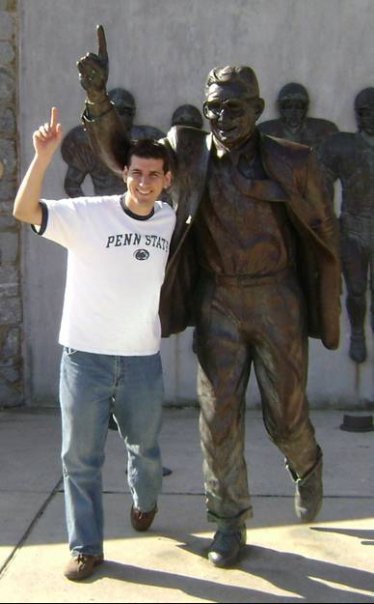
I never imagined that this picture would be awkward or evoke such ambivalent feelings within me. This picture was taken while I was working on my Ph.D. in geography at the Pennsylvania State University. Ironically enough, my dissertation focused on statues, their impact on the cultural landscape and how they are used to shape or contest historical narratives about communal identity. I feel intellectually and emotionally compelled to publicly voice my opinion in the aftermath of the Freeh report being published. I’m still digesting the report but having listened to the full press conference, I understand the implications of the evidence against many key authorities that were on the Penn State campus while I was a graduate student.
I’m writing this on the assumption that the Freeh Report is completely accurate, which I understand that many within the Penn State community are disputing. I dearly wish that these were not facts. When the charges against Sandusky were filed, I wanted to believe that he was one horrible individual who could not tarnish the Penn State reputation. Now I’m forced to admit that many high-ranking PSU officials knew about Sandusky and did nothing. Even worse than doing nothing, they actively sought to conceal information in hopes of avoiding bad publicity. Their collective lack of integrity has created the worst public relations nightmare that the school could have ever imagined. I do not wish to go over the legalities, evidence, accusations and reports at this time—you can read for yourself since it is all publicly accessible. I want to focus on my specialty and what I am qualified to talk about: monuments and their meaning in highly visible places. The iconography of symbolic landscapes is not just a passive reflection of cultural values, nor is it simply a controlled message for authority figures to manipulate that the community will blindly accept. These are sites where cultural messages and historical narratives are both created and contested. It is in this interplay between the molders of the landscape and those that use these public places that intrigues me.
This all brings me to the statue of Joseph Vincent Paterno on the Penn State Campus outside of Beaver Stadium. This was once a revered statue that embodied the values, aspirations and identity of Penn State football, but also the institution as a whole. JoePa, leading his team to victory; all eyes looking to his leadership and moral authority, the campus galvanized under one banner, so to speak. I loved my 4 years at Penn State; I was a season ticket holder and enjoyed going to Beaver Stadium tailgates, white-outs and feeling like I was a part of the larger community. I don’t want to forget those times. All of that was WHY I took a picture next to the statue—to feel a part of the cultural ethos that embodied Penn State; academic excellence, integrity and hard work.
I still believe in those values and I still believe that Penn Staters aspire to those values; but how we symbolically demonstrate our commitment to these values in our memorials becomes a critical issue moving forward. Monuments are not meant to perfectly reflect the human body, but are designed to embody ideals, values and beliefs. Monuments, when they move from one location to another, are indicative of shifting cultural values, ideas and identities. If an institution ever needed to show that they are changing the institutional culture that literally made a man larger than life and deified him to the extent that he became as powerful as he was, it’s Penn State. I’ll admit, when I was at football games, I’d chant with the crowd “Joe Paterno!” Clap, Clap, Clap, Clap, Clap. “Joe Paterno!” In some small way, I was a part of the “football IS our school identity” that empowered Paterno to disregard the law and human decency to protect the program’s image. And aren’t statues really all about image? What image is the University community trying to project into the future? How do current students feel about the past? How do we reconcile horrific parts of our history?
Karen Till is a geographer who has written extensively on the geography of memory specifically within the German context. I applaud the German people for erecting monuments that tell a painful story to remember that it wasn’t just one evil man responsible for World War II; it was also a people that enabled him and kept quiet when they saw atrocities being committed. These memorials act not to dredge up bad memories about a generation that has passed on, but to put into perspective the nationalistic fervor that unwittingly empowered evil to persist. The magnitude of the Sandusky trial does not compare to the Holocaust, but for the dozens (if we know of approximately 10 victims, that’s likely just the tip of the iceberg) of abuse victims it is a personal tragedy that I can’t fathom.
I wish it were the crimes of one villain acting alone—that is a neat and simple historical narrative. But the world isn’t divided into good guys and bad guys, despite what the monumental landscape would have us believe. My dissertation on monuments sits in the Pattee-Paterno Library—and I personally hope that name stays. He built that library, something that is unheard of for a football coach, and his mark on the campus was palpable. He should not be completely erased from campus as though he did not exist—but I think it is far past time to stop the full deification of the man. Penn State culture has been ruled by the cult of JoePa, and the new evidence shows that we were wrong to make one man a symbol of all that was good. There is not a statue for Graham Spanier or Tim Curley, but if there were I’d call for their removal. If the Paterno family wants to remember him in the light that the statue casts Joe in, I understand that; I still am greatly impressed by the vast majority of his life. But as long as Penn State has that statue on campus they have not acknowledged the depth of the institutionalized cover-up on child rape that they allowed to continue and turned a blind eye on. The cover-up happened BECAUSE Joe Paterno was made larger than life and was cast in bronze as our infallible, dauntless leader.
The importance of that image, and the image of Penn State to senior officials was more important than living up to that image. That’s why I think the embodiment of that mindset, the Joe Paterno statue, should be removed from the University Park campus. That may not be a popular opinion, but symbols matter and neglecting to change this particular symbol would indicate that not much has really changed, showing a “we wouldn’t want to upset the boosters or former players” attitude. True leadership does not mean taking a popularity poll on every issue but taking hard stands on critical issues that might be unpopular. I would encourage Penn State to step forward and make the hard choice…something that the (now deposed) Penn State leadership has failed to do. It won’t undo the damage, but it’s a symbolic fresh start.
Ironically, I would take no joy in seeing the statue come down. In fact, when I look at that 2009 picture of myself it gives a complex mix of emotions. That picture reminds me of some great times that I had at Penn State and being a part of campus life. I remember friends, fellow grad students, and part of me still cherishes that photo…it represents a time of innocence when the moral virtue of being a Nittany Lion was uncompromised and uncomplicated. I love that photo because it represents all that I wish were still true.
When statues move, it’s because culture and identity have shifted, but it’s also an indicator that how people view ‘the truth.’ The historical narrative of moral virtue of the Penn State football program under Joe Paterno has changed and will never be the same. The PSU campus’ symbolic landscape should reflect a new narrative, one that looks at the facts and doesn’t try to make excuses.
UPDATE: As the statue has since been moved, here is a gallery of images from the Centre Daily Times.








 GEOGRAPHY EDUCATION