Search

GEOGRAPHY EDUCATION

Supporting geography educators everywhere with current digital resources.

Twitter for [Geography] Teachers: Intro & Signing Up

See on Scoop.it – Geography Education

“I just returned a few days ago from a great week in Cincinnati, reading AP Human Geography exams with 400 colleagues from all over the country. In our conversations during the reading, I’ve come across a number of these folks, many of them high school teachers, who are interested in using Twitter but have no idea where to start.


What I’m hoping to do in the next few entries is give a beginner’s guide to using Twitter, specifically geared toward folk who are completely lost at how to begin. I’ll also be working toward some ‘best practices’ once the basics are out of the way.” 


If you are unconvinced that you should get on twitter (#aphg), see: http://www.creativeeducation.co.uk/blog/index.php/2011/09/10-reasons-to-tweet/

See on andrewshears.com
Urban issues: Transportation and Density

See on Scoop.it – Geography Education

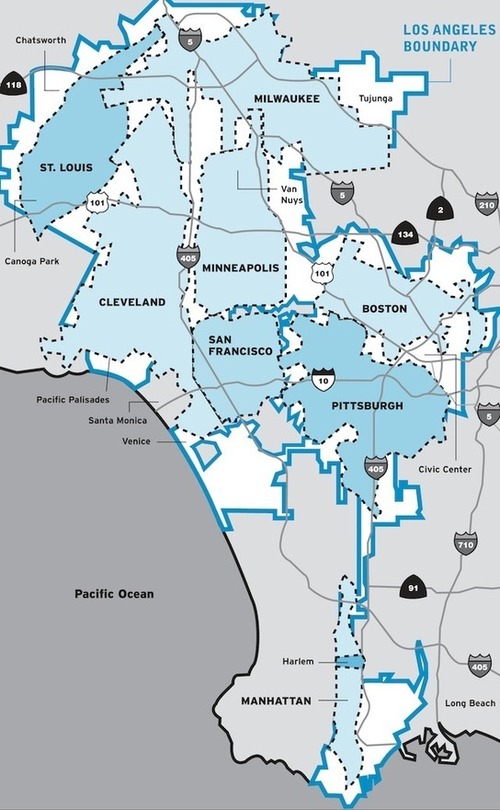
A map that has been making the rounds on the internet demonstrates how you can fit 7 major U.S. cities plus New York’s most famous borough within Los Angeles city limits.


So Los Angeles is big, but, LA’s spatial extent is in part due to it’s history with transportation (ripped out the streetcars to let the automobile and freeway take over).  How do density and transportation affect cities? 

See on laist.com

Making Cities Sing

See on Scoop.it – Geography Education

In urban centers around the country, local governments are looking to attract emerging industries and the next generation of entrepreneurs.


This is a panel of urbanists who specialize in revitalizing cities and creating economically and culturally vibrant urban centers.  They focus not on public policy, but rather finding ways to implement the locally produced ideas of people from the neighborhood with an intimate knowledge of the community as well as a vested in strengthening the local networks.  They also highlight the arts, sense of place and the culture of a neighborhood as key components create attractive cities.


For another video from the Apsen Ideas Festival on urbanism (Megacities), see: http://www.aspenideas.org/session/advice-megacity   


See on www.aspenideas.org

Ten Ways Walmart Changed the World

See on Scoop.it – Geography Education

On July 2, 1962 — 50 years ago today — Sam Walton opened the very first Walmart store in Rogers, Arkansas.


The Walmart business model has profoundly reshaped the economic paradigm of retail these has 50 years.  Walmart is commonly cited as a business that exemplifies the processes of globalization.  How has Walmart reshaped aspects of society such as industrial production, environmental standards, labor, urban shopping locations, the outsourcing of manufacturing and consumption? 

See on business.time.com

Immigrants Working In America

See on Scoop.it – Geography Education

The U.S. is still a nation of immigrants: One in six U.S. workers was born somewhere else. Here’s where America’s immigrants come from, and what they do for work.


Of the American immigrant population, where were the workers born?  In what industries are they employed?   

See on www.npr.org

Self-dignified indeed

See on Scoop.it – Cultural Geography

THE picture of a young woman in a see-through dress was meant as a kindly entreaty. “Girls”, the accompanying text on Shanghai Metro’s microblog went, “please be self-dignified to avoid perverts”.


This issue in China raises the question, should the onus of preventing sexual harassment be placed on women?  The fact that The Shanghai Metro was insinuating that has angered some Chinese.  How do culture norms influence how we think about behavior in public?   

See on www.economist.com

Pena Nieto claims victory in Mexico election

See on Scoop.it – Geography Education

Presidential candidate says Mexicans have voted for change of direction after exit polls project win for his PRI party.


For the first time in 12 years, Mexico’s president will be from the PRI party (which dominated and led power from the 1920’s to 2000).  Enrique Peña Prieto won the election, in large part due to Mexico’s dissatisfacation with the PAN’s handling of the escalating drug violence.  A few decades back, the PRI kept the violence out of the streets with some tacit agreements with the drug cartels to stay within particular territories.

See on www.aljazeera.com

What is in a Name?

See on Scoop.it – Geography Education

Issues in Focus East Sea…


Does it matter if I call the sea to the east of the Korean Peninsula the “East Sea” and if you call the body of water the west of Japan the “Sea of Japan?”  Absolutely.  When dealing with matters of diplomacy, a name reflects how a country is viewed.  For many years the Sea of Japan has been the defacto name internationally and South Korean officials have lobbied (quite successfully) to bolster the legitimacy of the name within the media, publishers and cartographers.  What other places have multiple names?  What are the political overtones to the name distinctions?  To watch a 10 video on the history of the name, see: http://bit.ly/Lu5puJ  

See on www.mofat.go.kr

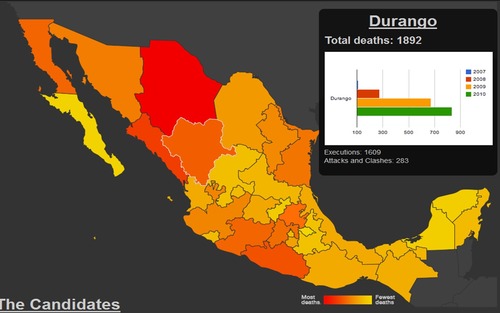
Mapping Mexico’s gang violence

See on Scoop.it – Geography Education

Voters are counting on the next president to find a solution to the country’s alarming rise in organised crime.


This interactive features shows temporal and spatial data on drug-related deaths in Mexico since 2007.  Also connected are profiles of the presidential candidates of the three major political parties (PRI, PAN and PRD) and with their platform on drugs and violence.  Mexico’s presidents can only hold office for one term, but it is a six-year term…2012 isn’t just about Obama and Romney. 

See on www.aljazeera.com

Blog at WordPress.com.

Up ↑