Search

GEOGRAPHY EDUCATION

Supporting geography educators everywhere with current digital resources.

Spoof Candidate, Jerry Mandering

“Ok…we’ll admit it. Jerry Mandering isn’t a real political candidate.  We created this video to highlight the absurdity of the process behind having elected officials draw their own lines to their advantage – a manipulative practice known as ‘gerrymandering.’ Public officials like Del. Jerry Mandering wish you wouldn’t worry about the fact that he can pick and choose his own voters, but you can let your legislators know that you support a non-partisan effort for fairer, more competitive elections.”

Source: www.youtube.com

This spoof video was highlighted in a Washington Post article, and most parodies, it wouldn’t be funny if there weren’t so much truth in it. 


Tags: political, gerrymandering, mapping, unit 4 political.
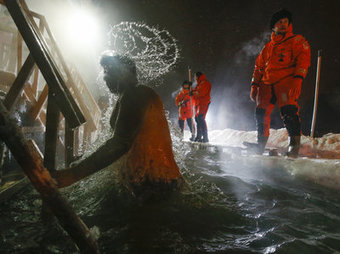
In Russia, Epiphany Comes With A Shockingly Cold Swim

“Thousands of members of the Russian Orthodox Church marked Epiphany in January with a dip in freezing waters blessed by a cleric. Epiphany is a celebration of the baptism of Jesus Christ and the revelation of God as a human being in his form. Much like a baptism, the icy plunge is considered a purifying act of faith.”

Source: www.npr.org

Some of the photography and photo galleries of this cultural event are breathtaking–literally for those taking the plunge.  Russians cut the ice in the shape of a cross and bath in water that is blessed and considered holy as explained in this NPR podcast.  This religious tradition is particularly well-suited to the environmental conditions of the religious adherents (since the extreme climate plays a critical role in the activity).  Part of the practice involves sacrifice; the colder the swim, the greater the manifestation of religious devotion.    


Tags: Russia, religionChristianity, culture

Language Reflects Culture

“Being a fluent speaker of English and Saulteaux, I have to say that I view the world in two different ways. I have two different attitudes and even two different personalities, depending on which language I use…English offers me one way to order information and cope with reality, one set of attitudes and behavioral styles, and Saulteaux offers me a different way. When I switch languages, I also move from one constellation of attitudes and thought patterns to another.”

Source: www.sicc.sk.ca

This passage was written by Margaret Cote, a  member of the Saulteaux people, who are part of the larger Ojibwa or Chippewa Native American tribe. 


Questions to Ponder: How does language shape cultural attitudes, traits, and customs? How does language shape a speakers world view and personality?  How does language influence how a speaker may feel about place?


TagsCanadalanguage, placeculture

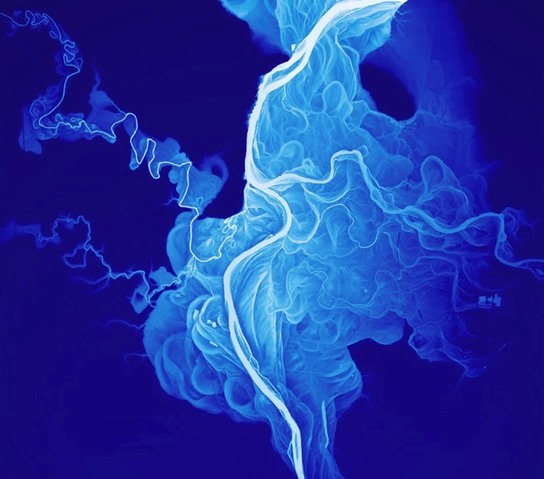
The memory of a river

“If you measure the contours of a river valley with Lidar (like radar with lasers), you get a beautiful map of all the historical river channels.”

Source: kottke.org

This particular image is fantastic for teaching about geomorphology and river systems.  Students can ‘see’ the historical layers of a meandering stream winding it’s way across the landscape.  Here’s a meandering stream image (Willamette River, Oregon) that shows the dynamism of fluvial processes quite nicely.


Tags physical, fluvial, geomorphology, erosion, landscape.

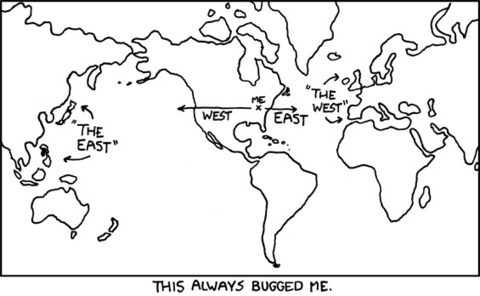
xkcd: Terminology

Source: xkcd.com

I use this classic xkcd image every semester that I teach world regional geography.  The explanation of this image is helpful if the students fail to understand the context or the point of this comic strip.  The very idea of ‘western’ and ‘eastern’ is very much an idea that comes from ‘the west’ (Greek and Roman civilizations anciently, and a broadly European more recently). The Euro-centric view of the world from a single ‘starting point’ is one reason some geographers don’t like the term ‘Middle East,’ but prefer Southwest Asia and North Africa.  The Middle East implies a European starting point as does the Far East.     


Tagsregions, perspective.

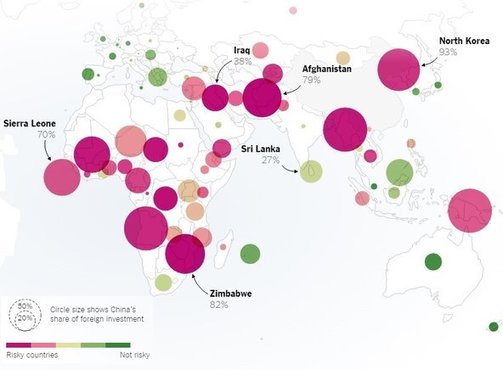
Analyzing Maps to Better Understand Global Current Events and History

In this lesson, we provide strategies to help students accurately interpret maps, and we suggest ways for using current event maps as a tool to better understand both history and what’s going on in the world today.

Source: learning.blogs.nytimes.com

Many of the more fortunate students (access to portable electronic devices, multi-car families with parents who drive them around, etc.) are actually worse off in map reading skills in part because they have never needed to develop a mental map and are not adept at navigating their neighborhoods (in the last few generations most and the range that part).  When these children become drivers, they are unable to navigate without GPS devices, but they still need to learn map reading skills. They are convinced that their apps can do all the work and that an old fashioned paper map is outdated technology, but their spatial thinking skills become atrophied. Spatial skills are crucial for understanding the world as a global citizen, to understand your local environs and for making scientific discoveries.  So teach a kid how to read a map…the sooner the better. 


Tagsmapping, K12, scale, location.

Land Use and Watersheds

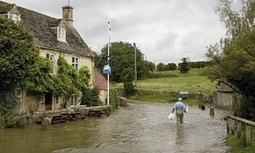
George Monbiot: Every year billions are spent in Britain and Europe on policies that wreck homes and lives through flooding

Source: www.theguardian.com

Governments and property owners often act as though a parcel of land is not connected to the broader forces and systems that reshape our Earth.  This article is a reminder that what happens upstream can impact the entire watershed.


Tags: environmentwaterUK, land use, sustainability.

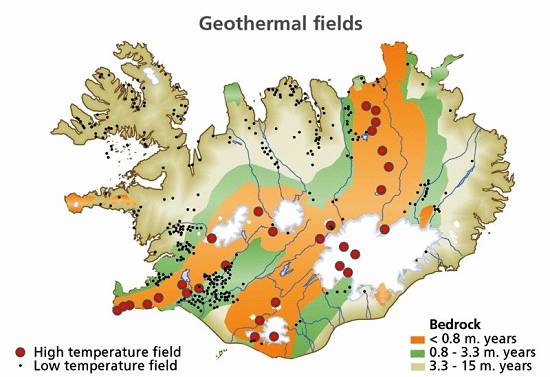
“Green” Iceland gets greener

Country that is 100 percent powered by renewable energy taps into new natural resource.


Tags: Iceland, energy.

Source: www.cbsnews.com

Galapagos Islands and Biodiversity

Radiolab wraps 2015 with a series of special episodes.

Source: www.radiolab.org

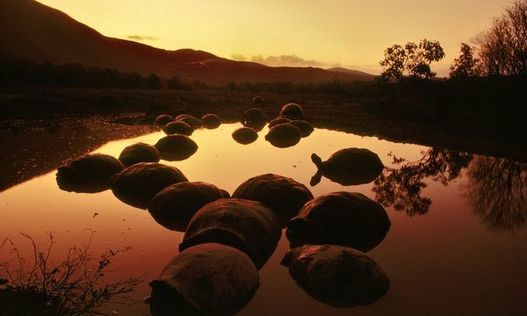
The Galapagos Islands (as are most islands) filled with remarkably distinct species from the mainland–one of the key reasons that the island were so instrumental in shaping Charles Darwin’s thinking about evolution.  This environmental Radiolab podcast is mainly about the Galapagos wildlife and it’s conservation and covers many important biogeographic concepts (with time in the episode): 

  • Traveling to the Galapagos (5:25)
  • Who will fight to protect the environment? (10:00)
  • Tortoises and their role in habitats (13:30)
  • Invasive Species and goats (16:30)
  • Removal of Invasive species (19:00)
  • The return of the original habitat (25:40)
  • Local anger against conservation (26:30)
  • ‘Restoring’ extinct tortoise species (30:00)
  • How do we best protect nature? (37:00)
  • Genetically engineering extinct species (41:00)
  • Tourism and ecological change (46:45)
  • Darwin and finches (50:00)
  • Endangered finches and flies (55:00)
  • Hybrid species (1:02:00)


Tags: Ecuador, biogeography, environmentecology, historical.

Create a free website or blog at WordPress.com.

Up ↑