“All the tweets regarding the 2017 APHG exam2017 APHG exam from the official social media outlet of College Board, Trevor Packer, Vice President of Advanced Placement.”
Source: storify.com
“All the tweets regarding the 2017 APHG exam2017 APHG exam from the official social media outlet of College Board, Trevor Packer, Vice President of Advanced Placement.”
Source: storify.com
Greetings from Cincinnati, OH, home of the 2017 AP Human Geography reading. Over 700 professionals are here to score over 200,000 exams. I’ve been delighted in the past to share the Professional Development activities and newsletters and will continue to do so. This post will be updated throughout the reading (June 2-8).
Source: geographyeducation.org

“The app built by expert teachers for savvy students. Practice hundreds of real AP-style questions. Level-Up from easy to expert; learn while you play.”
Source: www.iscore5.com
With all the great functionality and content of their prior version, iScore5 APHG is now updated (with no more lockouts and practice FRQs with rubrics for users to work through). Available on Apple and Google Play platforms and at a reduced price for bulk purchases. Also available is our AP Psych app, our AP US Government app and very soon for AP World History.
Tags: APHG, teacher training, edtech.

Source: www.illustratedtextbook.com
If you haven’t seen any resources from the Human Imprint, this is a great source of teacher-produced AP Human Geography as well as other social studies. This new project, the Illustrated Textbook, was created to be a “one-stop-shop for human geography fundamentals” using a fun, graphic style interlaced with content-heavy text. I’m very excited to see this online textbook continue to unfold. This is definitely on the shortlist of best materials on this site.
Tags: geography education, APHG, infographic, textbook.
In which John Green teaches you about population. So, how many people can reasonably live on the Earth? Thomas Malthus got it totally wrong in the 19th century, but for some reason, he keeps coming up when we talk about population. In 1800, the human population of the Earth passed 1 billion, and Thomas Malthus posited that growth had hit its ceiling, and the population would level off and stop growing. He was totally right. Just kidding, he was totally wrong! There are like 7 billion people on the planet now! John will teach a little about how Malthus made his calculations, and explain how Malthus came up with the wrong answer. As is often the case, it has to do with making projections based on faulty assumptions. Man, people do that a lot.
Source: www.youtube.com
This is a succinct summary of Malthusian ideas on population. What do you think of his ideas? Any specific parts of his theory that you agree with? Do you disagree with some of his ideas? What did history have to say about it?
Tags: Demographics, population, models, APHG, unit 2 population.
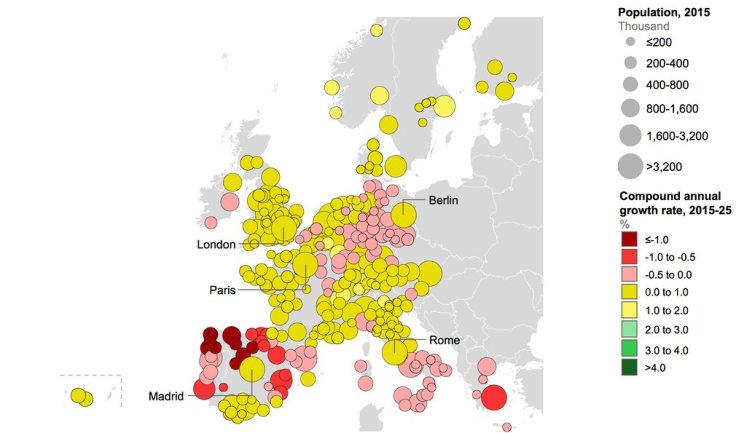
“The world is experiencing rapid urbanisation, but not every city is growing. Population is likely to decline in 17% of large cities in developed regions and 8% of cities across the world from 2015 to 2025, according to a McKinsey report.”
Source: www.theguardian.com
This is a fantastic series of maps for human geography and regional geography classes. Some cities throughout Africa and Asia have experienced spectacular growth (click here for 5 infographics showing East Asia’s massive urban growth). Europe, on the other isn’t see the same level of growth and is even experiencing urban decline in a few regions.
Questions to Ponder: What patterns do you see in these maps? What cultural, demographic and economic factors explain some of the regional patterns in these maps?
Tags: APHG, urban, unit 7 cities, megacities.

“Each June, over 15,000 AP® teachers and college faculty members from around the world gather to score the free-response sections of the AP Exams. These AP Readers are led by a Chief Reader — a college professor who has the responsibility of ensuring that students’ responses are scored to accurately reflect college-level achievement. AP Readers often describe the AP Reading as one of the best professional development experiences they have ever had.”
Source: apcentral.collegeboard.com
First off, I’m impressed by the phenomenal growth of the AP Human Geography exam and the number of exams this year will be unprecedented (213,000 anticipated exams). While the number of exams has grown, the number of readers to score the exams hasn’t kept pace. Consequently, human geography is in a deficit with our list of applicants in our reader pool. College Board is changing the usual requirements of 3 years of experience teaching APHG for High School teachers to TWO YEARS of experience. For higher education, anyone who teaches a class that is comparable to human geography is certainly invited to apply and we appreciate having those with college teaching experience within our ranks. (OPEN DISCLOSURE: I am the Chief Reader Designate, so while I will be reviewing applications, I do not have the final say and obviously can’t promise that anyone will or will not get invited to the reading). Personally, I LOVE attending the readings and consider it the best networking/professional development opportunity for a geography educator out there.
Tags: APHG, geography education, teacher training.
This is video is a great tool to drum up interest in an AP Human Geography course produced by David Burton. See more promotional videos/start-of-the-year clips at http://wp.me/P2dv5Z-1ec
Source: www.youtube.com
This is just one of my favorite “start of the year” videos. I’ve compiled them for when you need to show the importance of geography, spatial thinking and geo-literacy. Collectively, they show why taking geography courses is so important, useful and interesting.
Tags: geo-inspiration, geography education, APHG.

“Welcome to Mr. Varley’s AP Human Geography website. Scroll over ‘AP Human Geography’ located above to find a drop-down menu for each unit.”
Source: wp.lps.org
There are many great teacher sites; this one has the great unit-specific resources as well as a student-produced “Motherload review packet.” Consider having your students collaboratively produce their own review packet.
Tags: geography education, APHG.


 GEOGRAPHY EDUCATION