Search

GEOGRAPHY EDUCATION

Supporting geography educators everywhere with current digital resources.

Tag

cartography

Making Globes

“Colored printed sections showing the map of the world are cut to shape then pasted onto the surface of the globes and a protective coat of varnish is added. Narrator recounts the fact that lots of the workers have been there for over 30 years and quips: ‘While the rest of the mankind does its best to blow the world up, they like building a new one.'”

Source: www.youtube.com

I love watching globes made by hand and this vintage video shows the process of globes being made in London in 1955.  While most globe production is mechanized today, you can also watch the Bellerby company use gorgeous artistry to handcraft globes today.   


Tags: cartography, visualization, mapping, artgeo-inspiration.

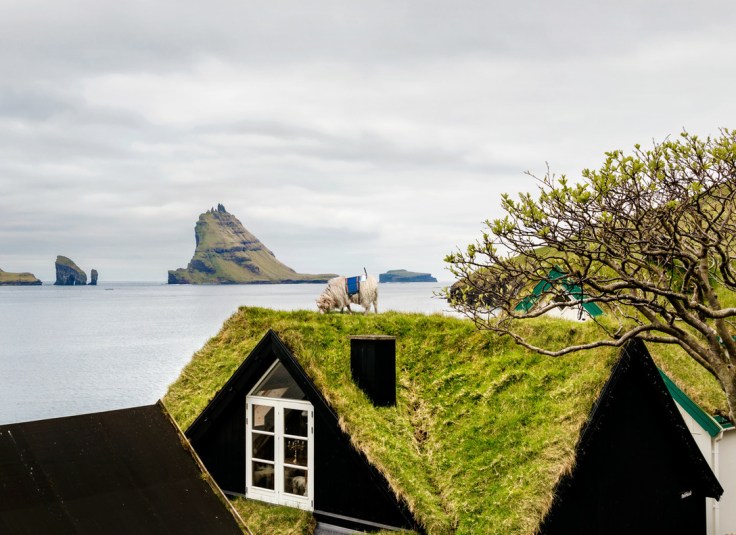
This Sheep Is Mapping The Faroe Islands By Wandering Around With A Camera

How do you get Google to visit your small, remote island group with its Street View vehicles, and digitize your roads for the benefit of locals and tourists alike? If you are the Faroe Islands, then you exploit your local resources to roll your own Street View, in the hopes of attracting Google’s attention. Behold: Sheep View 360, a solar-powered 360-degree camera, mounted on a sheep’s back. Sheep View takes advantage of one great Street View feature: You can upload your own images to Google’s service. So Durita Dahl Andreassen, working for the tourist site Visit Faroe Islands, decided to kick-start the Faroe Islands’ entry by putting the camera on a sheep and letting it wander free, then uploading the photos.”

Source: www.fastcoexist.com

I think this is my favorite mapping story of the year…I’m sharing this just because I can.  Google wouldn’t originally bring its Street View-recording cars to the islands (part of Denmark), so a solar-powered, ovine-mounted camera was put to work.  Fact can be stranger than fiction.


Tags: google, mapping, cartography, technology, Denmark,

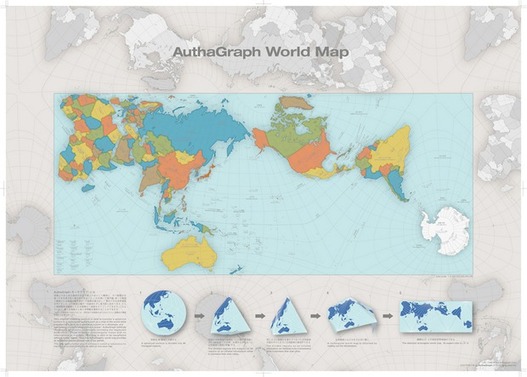
A More Accurate World Map Wins Prestigious Japanese Design Award

“To design a map of the world is no easy task. Because maps represent the spherical Earth in 2D form, they cannot help but be distorted, which is why Greenland and Antarctica usually look far more gigantic than they really are, while Africa appears vastly smaller than its true size. The AuthaGraph World Map tries to correct these issues, showing the world closer to how it actually is in all its spherical glory.”

Source: mentalfloss.com

This just shows how subjective the concept of “accurate” can be. First off, this is a fabulous map that nicely minimizes distortions (distance, direction, area, and shape) of the land on our planet. Any criticism of the map just shows the impossibility of making an accurate 2D map of a 3D Earth, but I still think that there is plenty of room to discuss the flaws/distortions that were chosen instead of others. It is interesting to note that a Japanese contest awarded this map with it’s top honor (I doubt a Brazilian organization would feel the same way about this map). This map does make with some traditional cartographic conventions in its representation of Earth.  


Questions to Ponder: What are some elements of this map that are different from more traditional maps? This map claims to be more accurate; does that make it more useful?    


Tags: visualization, mapping, cartography, geospatial, technology.

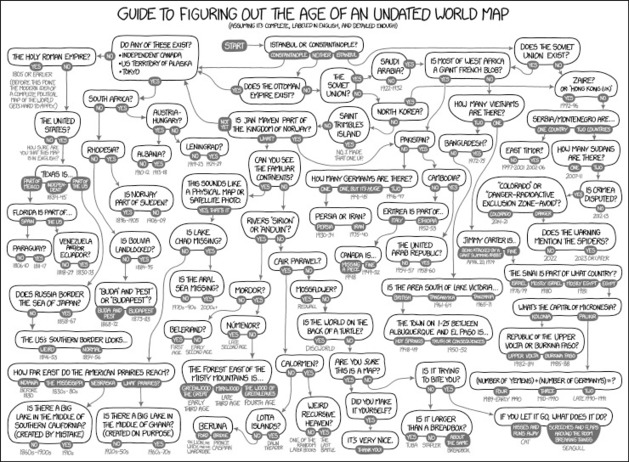
xkcd: Map Age Guide

Source: xkcd.com

I was riding my bike during Labor Day weekend and chanced upon a yard sale with an old globe going for $4 (of course I bought it and rode home one-handed).  There were some clues that it wasn’t a recent globe (The Soviet Union and Yugoslavia still existed and Burkina Faso was labeled Upper Volta and Zimbabwe was listed as Rhodesia). I knew that if I wanted to know what year this globe was produced, I would need this XKCD guide. XKCD is a comic strip that deals with many intellectual issues, but it can also be a wealth of quality scientific information.  This infographic (hi-res) is amazingly useful if you are trying to find the map of an undated map, but the flow chart also is a wealth of global history and moments that ‘changed the map.’


Tags: XKCD, artinfographic, mapping, trivia, cartography.

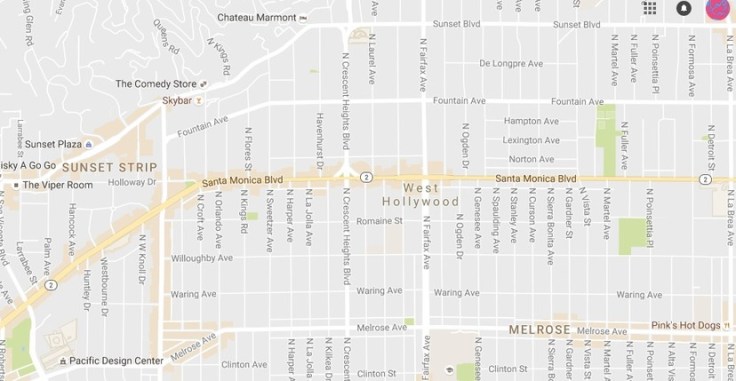
All Maps Are Biased. Google Maps’ New Redesign Doesn’t Hide It.

“Google rolled out its new Maps design…from a navigational tool to a commercial interface and offers the clearest proof yet that the geographic web—despite its aspirations to universality—is a deeply subjective entity.”

Source: www.slate.com

Google Maps was updated over the summer, and the updates don’t make them more impartial, but that isn’t a bad thing.  Google Maps now highlight ‘Areas of interest,’ which are created with algorithms designed to reveal the “highest concentration of restaurants, bars, and shops.” The algorithms aren’t ‘objective,’ but are fine-tuned by human engineers to reflect what they consider ‘Areas of Interests’ should look like.  Maps are never as objective as they appear to be, and that can often be a great thing. 


Tags: google, mapping, geospatial, cartography, visualization.

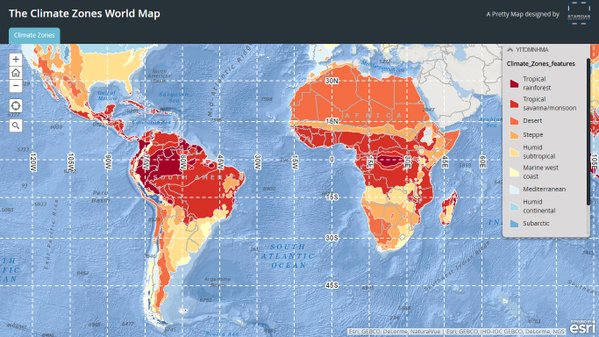
Interactive Climate Map

“Obsessed as we are with cartography we in Staridas Geography perceive any aspect of the actual 3D World as a constant opportunity for another pretty map creation!”

Source: staridasgeo.maps.arcgis.com

This is a great interactive map of the world’s climate zones. 


Tags: ESRIStoryMapedtech, GIS, mapping, cartographyphysical.

Do You Know The Outline of These Countries?

Can you spot the real outline from the fake?..

Source: www.buzzfeed.com

This is just for fun…The borders/coastlines of these 14 countries are slightly photoshopped in one of the two images, and you have to remember from your mental maps which one is correct.  And yes, of course I got a 14. 


Tagsmapping, trivia, funborders, cartography.

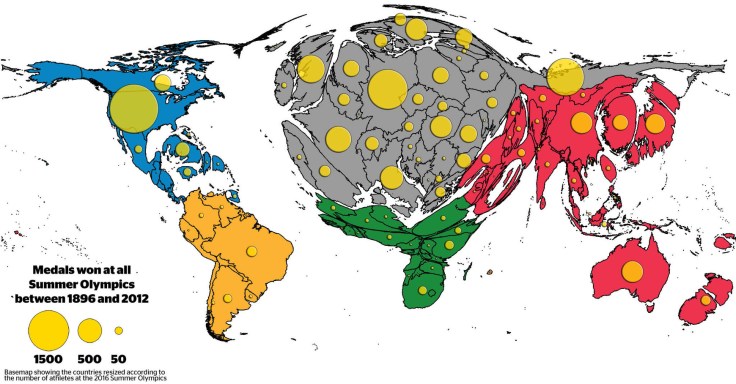
Cartograms of the Olympic Games

The distribution of medals shows the existing Olympic inequalities: The overall patterns are a reflection of wealth distribution in the world, raising the question whether money can buy sporting success. Besides investment in sports by those countries who can afford it, the medal tables also reflect a battle for global supremacy in political terms.


Tags: sport, popular culture, mapping, historical, cartography.

Source: geographical.co.uk

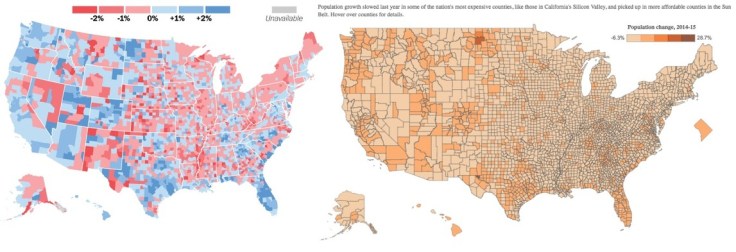
The dirty little secret that data journalists aren’t telling you

How to tell two radically different stories with the same dataset.

Source: www.washingtonpost.com

Mapping matters, but that doesn’t mean that maps convey an objective truth.  They are rhetorical devices used to convince and persuade.  So approach maps critically because while they can convey great spatial patterns, they can conceal patterns just as easily.  


Tagsstatisticscartography, visualization, mapping.

Create a free website or blog at WordPress.com.

Up ↑