Search

GEOGRAPHY EDUCATION

Supporting geography educators everywhere with current digital resources.

Tag

culture

Music and Resistance

“Life imitated art in early 1980 when South African school children, fed up with an inferior apartheid-era education system, took to chanting the lyrics of Pink Floyd‘s ‘Another Brick in the Wall.’ The song, with its memorable line stating, “We don’t need no education,” had held the top spot on the local charts for almost three months, a total of seven weeks longer than it did in America. By May 2, 1980, the South African government had issued a ban on ‘Another Brick in the Wall,’ creating international headlines.”

Source: www.youtube.com

How a song about rigid school rules in England became banned in South Africa is a fantastic lesson in cultural diffusion and glocalization (where the global becomes intensely local).  Here we see an historical example of a global cultural phenomenon taking on local political dimensions.  If you are interested in teaching more about the social and historical content of music, check out TeachRock.org.      


Questions to Ponder: Why would this song resonate in South Africa?  How might the video/lyrics map onto the South African situation? 


Tags culturediffusion, globalization, popular culture, South AfricaAfrica, music.

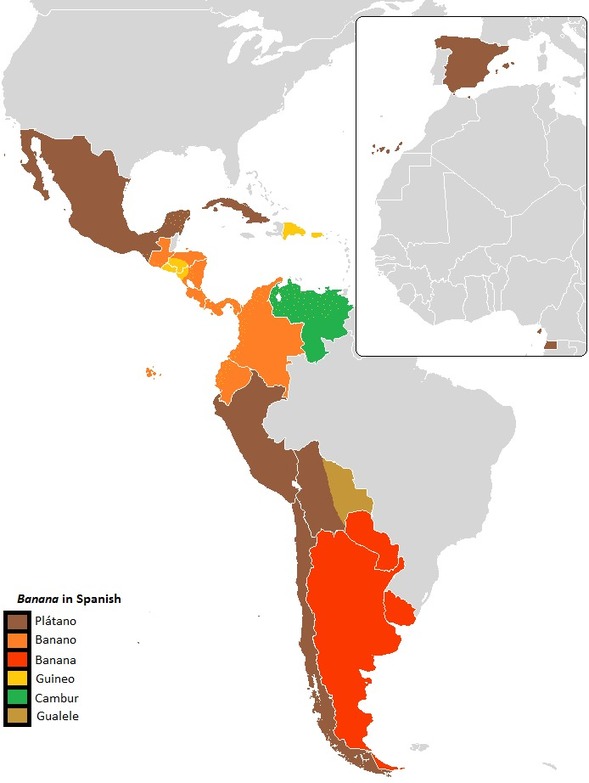
How to Say ‘Banana’ in Spanish

Source: i.imgur.com

I’ve lived in both the plátano and banano sub-regions of the Spanish-speaking realm and this discrepancy was one I always found curious (likewise, peanut butter is called crema de cacahuate in Mexico, but mantequilla de maní in Costa Rica). I’ve had many humorous encounters with friends from throughout the Spanish-speaking world when words that mean one thing in a particular country have VERY different connotations in another.


Questions to Ponder: Why do languages have different vocabularies in distinct places?  Why makes a language especially prone to a varied set of regionalized terms?


Tags: language, colonialismdiffusion, culture, mapping, regions.

‘Leftover Women’ in China

“Chinese women face immense pressure to get married before they turn 27. In many Chinese cities, so called marriage markets are a common sight, where parents go to post and match personal ads. A number of brave Chinese women have finally stood up to speak their mind against society’s labels and their parents’ pressures.”

Source: www.youtube.com

This emotional ad about ‘leftover women‘ in China has received a lot of traffic and is now invigorating a national conversation about marriage customs, gendered norms, and cultural expectations.  What isn’t as explicit in the video is how demographic policies and cultural preferences for boys has created the situation that puts added pressure on single women


Questions to Ponder: How is this (at least partially) a lingering impact of the One Child Policy?  What traits of traditional Chinese culture led to this current situation?   


Tags: gender, folk culture, China, culture, population.

Thousands Leave Norwegian Church as Online Registration Backfires

“15,035 people have ‘unsubscribed’ from the church since Monday.”

Source: www.atlasobscura.com

Europe, the most developed region in the world, is also the most secular region today.  During colonial times, Europeans were spreading Christianity across the globe, but now Christianity is becoming more a part of Europe’s historical landscape.  Secularization can be seen as either the cause or the effect of several other European trends such as declining fertility rates.  Today Europeans have stopped attending mass en masse, and many cathedrals sit empty.  This example for Norway has an amusing twist, but it is rooted in a powerful cultural shift. 


Questions to Ponder: What are other signs of secularization on the cultural landscape?  What would you do with a former sacred site (and an architectural treasure) that is can’t be maintained?


Tags: culturepopular culture, religion, ChristianityNorway, Europe.

Why China and India face a marriage crisis

“What has lead to this marriage squeeze?  First, millions women have gone ‘missing’. A generation ago, a preference for sons and the greater availability of prenatal screening meant first Chinese couples, then Indian ones, started aborting female fetuses and only giving birth to boys. At its extreme, in parts of Asia, more than 120 boys were being born for every 100 girls. Now, the generation with distorted sex ratios at birth is reaching marriageable age. The result is that single men far outnumber women.”


Tags: gender, ChinaIndia, culture, population.

Source: www.youtube.com

What assimilation means to the ‘taco trucks on every corner’ Trump supporter

Marco Gutierrez, founder of Latinos for Trump, explains his view of immigration and assimilation to the US.

Source: www.pri.org

I’m NOT trying to use this platform to advance any partisan political agenda, but I think this brings up some very interesting narratives that are used when discussing migration and culture, which becomes a political ‘hot-button’ topic.  There is often cultural pressure on the migrant to assimilate into the host culture (or at least acculturate to a certain degree).  This larger national discussion centers on whether cultural assimilation should be expected of migrants and how much cultural diffusion the host culture will be receiving from the migrants.

Questions to Ponder: How are cultural norms placed on migrants?  What are some recent examples of migrants not wanting to assimilate that have led to political tension?

Tags: culture, cultural norms, migration, political.

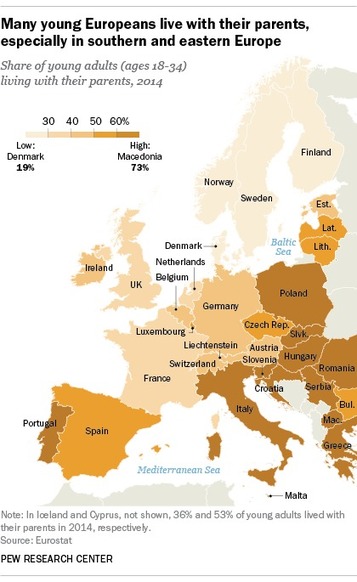
More young adults are living with their parents

Across much of the developed world, researchers have found that more young adults are living at their parents’ home for longer periods of time.


Across the European Union’s 28 member nations, nearly half (48.1%) of 18- to 34-year-olds were living with their parents in 2014, according to the EU statistical agency Eurostat.  The Scandinavian countries have the lowest rates, with Denmark coming in at 18.6%. Southern and eastern European countries tend to have higher rates, led by the former Yugoslav republic of Macedonia: 72.5% of 18- to 34-year-olds reportedly were living with their parents.

Source: www.pewresearch.org

This isn’t news because this trend gradually became a new part of the economic and cultural norms of the developed world–but the impact is enormous.  In the United States, more young adults live with parents than partners (for the first time in the 130 years that the statistic has been collected).  The world isn’t what it was in 1880.  

32.1% of young adults in the U.S live with parents, and 48.1% of young adults in the European Union Union live with parents.   


Questions to Ponder: What are some contributing factors to this trend in the United States and Europe?  What does this say about housing costs, economic, and cultural conditions? 


Tags: socioeconomic, housingstatisticspopulation, cultural norms, culture.

Trailer: One Day on Earth

//cdn.embedly.com/widgets/media.html?src=https%3A%2F%2Fplayer.vimeo.com%2Fvideo%2F26378195&wmode=opaque&url=https%3A%2F%2Fvimeo.com%2F26378195&image=http%3A%2F%2Fi.vimeocdn.com%2Fvideo%2F215566910_1280.jpg&key=359ed8ab27db4f02a128049b1f89d6a1&type=text%2Fhtml&schema=vimeo

One Day on Earth is a unique global movement, community media creation platform, and collaborative film production engine. We invite you to join our international community of thousands of filmmakers, hundreds of schools, and dozens of non-profits, and contribute to this unique global project (with a map of all participants). Many future filming events will be announced in the coming year. One Day on Earth is a community that not only watches, but participates.”


Tagsvideo, mapping, social mediaplaceculture.

Source: vimeo.com

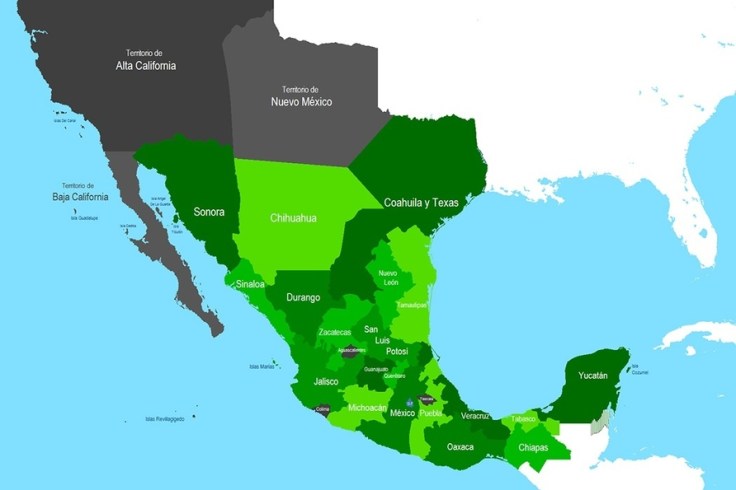
When Mexico Was Flooded By Immigrants

In the early nineteenth-century, Mexico had a problem with American immigrants.

Source: daily.jstor.org

A century and a half ago, the immigration debate and geopolitical shifts in power on the United States-Mexico border reflected a profoundly different dynamic than it does today.  This history has enduring cultural impacts on southwestern states that had the international border jump them.


Tags: culture, demographicsmigration, North Americahistorical, colonialism, borders, political.

Create a free website or blog at WordPress.com.

Up ↑