Search

GEOGRAPHY EDUCATION

Supporting geography educators everywhere with current digital resources.

Tag

globalization

The Spice Trade’s Legacy

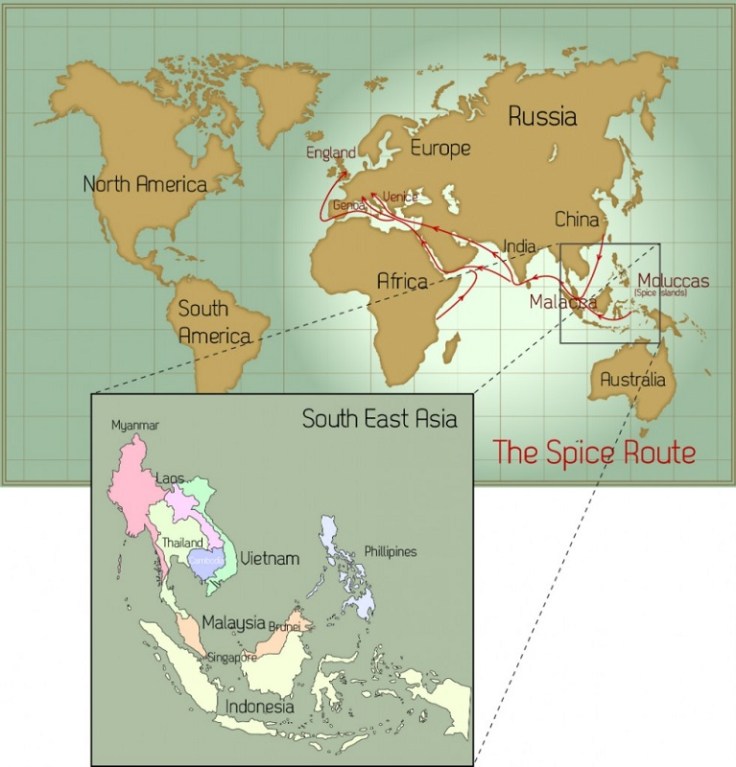
“In its day, the spice trade was the world’s biggest industry. It established and destroyed empires and helped the Europeans (who were looking for alternate routes to the east) map the globe through their discovery of new continents. What was once tightly controlled by the Arabs for centuries was now available throughout Europe with the establishment of the Ocean Spice Trade route connecting Europe directly to South Asia (India) and South East Asia.”

Source: cleanfooddirtygirl.com

The spice trade changed how we eat forever but it did so much more.  The fall of Constantinople to the Ottoman Empire cut off Europe from the vital trade routes to the east and access to the most prized commodities of the day.  What drove European exploration to get around Africa and to cross the Atlantic?  It was to reshape their situation location relative to the economic networks that shaped the emerging global economy.  In essence, the spice trade reshaped the fortunes and trajectories of several major world regions.   


Tags: Southeast Asia, food productiondiffusionglobalization, agriculture, economicindustry, economic, historical, regions.
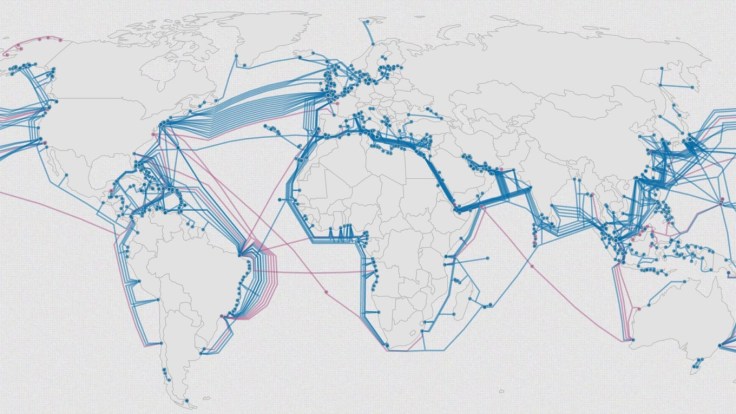
Growth of underwater cables that power the web

“The map above, created with data from Telegeography, shows how those cables have developed since 1990. Most existing cables were constructed during a period of rapid growth in the mid-2000’s. This was followed by a gap of several years during which companies steadily exhausted the available capacity. Over the last few years, explosive new demand, driven by streaming video, has once again jumpstarted the the construction of new cables.”

Source: qz.com

Twenty years ago, people were still connecting to the internet with a dial-up connection through their modem (if you don’t know what that sounds like, this was once the sound of interconnectivity).  People focus on cell phones, tablets, and cool gadgets when discussing the digital transformation of globalization, but it all rests on the infrastructure of the global connectivity that is mapped out here.  Even still, global trade rests on the back of container ships moving manufactured goods from far-flung factories to major markets.


Tags: technology, globalization, diffusion, industry, economic.

The other Asian tiger

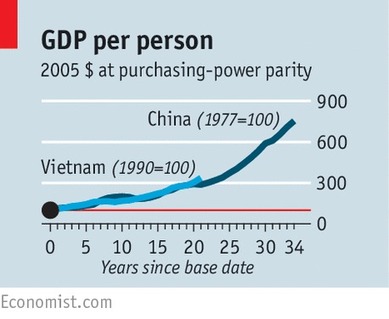
“Vietnam’s success merits a closer look.”


Which Asian country has roared ahead over the past quarter-century, with millions of its people escaping poverty? And which Asian economy, still mainly rural, will be the continent’s next dynamo? Most would probably respond “China” to the first question and “India” to the second. But these answers would overlook a country that, in any other part of the world, would stand out for its past success and future promise.

Vietnam, with a population of more than 90m, has notched up the world’s second-fastest growth rate per person since 1990, behind only China. If it can maintain a 7% pace over the next decade, it will follow the same trajectory as erstwhile Asian tigers such as South Korea and Taiwan. Quite an achievement for a country that in the 1980s was emerging from decades of war and was as poor as Ethiopia.


Tags: Vietnam, globalizationdevelopment, economic, SouthEastAsia.

Source: www.economist.com

Music and Resistance

“Life imitated art in early 1980 when South African school children, fed up with an inferior apartheid-era education system, took to chanting the lyrics of Pink Floyd‘s ‘Another Brick in the Wall.’ The song, with its memorable line stating, “We don’t need no education,” had held the top spot on the local charts for almost three months, a total of seven weeks longer than it did in America. By May 2, 1980, the South African government had issued a ban on ‘Another Brick in the Wall,’ creating international headlines.”

Source: www.youtube.com

How a song about rigid school rules in England became banned in South Africa is a fantastic lesson in cultural diffusion and glocalization (where the global becomes intensely local).  Here we see an historical example of a global cultural phenomenon taking on local political dimensions.  If you are interested in teaching more about the social and historical content of music, check out TeachRock.org.      


Questions to Ponder: Why would this song resonate in South Africa?  How might the video/lyrics map onto the South African situation? 


Tags culturediffusion, globalization, popular culture, South AfricaAfrica, music.

Turkey’s ‘bumpy ride’ into the EU?

“As the UK prepares for what looks like a slow and painful divorce from the European Union, the people of Turkey are wondering how their relationship with Europe will now develop.

The government in Ankara has been seeking to strengthen its case to join the EU, but as Europe grapples with Brexit – is the Turkey’s membership closer or further away?”

Source: www.bbc.com

This video show some of the recent shifts in the always important, often rocky Turkey/EU relationship.   Economically, Turkey has consistently sought greater ties with Europe for the past few decades and Europe keeps Turkey at arms length.    Turkey has applied to join the EU, but that is not going to happen without some massive social restructuring that would take years. 


Tags: EuropeTurkey, supranationalism, economicrefugees, political, video.

London Should Secede From the United Kingdom

Beyond the stunning act that has become Britain’s vote to leave the European Union lies a deeper message: Democracy is not destiny, but devolution. Ceaseless entropy — the second law of thermodynamics — applies to politics as well. The more countries democratize, the more local populations seek greater self-rule.

Source: foreignpolicy.com

In his book Connectography by Parag Khanna, he argues that connectivity and networks are more important today.  Using those ideas, Khanna discusses London’s options after the recent Brexit vote in this op-ed.      

Brexit: Reaction and the Aftermath

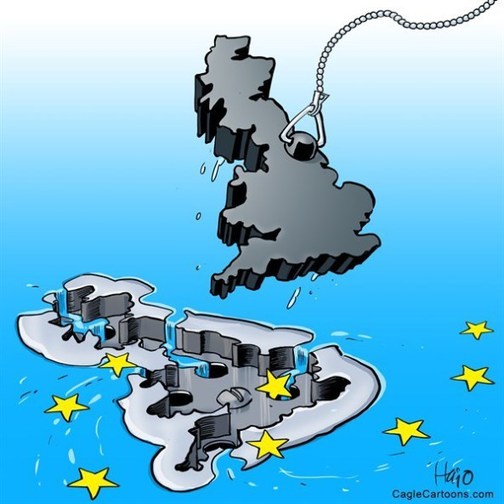
“The reactions to the Brexit have come in from all corners.  Since this was so shocking, newspapers articles that are insightful are using hyperbole in their titles to get our attention (Britain just killed globalization as we know it–Washington Post; Will Brexit mark the end of the age of globalization?–LA Times).  There have also been some excellent political cartoons and memes, so I wanted to archive a few of them here.”  


Tags: Europe, supranationalismglobalization, economic, political, images.

Source: geographyeducation.org

Do The Math – Why The Illegal Business Is Thriving

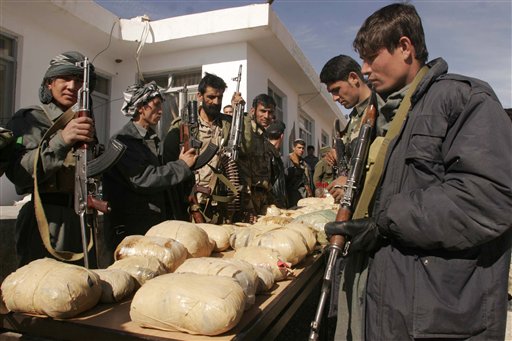
“Globalization hit organized crime over the last decade and now is integral to its most profitable business — the international narcotics traffic. Once a regional problem involving a customer base of a few million, and barely a billion dollars in sales, the illegal drug industry is now a worldwide enterprise with tens of millions of hard core consumers spending hundreds of billions on opiates, cocaine and amphetamines and marijuana, as well as other drugs.”

Source: www.pbs.org

The United Nations Office on Drugs and Crime (UNODC) calls drug trafficking “a global illicit trade involving the cultivation, manufacture, distribution and sale of substances which are subject to drug prohibition laws.”  While some individuals are profiting off these drugs, the overall impact of the society and the places involved with the illegal trade is detrimental. 


Tags: globalization, conflictnarcotics.

Cities are the New Nations

“Political geography is not determinant anymore, because cities are more important.”

Source: www.citylab.com

Controlling borders and territory were the main factors in geopolitics for centuries.  In his book Connectography by Parag Khanna, he argues that connectivity and networks are more important today.  The world’s most connected cities act in ways that transcend political boundaries.      


Blog at WordPress.com.

Up ↑