Search

GEOGRAPHY EDUCATION

Supporting geography educators everywhere with current digital resources.

Tag

historical

How Eratosthenes calculated the Earth’s circumference

“In the mid-20th century we began launching satellites into space that would help us determine the exact circumference of the Earth: 40,030 km. But over 2000 years earlier, a man in Ancient Greece came up with nearly the exact same figure using just a stick and his brain.”

Source: www.youtube.com

Eratosthenes is often referred to as the “father of geography” for creating meridians and parallels on his maps to organize global information, classifying climatic zones, and as shown in the video, calculating the circumference of the Earth. Plus, he coined the terms so he gets the credit. If you have never pondered the meaning of the word “geometry,” the accomplishments of Eratosthenes will certainly show that the mathematical prowess was at the heart of expanding our collective geographic knowledge (additionally, here is a retro Carl Sagan in a video clip from Cosmos that inspired this clip).    


Tagsmapping, math, locationSTEM, historical.

A Medieval Abbey Trapped by Tides and Time

“Mont Saint-Michel emerges from the tides in Normandy, France, like an ancient village from a fairytale. The coastal town built on a massive granite rock cuts a dramatic silhouette against the sky, rising from disappearing marshes to a Gothic Abbey at its height. With a permanent population of around 50, this popular tourist destination has a history dating back to at least the Roman era. Fancy a tour before the tides roll in?”

Source: www.youtube.com

Coastal physical geography produces some beautiful landforms such as tombolos.  A tombolo is created when sand deposits attach an island to a larger piece of land–think of it as special type of isthmus.  Mont St. Michel is the world’s most famous example because of the iconic walled city with crowned with a striking medieval abbey.  This is one of those fascinating places for both the human and physical geographer.   


Tags: water, physical, coastal, geomorphology, landformsFrance, historical, tourism.

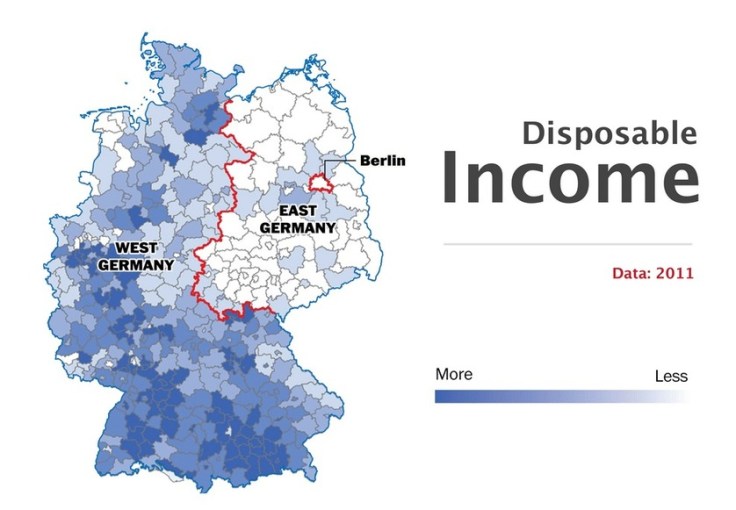
Germany reunified 26 years ago, but some divisions are still strong

“While 75 percent of Germans who live in the east said that they considered their country’s reunification a success, only half of western Germans agreed. With eastern and western Germans blaming each other for past mistakes over the past two years, that frustration has likely increased. Younger citizens, especially — who do not usually identify themselves with their area of origin as strongly anymore — have grown worried about the persistent skepticism on both sides. But where do those divisions come from? And how different are eastern and western Germany today?”

Source: www.washingtonpost.com

This series of 10 maps (and 1 satellite image) highlights many of the cultural and economic divisions between East and West, despite efforts to in the last 26 years to smooth out these discrepancies. The social geographies imposed by the Iron Curtain and the Berlin Wall are still being felt from this relic border and will for years to come. 


Tags: Germany, industry, laboreconomichistorical, politicalborders.

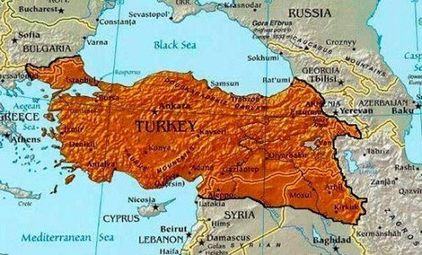
Turkey’s New Maps Are Reclaiming the Ottoman Empire

Erdogan’s aggressive nationalism is now spilling over Turkey’s borders, grabbing land in Greece and Iraq.


In the past few weeks, a conflict between Ankara and Baghdad over Turkey’s role in the liberation of Mosul has precipitated an alarming burst of Turkish irredentism. President Erdogan criticized the Treaty of Lausanne, which created the borders of modern Turkey, for leaving the country too small. Turkey won’t be annexing part of Iraq anytime soon, but this combination of irredentist cartography and rhetoric nonetheless offers some insight into Turkey’s current foreign and domestic policies and Ankara’s self-image.  The military interventions and confrontational rhetoric this nationalism inspires may worsen Turkey’s security and regional standing.


Tags: political, irredentism, culture, Turkeyhistorical, bordersempire, geopolitics.

Source: www.yahoo.com

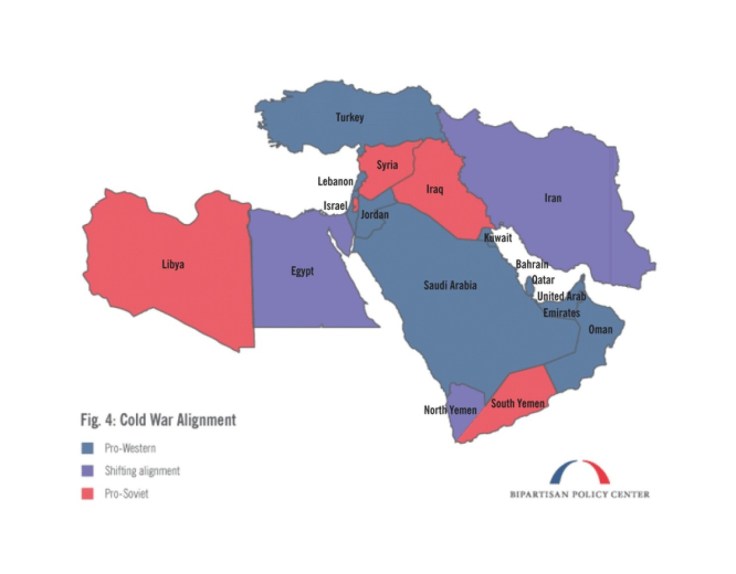
Four maps that explain the chaos of the Middle East

“Without trying to defend or absolve U.S. policy, then, it is worth stepping back to ask what shared historical experiences might have left these four countries — Iraq, Syria, Libya and Yemen — particularly at risk of violent collapse. The following maps help highlight how, at various points over the past century, historical circumstances conspired, in an often self-reinforcing way, to bolster the stability of some states in the region while undermining that of others.”

Source: www.washingtonpost.com

These maps are not cartographically inspiring, but the it’s the historical and political insight that makes them valuable. The goal of this set of maps is to find some underlying causal reasons for political stability(or more importantly instability) in the Middle East. These four maps focus on these key issues:

1. Century-old states are more stable today

2. Colonial rule led to fragile states

3. Instability and regime change

4. The shadow of the Cold War


Tags: MiddleEast, war, conflict, political, geopoliticshistorical.

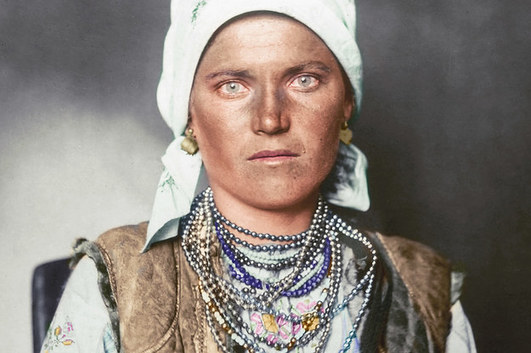
Portraits Of NYC Immigrants Reveal Cultural Backgrounds

Here are just a handful of the 12 million men, women, and children who arrived at Ellis Island, New York, between 1892 and 1954 to start a new life in the USA, often dressed in their finest clothes. The portraits show immigrants wearing the national dress of their country of origin, including military uniforms from Albania, bonnets from the Netherlands, and clothing of Sámi people from the Arctic regions.

The photographs were taken between 1906 and 1914 by amateur photographer Augustus Francis Sherman, the chief registry clerk at Ellis Island, then the country’s busiest immigration station. In 1907 some of the photos were published by National Geographic.

Source: www.buzzfeed.com

These images show some of the diverse cultural backgrounds of turn-of-the-century American immigrants.  The formal clothing that represents the folk cultures that they came from hint at the massive cultural shift that these immigrants must have experienced upon arriving to the United States.  These photos of migrants wearing clothing representing their Old World lives right as they are about to culturally assimilate (or acculturate) into the New World are pictures I find quite poignant and personal.    


Tagsculturemigrationhistorical, folk culturesethnicity, unit 3 culture.

The history of African-American social dance

Why do we dance? African-American social dances started as a way for enslaved Africans to keep cultural traditions alive and retain a sense of inner freedom. They remain an affirmation of identity and independence. In this electric demonstration, packed with live performances, choreographer, educator and TED Fellow Camille A. Brown explores what happens when communities let loose and express themselves by dancing together.

Source: www.youtube.com

Dance is more than just a way to have fun; dance reflects cultural forms of expression and communal identity.  This Ted-Ed talk demonstrates the rich cultural heritage that can be seen in particular cultural traits (such as food, clothing, dance, music, etc.).  This is bound to be a fun, vibrant way to show the how cultural patterns and processes play out using something that young people generally enjoy. 


Tags: culturediffusion, popular culture, music, race, historicalthe South, TED, video.

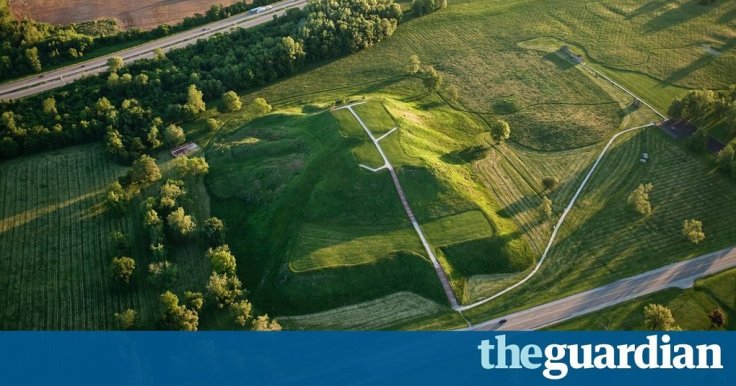
Cahokia – why did North America’s largest city vanish?

Long before Columbus reached the Americas, Cahokia was the biggest, most cosmopolitan city north of Mexico. Yet by 1350 it had been deserted by its native inhabitants the Mississippians – and no one is sure why

Source: www.theguardian.com

This article is the eighth in the “Lost Cities” series (Babylon, Troy, Pompeii, Angkor, Fordlandia, etc.).  The earthen mounds of Cahokia on the flat flood plains must have been the most awe-inspiring demonstration of political power and economic wealth in its day.  Like so many other civilizations before them (and many more in the future?), Cahokia probably declined from too many environmental modifications that led to unforeseen consequences.


Tagsurban ecology, indigenousenvironment, environment modify, historical, North America.

PBS Election Central

Check out Election Central from PBS with tools, resources & solutions to engage students in the political process.

Source: www.pbseduelectioncentral.com

The first presidential election last night has intensified the already polarized political conversation in the United States. This is a great resource to explore historic political maps and cartograms.  It also has rich tools to project the possibilities for the 2016 election with ready-made lesson plans. 


Tags: electoral, politicalhistorical, mapping.

Create a free website or blog at WordPress.com.

Up ↑