Search

GEOGRAPHY EDUCATION

Supporting geography educators everywhere with current digital resources.

Tag

Latin America

The Trails Leaving Venezuela

Venezuela Migrants

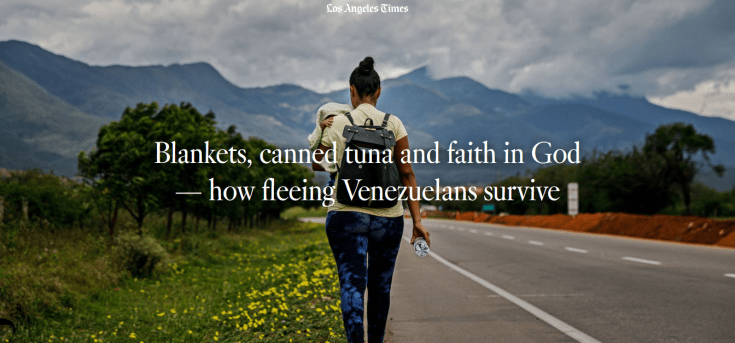
The rich were the first to leave. They wired their savings abroad and hopped on international flights. The middle class departed next. They went on buses, sometimes riding for days across several countries. The poor remained. They stayed as the economy collapsed, food got scarcer, medicine shortages turned deadly and the electricity cut out for days at a time. But finally, they too began to exit Venezuela. They simply walked out. The departure of the caminantes, or walkers, began slowly in 2017 with young men hoping to find jobs and send money home.

Now women and children, the sick and the elderly also are taking their chances, expanding an exodus that already is one of the biggest mass migrations in modern history. Each day an estimated 5,000 people flee.” SOURCE: LA Times

The economic, political, and demographic crisis in Venezuela might not be at the top of the headlines anymore, that that isn’t because the situation has gone away, but it just has become ‘normal.’   This article is an in-depth look at the lives of those fleeing Venezuela on foot into Colombia.

GeoEd Tags: migration, Colombia, Venezuela, refugees, South America.
Economies of South America

“Data from IMF, World Economic Outlook, April 2019

There are many stories in this video in the nearly 40 years of economic history of South America since 1990.The two most important stories portrayed (or at least the most dramatic) in the animated chart are decline of Venezuela’s economy and the rise of Chile’s.  This video can act as a primer to get students to consider the regional context of economic growth as well as the differing historical, political, and geographic context that leads to distinct results in any given country.

GeoEd Tags: South America, Latin America, economic, historical, political, video.

Why Colombia has taken in 1 million Venezuelans

“Colombia is currently dealing with a massive wave of refugees coming from Venezuela. Venezuelans are fleeing their home because of a severe economic crisis under President Nicolas Maduro. There are high inflation rates and there isn’t enough food available for people within Venezuela to even eat. Thousands of Venezuelans cross the Simon Bolivar bridge located at Cúcuta every day and Colombia doesn’t seem to be turning anyone way. This borders episode looks at why Colombia doesn’t turn away these refugees, the shared history of the two nations and how there may be a limit to Colombia’s acceptance of incoming Venezuelans.”

Source: www.youtube.com

The Vox border series is one of Youtube series that is the most infused with geographic themes and concepts.  If you haven’t yet discovered this yet, this episode is a great introduction to current issues in both Colombia and Venezuela.  This is also a curious case because it gets so close to the line of what we consider voluntary and involuntary migration. 

GeoEd Tags: South America, Venezuela, Colombia, borders, migration, poverty.

Belize: A Spanish Accent in an English-Speaking Country

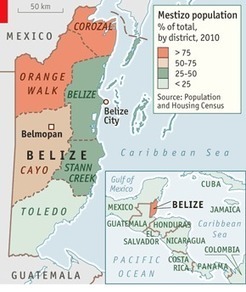
"BELIZE has long been a country of immigrants. British timber-cutters imported African slaves in the 18th century, and in the 1840s Mexican Mayans fled a civil war."

Source: www.economist.com

This is an older article (2012), but the pattern mentioned here is all the more relevant.  Belize has a much higher Human Development Index ranking that its Central American neighbors such as Guatemala.  That fact alone makes Belize a likely destination for migrants.  Given that Belize was ‘British Honduras’ during colonial times, English is (still) the official language, but that is changing as increasingly Spanish-speaking immigrants are changing the cultural profile of Belize.      

Peru gives landlocked Bolivia a piece of Pacific coast to call its own

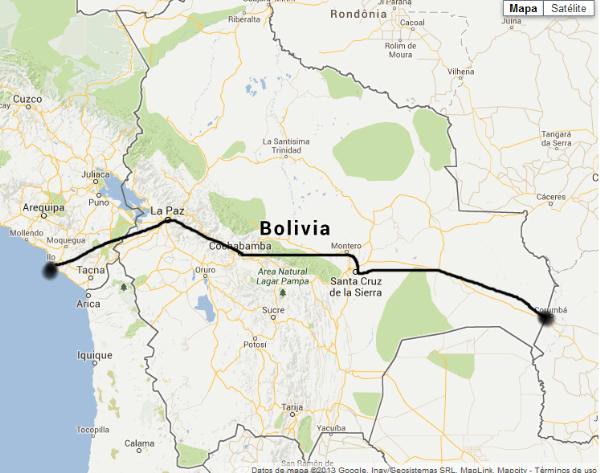
“It might be a strip of sand without even a jetty but a small stretch of the Pacific coast now harbors Bolivia’s dream of regaining a coast and becoming a maritime nation. The landlocked Andean country has won access to a desolate patch of Peru’s shoreline, fueling hopes that Bolivia will once again have a sea to call its own. President Evo Morales signed a deal yesterday with his Peruvian counterpart, Alan García, allowing Bolivia to build and operate a small port about 10 miles from Peru’s southern port of Ilo. The accord, sealed with declarations of South American brotherhood, was a diplomatic poke at Chile, the neighbor that seized Bolivia’s coast and a swath of Peruvian territory in the 1879-84 war of the Pacific.”

Source: www.theguardian.com

How important is a coastline to the economic viability of a country in the global market and to for the country’s geopolitical strengthen?  Ask the countries without one. 


TagsSouth America, Bolivia, economictransportation, political, coastal, borders.


Maya civilization was much vaster than known, thousands of newly discovered structures reveal

Scientists using high-tech, airplane-based lidar mapping tools have discovered tens of thousands of structures constructed by the Maya.


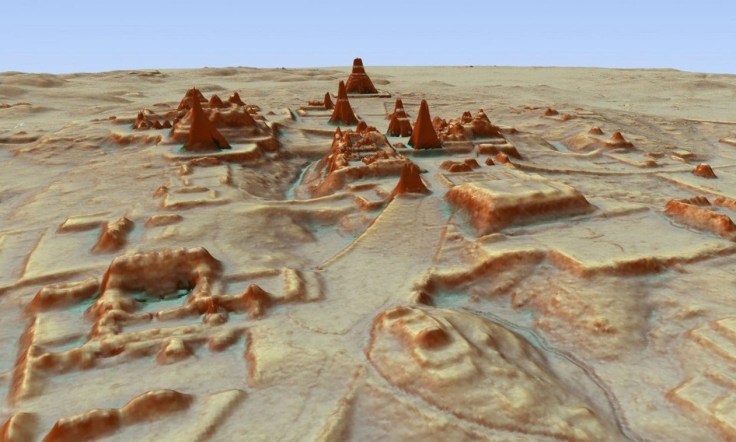
Archaeologists have spent more than a century traipsing through the Guatemalan jungle, Indiana Jones-style, searching through dense vegetation to learn what they could about the Maya civilization. Scientists using high-tech, airplane-based lidar mapping tools have discovered tens of thousands of structures constructed by the Maya: defense works, houses, buildings, industrial-size agricultural fields, even new pyramids.

The lidar system fires rapid laser pulses at surfaces and measures how long it takes that light to return to sophisticated measuring equipment. Doing that over and over again lets scientists create a topographical map of sorts. Months of computer modeling allowed the researchers to virtually strip away half a million acres of jungle that has grown over the ruins. What’s left is a surprisingly clear picture of how a 10th-century Maya would see the landscape.

Tags: lidar, spatial, remote sensing, geospatial, unit 1 GeoPrinciplesGuatemala, Middle America.

Source: www.washingtonpost.com

Divided island: How Haiti and the DR became two worlds

Haiti and the Dominican Republic share a border, and an island. But the two countries are very different today: the Dominican Republic enjoys higher quality of life for many factors than Haiti. I went to this island and visited both countries, to try and understand when and how their paths diverged.

Source: www.youtube.com

This video is an exciting debut for the new series “Vox borders.”  By just about every development metric available, the Dominican Republic is doing better than Haiti, the only bordering country on the Caribbean island of Hispaniola with the DR.   


Questions to Ponder: How does the border impact both countries?  How has sharing one island with different colonial legacies shaped migrational push and pull factors?


Tags: Haiti, Dominican Republic, video, poverty, development, economic, labor, migration, political, borders.

Mexico City, Parched and Sinking, Faces a Water Crisis

“A host of environmental factors are threatening to push a crowded capital toward a breaking point.”

Source: www.nytimes.com

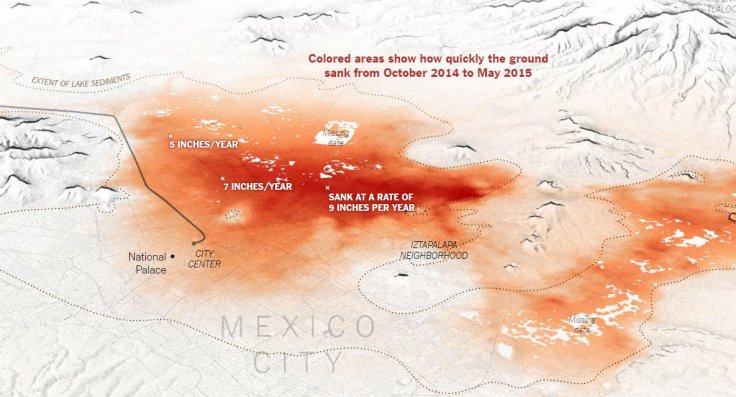
Urban ecology, environmental justice, gendered inequities, primate city politics, the struggle of growing megacities…it’s all here in this fantastic piece of investigative reporting.  The article highlights the ecological problems that Mexico City faces (high-altitude exacerbates air pollution, interior drainage worsens water pollution, limited aquifers that are overworked lead to subsidence, importing water outside of the basin requires enormous amounts of energy, etc.).  just because the article doesn’t use the word ‘geography’ doesn’t mean that it isn’t incredibly geographic. All of these problems are at the heart of human-environmental nexus of 21st century urbanization. 


Tags: urban, megacities, water, environment, Mexico.

Why the Catholic Church is losing Latin America, and how it’s trying to get it back

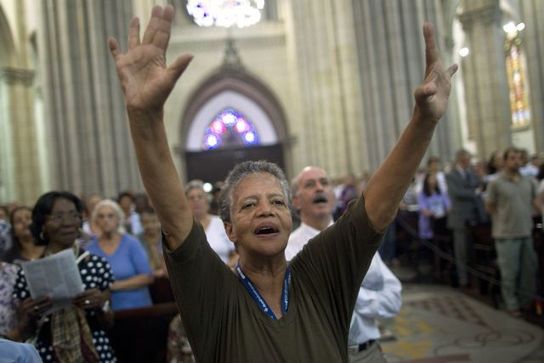
“A religious revolution is underway in Latin America. Between 1900 and 1960, 90% of Latin Americans were Catholics. But in the last fifty years, that figure has slumped to 69%, according to a recent survey by the Pew Research Center (from which most of the data in this article are taken). The continent may still be home to 425 million Catholics—40% of the world’s total—but the Vatican’s grip is slipping.”


Tags: culture, religionChristianityMiddle America, South America.

Source: qz.com

Blog at WordPress.com.

Up ↑