Search

GEOGRAPHY EDUCATION

Supporting geography educators everywhere with current digital resources.

Tag

political

Where Will The World’s Water Conflicts Erupt?

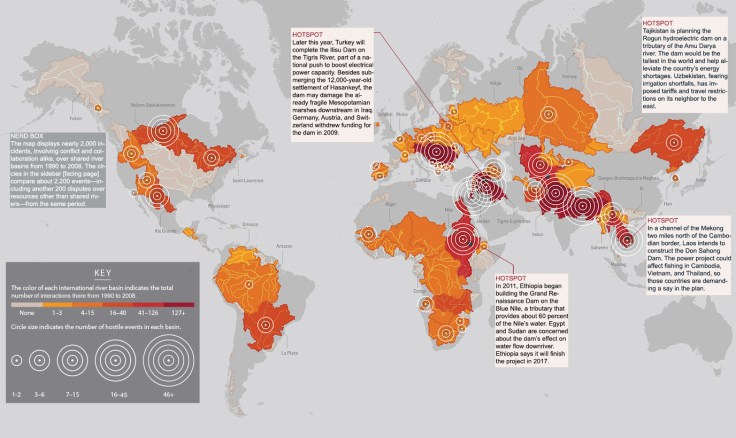
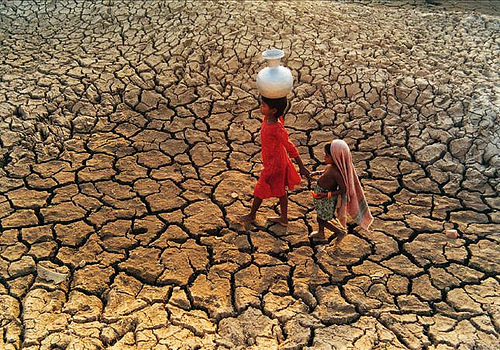
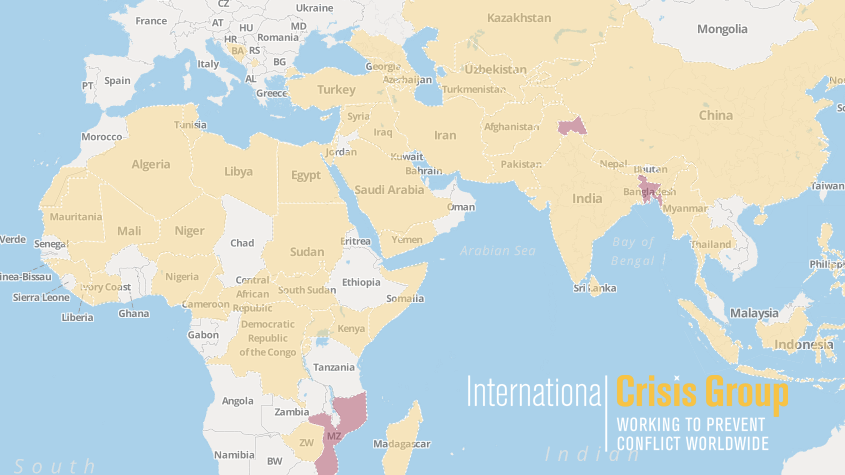
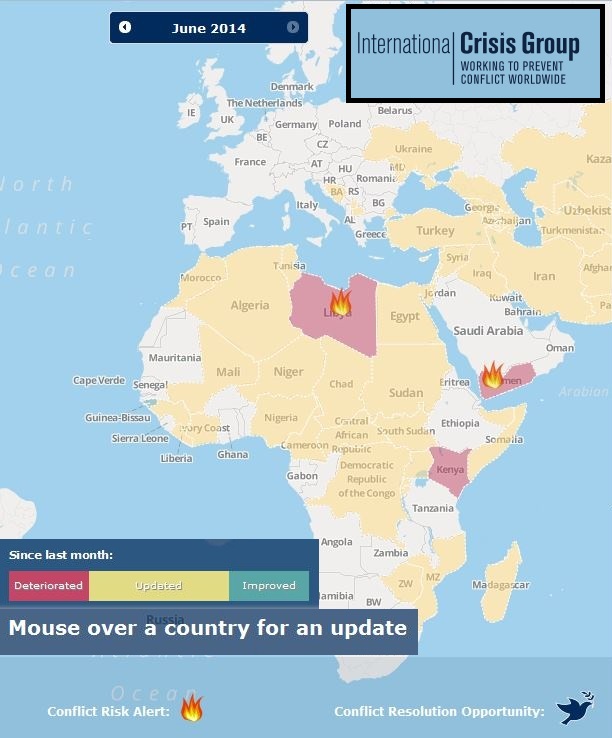
As the climate shifts, rivers will both flood and dry up more often, according to the latest report from the Intergovernmental Panel on Climate Change. Shortages are especially likely in parts of the world already strapped for water, so political scientists expect feuds will become even more intense. To track disputes worldwide, researchers at Oregon State University spent a decade building a comprehensive database of international exchanges—-both conflicts and alliances—over shared water resources. They found that countries often begin disputes belligerently but ultimately reach peaceful agreements. Says Aaron Wolf, the geographer who leads the project, “For me the really interesting part is how even Arabs and Israelis, Indians and Pakistanis, are able to resolve their differences and find a solution.”

Source: www.popsci.com

Too often we think of political conflicts within the framework of state borders; this mapping project divides the world into watersheds and forces us to look at global politics through a different and enlightening lens (Hi-Res image).  Oil might be the most economically valuable liquid resource, but water is the most critical for human habitation.  This infographic is reminiscent of this one, asking where the next ‘water wars’ might take place.   


Tags: water, political, unit 4 political environment, conflict, infographic

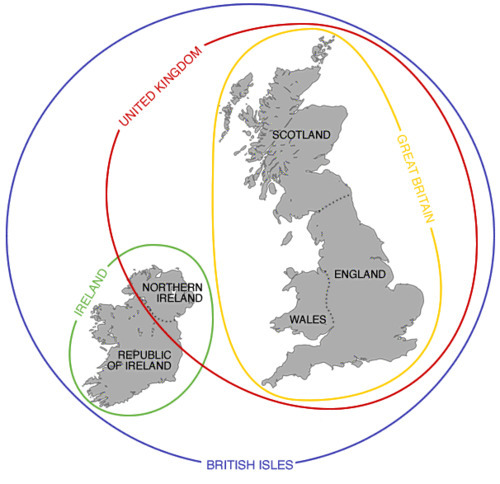
England, Britain and the UK

This is the short version of the differences between these interrelated places and terms; the long version (in the video below) is much more complicated than this.

Tags: Europe, political, unit 4 political, states, toponyms.

See on imgfave.com

Globalization

The world is becoming more and more interconnected. Globalization changes how people consume, work and live almost everywhere on the world. Today, many economic, political, cultural or ecological relationships are not explainable from a national perspective. At the same time, a controversial debate about the consequences of globalization has begun.

Questions to ponder: What are the driving forces behind globalization? What areas are most impacted by globalization?  How does globalization benefit some, and adversely impact others? Why?

Tags: Globalization, economic, industry, NGOs, political, scale, unit 6 industry.

See on www.youtube.com

Can Europe Survive the Rise of the Rest?

The European Union will never manage to compete with China and other rising powers unless it unites politically, scales up and becomes a genuine giant.

This author argues that the main driving forces that led towards European unification in the decades after WWII are now gone or are diminished in importance.  As many of the economies of Europe, especially southern Europe are struggling, it is time for the European Union to rediscover and restructure it’s raison d’être–it’s reason for being–if it wants to continue to compete on a global level.

Tags: Supranationalism, Europe, political, unit 4 political and economic.

See on www.nytimes.com

Sex and World Peace

Via Scoop.itGeography Education

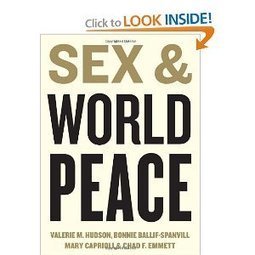
Sex and World Peace (9780231131827): Valerie M. Hudson, Bonnie Ballif-Spanvill, Mary Caprioli, Chad F. Emmett

I have not yet had the opportunity to read this book but feel that it touches on some of the core issues in geography today: gender, culture and political stability (plus, it’s just a great title).  The authors of Sex and World Peace explore the relationships between cultural norms regarding gender and political stability and war.  They show that security for women translates to security for the state. According to the authors, they “compare micro-level gender violence and macro-level state peacefulness in global settings…[and] mount a solid campaign against women’s systemic insecurity, which effectively unravels the security of all.”

Written by professors in geography, political science and psychology, Sex and World Peace is the synthesis of years of research produced by the WomanStats project.  For more about this ongoing project and the great database which they have produced (loaded with potential for student projects) see: http://womanstats.org/

Via www.amazon.com

U.S. Intelligence Says Water Shortages Threaten Stability

Via Scoop.itGeography Education

“Competition for increasingly scarce water in the next decade will fuel instability in regions such as South Asia and the Middle East that are important to U.S. national security, according to a U.S. intelligence report.”

Geographic thinking is about uncovering the spatial connections between issues that on the surface might not seem related.  Multinational river basins are a perfect example of environmental resources that demand international cooperation for successful management, and it regions of scarcity and population growth, it is easy to envision clashing viewpoints on how to fairly share such resources.

Discussion questions: What geographic themes are evident in this article? What geographic problems could exacerbate the problem? What could alleviate these issues in the future?

Via www.businessweek.com

The Political Geography of Gasoline Prices

Via Scoop.itGeography Education

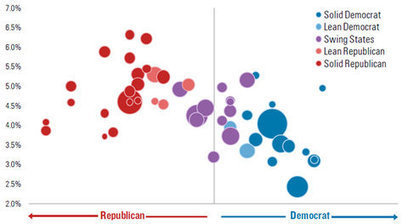
Rising gas prices make people unhappy, but the pain is felt most acutely in states where it is unlikely to make an electoral difference.

There are numerous geographic themes that make this article a worthwhile read.  The evidence suggests that states the vote more solidly Republican are being hit hardest at the pump.  Gasoline expenditures as a share of personal income are higher in pro-Republican states than pro-Democrat states.  Understanding the demographic base of each party as well as population density explains much of this issue: states that are very rural drive greater distances with less public transit option, spending more per capita on gasoline.  Also, since the most affluent urban centers are Democrat-leaning, they spend a less sizeable portion of their income on gasoline.  This article would be a nice resource for a classroom/small group discussion.

Via economix.blogs.nytimes.com

Jared Diamond: Why societies collapse

Via Scoop.itGeography Education

This talk (based on his controversial book, Collapse) explores the economic and environmental causes behind why a society that is overextended might collapse or recede from a golden age. Jared Diamond uses multiple historical examples such as classical Mayan civilization and Easter Island as well as modern societies such as Rwanda and Haiti, to argue that unsustainable management of the environmental resources might lead to short-term economic successes, but the environmental degradation may threaten the long-term economic viability of the economic system. This talk ties agricultural patterns, economic practices and political policies that can strengthen or weaken a society and the book looks to the past to assess the challenges of the present and future. This TED talk brings geographic concepts and spatial thinking to many of contemporary global issues.

Via www.youtube.com

No, a nation’s geography is not its destiny

Via Scoop.itGeography Education
One of the most widely accepted alternative theories of world inequality is the geography hypothesis, which claims that the great divide between rich and poor countries is created by geographical differences.

This article is an excerpt of the forthcoming book “Why Nations Fail” that should serve as an ideological counterweight to the book “Guns, Germs and Steel.”  The authors argue that the wealth of a country is most closely correlated with the degree to which the average person shares in the overall growth of its economy, meaning that political institutions are more relevant to economic success and development than physical geographic resources.

For more on this upcoming book and it’s hypothesis see this New York Times review.

Via blogs.reuters.com

Blog at WordPress.com.

Up ↑