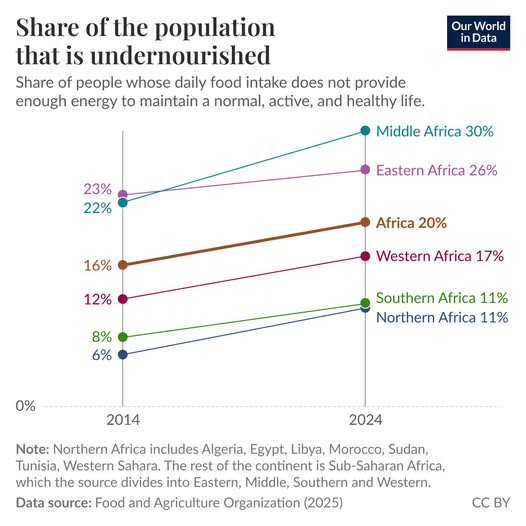
“Hunger levels have increased across Africa over the last decade—In every region of Africa, hunger is more prevalent than a decade ago.The chart shows the increase in the share of the population that is undernourished, comparing 2014 and 2024 (the most recent year available). These estimates come from the Food and Agriculture Organization of the United Nations.The situation across Africa is dire. In Middle Africa, where hunger is most acute, almost 1 in 3 people are undernourished. In Eastern Africa, the figure is roughly 1 in 4. Across Africa as a whole, it’s 1 in 5. This marks a reversal of a longer positive trend: over the preceding decades, hunger had been falling across much of the world, including parts of Africa. That progress has now stalled or gone into reverse. Conflict, extreme weather, and the economic disruption of the COVID-19 pandemic have all contributed.” SOURCE: by Esteban Ortiz-Ospina from OUR WORLD IN DATA
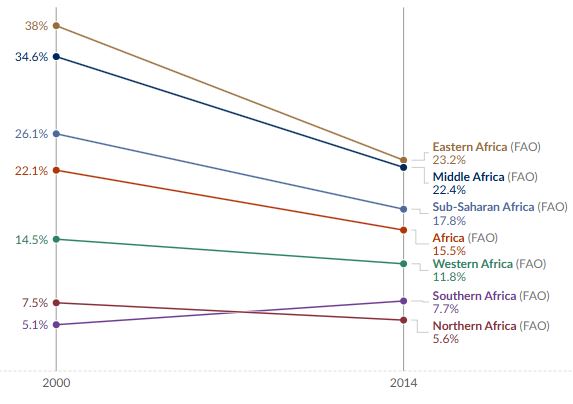
By many metrics, things are improving across the world, but it is important to not when they are not. What areas aren’t seeing improvements? In what ways are issues getting worse? For which populations and in which places are these issues most noticeable? These are questions geographers need to ask and the folks at Our World In Data are an invaluable resource for geography educators to not simply rely on what were learned back in college or narratives we hear in the news, but using current information about how the world actually is today. Hunger and nutrition from 2000-2014, most of Africa saw incredible progress, but since 2014, progress has stalled. Still better that than 2000-levels of hunger, but sustained progress is certainly a hope for the continent that is currently the least developed. What to learn why? Here is an article from Health Policy to explain these complex regional patterns that include economic, environmental, and political dynamics.
Tags: Africa, development, food.




Leave a comment