Search

GEOGRAPHY EDUCATION

Supporting geography educators everywhere with current digital resources.

Author

sethdixon

I am a geography professor at Rhode Island College.

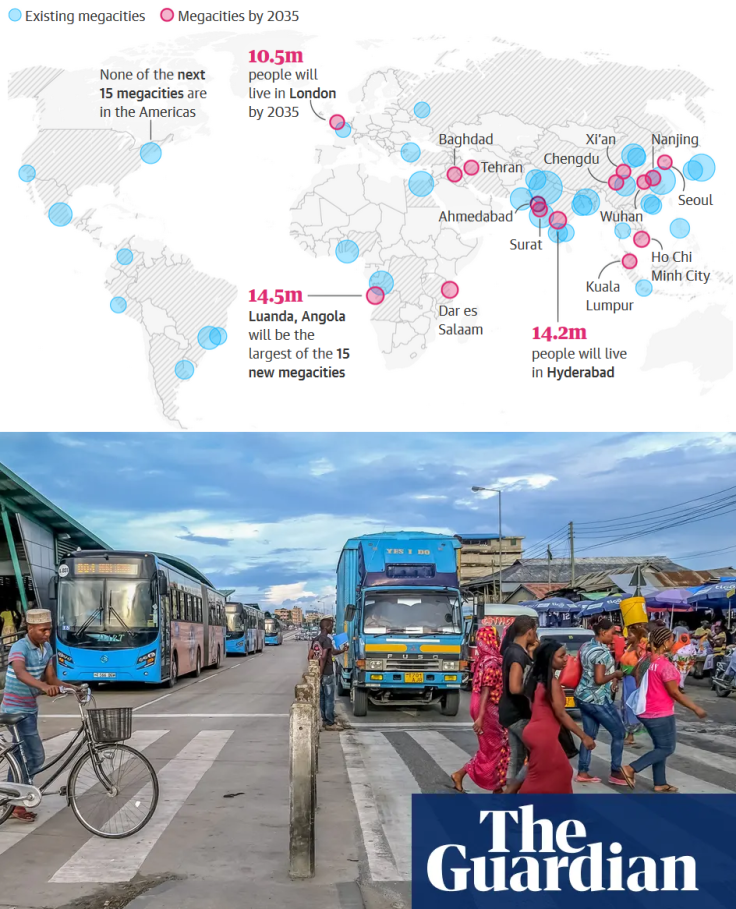
How an emerging African megacity cut commutes by two hours a day

The next 15 megacities #2: Could Dar es Salaam’s experiment with Africa’s first ‘gold standard’ bus rapid transit system offer an alternative to a future dependent on private cars?

Source: www.theguardian.com

This is a good article about the critical nature of transportation infrastructure to a growing city in the developing world.  More important than this one article, I want to highlight the entire Guardian series entitled "The Next 15 Megacities." 

In 1975 there were only 3 megacities (cities population over 10 million) in the world.  Today there are 33 megacities and by 2035, there are expected to be 48.  This acceleration is one of the more astounding and important facts about how the world is changing today. This series explores these emerging megacities that will have over 10 million by 2035; overwhelmingly these cities are in Asia.  


GeoEd Tags: Tanzania, Africa, urban, transportation, planning, megacities, regions, APHG.

Scoop.it Tags: Tanzania, Africa, urban, transportation, planning, megacities, regions, APHG.

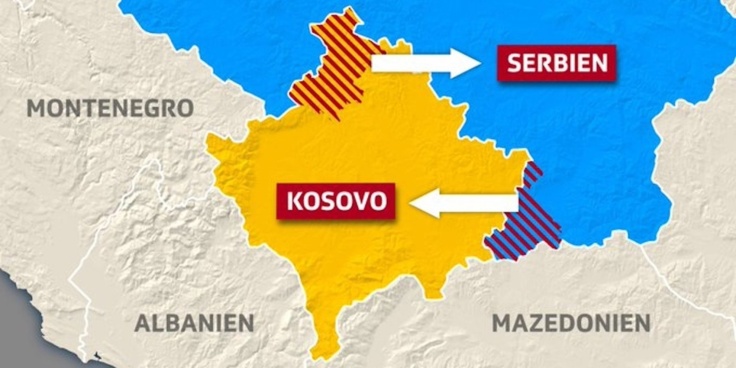
Kosovo-Serbia land swap could end conflict – or restart war

“A land swap proposal between Kosovo and Serbia could end the last ethnic conflict of the Yugoslav Wars, or it could reignite it. The proposal involves swapping Serbian-majority district of Mitrovica in north Kosovo, and the Albanian-majority Presevo Valley, in southwest Serbia. The deal excludes 6 Serbian-majority municipalities within Kosovo.”

Source: bigthink.com

Land swaps are about fixing problematic borders–and we know that the world is full of problematic, contentious, and disputed borders.  Yet land swap are incredibly rare because it upends the status quo.  A few years back Belgium and Netherlands swapped some land, but more often then not, calls to simply give land to another country just because the land appears to be controlled by the ‘wrong’ country usually go unanswered.  This proposed swap is especially intriguing because (to an objective outside observer) it could benefit both countries and lead to a mutual recognition of their shared border.  This BBC podcast explores local impacts and opinions about borders, ethnic identity, and place.  

GeoEd Tags: borders, political, territoriality, unit 4 political, Serbia, Kosovo, Europe.

Scoop.it Tags: borders, political, territoriality, unit 4 political, Serbia, Kosovo, Europe.

Language Warriors

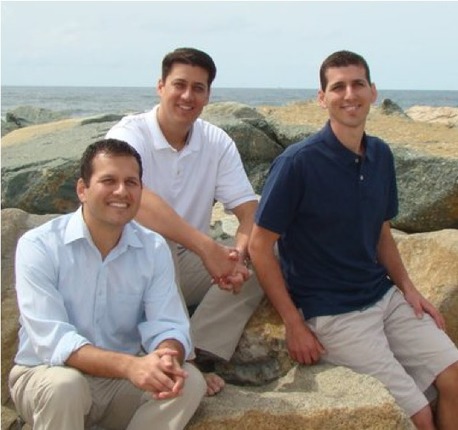
"The three Dixon brothers: one goes about teaching how geography influences global culture while another goes around the world teaching about how language learning improves global culture.  The smart one makes money."

Source: language-warriors.com

My brother recently he introduced me to his new online course, Learning How to Learn a Language (complete with a really fun book), as well as a companion website.  If you want to improve your language skills, you will find a lot of free resources on his Facebook group (just search Language Warriors) and his website. 


In fact, in the Our Story portion of the website, you get the story of what made me go back to grad school and eventually become a geography professor.  My brother, ever the storyteller, explains how this family story relates to the challenges of learning a language. 


As you fellow geographers know, learning a new language is a great way to explore the world.  For the next five days, he’s offering geography teachers a 60% discount on his online course and book by clicking here.  I’m loving this course so far and would love to hear about your experiences learning other languages. 

Spotify data shows how music preferences change with latitude

"The farther from the equator, the greater the seasonal swings."

Source: arstechnica.com

I’m not posting this in spite of its controversial nature—I am sharing this precisely because it raises eyebrows.  Many have read this and see elements of environmental determinism while simultaneous recognizing some of its core assumptions.  Arctic communities have devastatingly high suicide rates that most agree is in part impacted by the cold weather, the lack of sunshine, or in other words, the physical environment.


Questions to Ponder: How much environmental determinism actually is in this research and its assumptions?  How much does latitude impact the human condition?  How much of a factor is the environment in shaping cultural patterns?  How would you adapt to the physical environment if you lived north of the the Arctic Circle? 


GeoEd Tags: environment, musicArcticenvironment adapt, unit 1 geoprinciples.

Scoop.it Tags: environment, musicArctic, environment adapt, unit 1 GeoPrinciples.

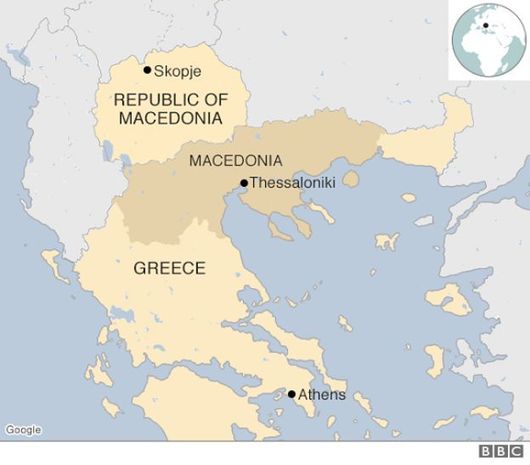
Macedonia signs NATO accession agreement

This comes after Greece backed a deal to rename its neighbour North Macedonia, ending a long row.

Source: www.bbc.com

Oh, what’s in a name?  National pride, fear of irredentist dreams, border disputes and supranational exclusion…that’s all.  Ever since the collapse of Yugoslavia, Greece has opposed an independent neighbor using the name "Macedonia" when they have an adjacent region of the same name.  This has be a point of contention, in part, over the historic memory of Alexander the Great and Hellenic grandeur which Greece feels have been wrongfully appropriated.  It is also regarding expansionist ambitions of a "greater Macedonia" so Greece has blocked Macedonia’s entry to NATO and the EU.  To appease Greece, lessen international strife, and gain greater access to the global community Macedonia approved this change, but this move has lead to internal strife as many Macedonians feel that this name change is unfair.           

GeoEd Tags: culture, Political, place, toponyms, historical.

Tagsculturepolitical, placetoponyms, historical.

The last Blockbuster: ‘I’m proud that we’ve survived’

“The company was founded in 1985 in Dallas, Texas, and it was worth billions of dollars at its peak, employing dozens of thousands of people. It was so popular across the US that, in 1989, a new store was opening every 17 hours. The rapid rise of digital services such as Netflix, which launched in 1999, and online retailers, like Amazon, made Blockbuster’s video and DVD business model practically obsolete.”

Source: www.bbc.co.uk

In my neighborhood, as in neighborhoods around America, there is an old Blockbuster building that is used to sell fireworks before the 4th of July and Halloween paraphernalia in October.  Most of the year however the property is a vacant lot where you might find police officers filling out their paperwork in the parking lot.  If video killed the radio star, Netflix killed the Blockbuster store.  Creative destruction leaves littered industries that, because of technological innovations, are no longer viable (if you want a deep dive into the demise of Blockbuster that goes beyond the obvious rise of streaming technology, this article by Retail Dive is solid).  

In addition to technological changes, some product shifts hint at societal and demographic changes (see this witty article about the demise of mayo). 

GeoEd TAGS: globalization, industry, economic.

Scoop.it Tags: globalizationindustry, economic.

Belize: A Spanish Accent in an English-Speaking Country

"BELIZE has long been a country of immigrants. British timber-cutters imported African slaves in the 18th century, and in the 1840s Mexican Mayans fled a civil war."

Source: www.economist.com

This is an older article (2012), but the pattern mentioned here is all the more relevant.  Belize has a much higher Human Development Index ranking that its Central American neighbors such as Guatemala.  That fact alone makes Belize a likely destination for migrants.  Given that Belize was ‘British Honduras’ during colonial times, English is (still) the official language, but that is changing as increasingly Spanish-speaking immigrants are changing the cultural profile of Belize.      

Petition calls for U.S. to give Northwest Angle to Canada

"There’s a petition that calls for the United States government to adjust the border near Manitoba to give Canada the geographic oddity known as the Northwest Angle."

Source: www.cbc.ca

Enclaves and exclaves are often bizarre examples that test the normal rules regarding the political organization of space.  Historical quirks, landform oddities, competing national goals, and irregular demographic patterns mean that the world is filled strange little case studies about places that seem to defy our normal expectations.  However, the most enduring rule seems to be this: never voluntarily give up territory that you can easily control. 


GeoEd TAGS: borders, politicalterritoriality, USA, Canada.

Scoop.it Tags: borders, politicalterritoriality, USACanada.

Beautiful Maps of the World’s Watersheds

Nothing is more fundamental to life than water – so see the world’s watersheds like never before with these colorful and absolutely stunning maps.

Source: www.visualcapitalist.com

I love the cartographic design of these three maps that shows the importance of river basins. In this one in particular, highlights the Danube and Volga river basins as the most extensive river basins in their regions. For countries in the Danube basin without a coastline, these fluvial connections are critical. The Volga river basin is enormous, but the fact that it flows into the Caspian Sea limits the natural advantage of this river system (this shows exactly why the Volga-Don Canal was such a massive project during the Soviet era).

Often we focus on political boundaries to define regions, but watersheds are natural ecological regions that shape transportation and trade connections.    


Scoop.it Tags: water, mapping, physical, fluvial, regions.

WordPress TAGS: water, mapping, physical, fluvial, regions.

Blog at WordPress.com.

Up ↑