Search

GEOGRAPHY EDUCATION

Supporting geography educators everywhere with current digital resources.

Category

Industrialization and Economic Development

What America Manufactures

Via Scoop.itGeography Education

“It’s a myth that the U.S. doesn’t make anything anymore.” 
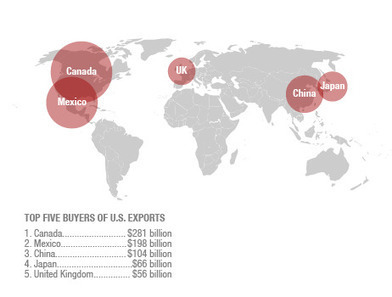
The U.S. economy still produces more through manufacturing tangible goods ($1.5 trillion) than it does in providing services ($600 billion) for the international market.  The maps and graphs in this article are great teaching materials.  The impact of NAFTA is shown powerfully in the regionalization of U.S. trade partners, making this salient material for a discussion on supranationalism as well.
Via www.npr.org


What March Madness Can Teach Us About the Economic Geography of Sports

Via Scoop.itGeography Education

The Atlantic Cities:  What exactly can account for the dominance of small and medium sized metros generally and college towns in particular in the economic…

While it is clear that superstar athletes in the professional ranks are concentrated in the largest cities, college athletics still let’s the ‘Davids’ compete with the ‘Goliaths.’  Interestingly, the largest cities don’t have the highest per capita concentration of athletes but many small college towns do.  Among the Top 25 cities with the highest concentration of athletes in the workforce (include scholarship athletes) we find South Bend, Indiana, home to Notre Dame; Auburn, Alabama, home to the university that bears its name; Ames, Iowa, home of Iowa State; Blacksburg, Virginia (Virginia Tech); Burlington, Vermont (University of Vermont); and Boulder, Colorado (University of Colorado).
Via www.theatlanticcities.com

America Is Stealing the World’s Doctors

Via Scoop.itGeography Education
Who wants to practice medicine in a country where they use power tools in surgery? The dilemma of doctors in the developing world.  

This article’s title is inflammatory, but it touches on some very real interconnected geographic issues.  Economic development in the many parts of the world is complicated by the migration issue of ‘brain drain.’  The individual choices that doctors from the less developed world face often lead the best and brightest workers to leave their home country.  If you could make a very good living as in the United States(the median salary of a surgeon in New Jersey is $216,000) or go back to your home country where your skills are more desperately needed (in Lusaka, Zambia a surgeon makes about $24,000 a year), which would you choose?  This is not a hypothetical example (nor one with only one right answer) but one rooted in a globalized economy, where the places that offer the greatest opportunities for individual advancement get the top talent–excellent for the individual and family economies but problematic at the national scale.
Via www.nytimes.com

Pass the Books. Hold the Oil.

Via Scoop.itGeography Education
Education is a better economic driver than a country’s natural resources.

This New York Times article is compelling fodder for a discussion on economic development.  While having natural resources on the surface sounds like the best valuable asset for a nation economy, why does Friedman argue that an abundance of natural resource can hurt the national economy?  While an educated workforce is obviously an asset, just how important is it compared to other factors?
Via www.nytimes.com

MDG drinking water target being met is cause for celebration

Via Scoop.itGeography Education
Sanjay Wijesekera: This achievement shows that where there is a will, it is possible to truly transform the lives of hundreds of millions of people for the better.  

The MDG (Millennial Development Goal) to cut the global population that does not have access to clean drinking water was cut in half, and five years ahead of schedule. The World Health Organization and the United Nations are very pleased with this achievement, but it is a timely reminder of the developmental problems of poverty and access that still exist. For example, 783 million people still do not have access to clean drinking water.  3,000 children die each day from diarrheal diseases (usually from bad drinking water and poor sanitation). Although some success should be celebrated, the world, in the currently constituted social, economic and political framework, still does not provide the most basic of requirements for a sizable portion of humanity.
Via www.guardian.co.uk

Create a free website or blog at WordPress.com.

Up ↑
