Search

GEOGRAPHY EDUCATION

Supporting geography educators everywhere with current digital resources.

Category

Scoop.it

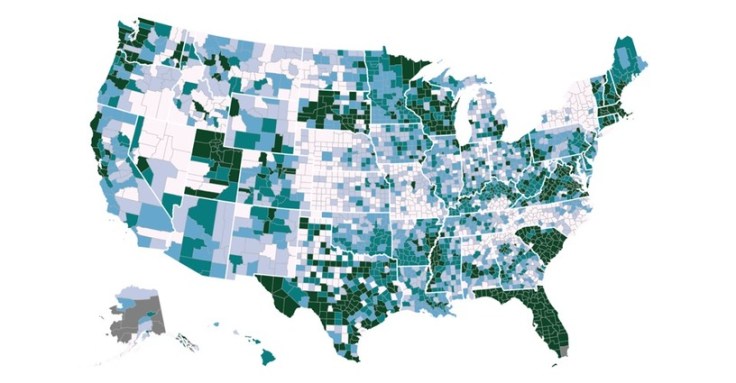
U.S. Counties Vary by Their Degree of Partisan Prejudice

A guide to the most—and least—politically open-minded counties in America

Source: www.theatlantic.com

I would like to start off by saying that I’ve lived in Red America and Blue America, and I love the people and places of both.  This is a fascinating set of maps because it isn’t just about where are the Republicans and Democrats–we’ve all seen those maps.  More important to to me is attempting to discern where people can still see their neighbors as neighbors, even if they strongly disagree politically.  "In general, the most politically intolerant Americans, according to the analysis, tend to be whiter, more highly educated, older, more urban, and more partisan themselves."


GeoEd TAGS: electoral,  political, mapping.

Scoop.it Tags: electoral, political, mapping.

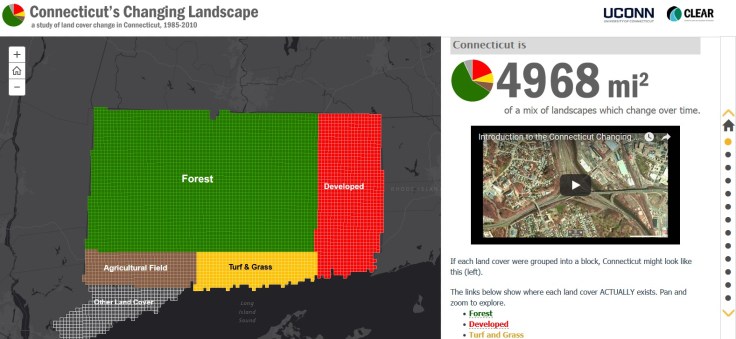
Connecticut’s Changing Landscape

“Changing Landscape is a remote sensing-based land cover study that charts landscape changes in Connecticut and portions of New York. It covers the 25-year period from 1985 to 2010 (with in-between dates of 1990, 1995, 2002 and 2006). It includes information on basic land cover, as well as subsidiary analyses of riparian corridor land cover, impervious cover and agricultural field and soil analysis.”

Source: clear3.uconn.edu

This story map, created with the Story Map Journal application in ArcGIS Online, is a great example of how to use the “Story Action” features.  Story Action features can move the map view to a particular location or change what is being displayed on the main stage of the story map.  These can also be used to navigate to a different section of the a story map.

Here are two excellent Story Maps that use “Story Action” features.  Please take some time to explore both of them and note how these features enhance the presentation of this spatial information:

  1. Connecticut’s Changing Landscape
  2. Damaged and Defiant: Houston Stories
  3. And just for fun, the Cross-Section of elevation along the meridians.

GeoEd TAGS: urban ecology, mapping, esri, storymap.

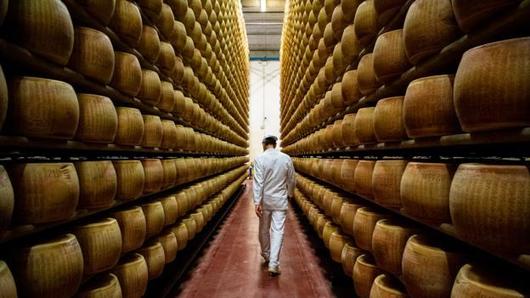
Italy’s practically perfect food

"Pound for pound, Parmigiano-Reggiano can compete with almost any food for calcium, amino acids, protein and vitamin A – and is prescribed by doctors to cure ailments."

Source: www.bbc.com

While this article focuses often on the nutritional aspects of Parmigiano-Reggiano, I want people to notice the understated importance of place and the cultural ethos surrounding the production of this product. True, it is an economic industry for the region, but it is also a defining cultural characteristic of the place and a way of life. The place makes the product and the product makes the place. 


GeoEd Tags: culture, place, Italy, Europe, food, food production, agriculture.

Scoop.it Tags: culture, place, ItalyEurope, regions, foodfood production, agriculture.

Gender and Mobility in the Middle East

"The adult daughter of Dubai’s ruler tried to escape a life of stultifying restrictions. She was captured at sea, forcibly taken back, and has not been heard from since. For all its megamalls, haute cuisine and dizzying skyscrapers, Dubai can flip at speed from international playground to repressive police state."

Source: www.nytimes.com

Both of these particular case studies are incredibly interesting but I want to talk about how this is connected to a larger cultural and political issue: that of female mobility in Persian Gulf countries.  The ability to move freely without familial supervision or approval is something that adults in most countries take for granted, but that is not the case in some countries in the Middle East.  How we experience place is dependent of our mobility—this is why there is no one singular geography or story of any given place, but there are many geographies that help to explain a place.  The story of the ‘vanished princess’ of Dubai and the woman seeking a divorce but trapped by her family cast a different light on the glamorous and glitzy reputation of the United Arab Emirates.    


GeoEd Tags: culture, cultural norms, gender, mobility, UAE, MiddleEast, political.

Scoop.it Tagsculture, cultural norms, gender, mobility, UAE, MiddleEast, political.

Why Asia is the center of the world again

"Asians don’t think of themselves as Asian, but as the new Silk Roads re-emerge and propel Asia to the center of the world economy, Asians are rediscovering their greatness and forging a new Asian identity for the 21st century."

Source: www.youtube.com

When discussing global economic growth, it is impossible not to mention Asia. Parag Khanna is the author of the book, The Future is Asian, and in this TED talk he highlights how Asia is growing.  More importantly, he looks at how discrete Asian cultures are becoming more intermixed as the economic infrastructure of Asia becomes increasingly interconnected (a summary article is titled, We are all Asians Now).  His 2009 TED talk, Mapping the Future of Countries, about border conflicts, is an APHG classic.       


GeoEd Tags: regions, political, globalization, culture, economic, TED, video.

Scoop.it Tags: regionspolitical, globalization, culture, economic, TED, video.

How an emerging African megacity cut commutes by two hours a day

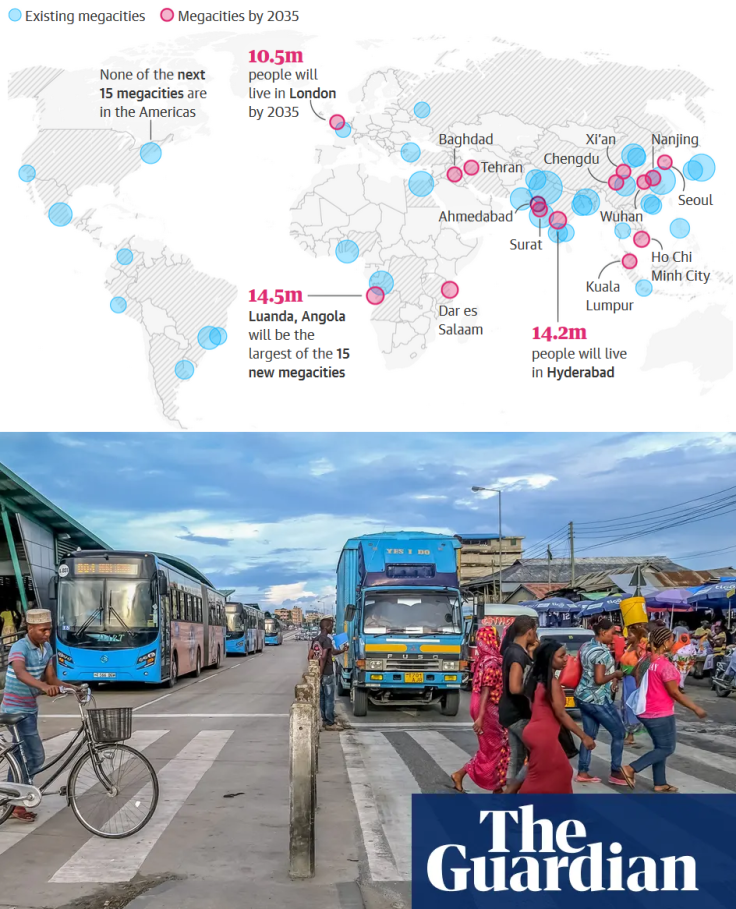
The next 15 megacities #2: Could Dar es Salaam’s experiment with Africa’s first ‘gold standard’ bus rapid transit system offer an alternative to a future dependent on private cars?

Source: www.theguardian.com

This is a good article about the critical nature of transportation infrastructure to a growing city in the developing world.  More important than this one article, I want to highlight the entire Guardian series entitled "The Next 15 Megacities." 

In 1975 there were only 3 megacities (cities population over 10 million) in the world.  Today there are 33 megacities and by 2035, there are expected to be 48.  This acceleration is one of the more astounding and important facts about how the world is changing today. This series explores these emerging megacities that will have over 10 million by 2035; overwhelmingly these cities are in Asia.  


GeoEd Tags: Tanzania, Africa, urban, transportation, planning, megacities, regions, APHG.

Scoop.it Tags: Tanzania, Africa, urban, transportation, planning, megacities, regions, APHG.

Kosovo-Serbia land swap could end conflict – or restart war

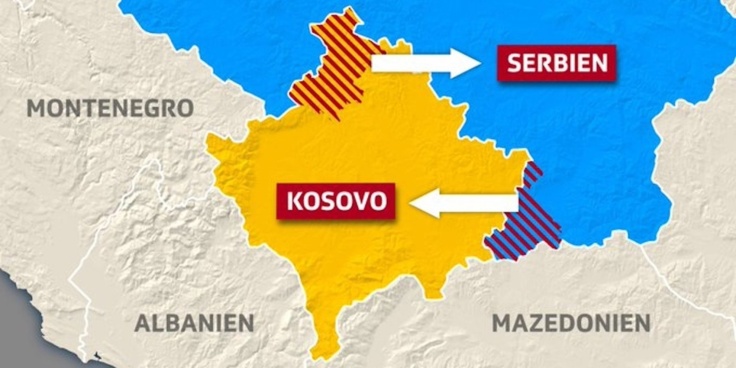
“A land swap proposal between Kosovo and Serbia could end the last ethnic conflict of the Yugoslav Wars, or it could reignite it. The proposal involves swapping Serbian-majority district of Mitrovica in north Kosovo, and the Albanian-majority Presevo Valley, in southwest Serbia. The deal excludes 6 Serbian-majority municipalities within Kosovo.”

Source: bigthink.com

Land swaps are about fixing problematic borders–and we know that the world is full of problematic, contentious, and disputed borders.  Yet land swap are incredibly rare because it upends the status quo.  A few years back Belgium and Netherlands swapped some land, but more often then not, calls to simply give land to another country just because the land appears to be controlled by the ‘wrong’ country usually go unanswered.  This proposed swap is especially intriguing because (to an objective outside observer) it could benefit both countries and lead to a mutual recognition of their shared border.  This BBC podcast explores local impacts and opinions about borders, ethnic identity, and place.  

GeoEd Tags: borders, political, territoriality, unit 4 political, Serbia, Kosovo, Europe.

Scoop.it Tags: borders, political, territoriality, unit 4 political, Serbia, Kosovo, Europe.

Language Warriors

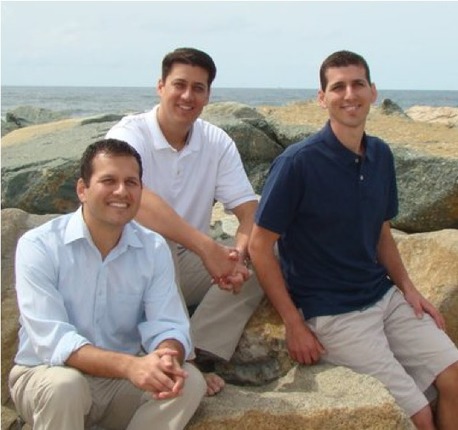
"The three Dixon brothers: one goes about teaching how geography influences global culture while another goes around the world teaching about how language learning improves global culture.  The smart one makes money."

Source: language-warriors.com

My brother recently he introduced me to his new online course, Learning How to Learn a Language (complete with a really fun book), as well as a companion website.  If you want to improve your language skills, you will find a lot of free resources on his Facebook group (just search Language Warriors) and his website. 


In fact, in the Our Story portion of the website, you get the story of what made me go back to grad school and eventually become a geography professor.  My brother, ever the storyteller, explains how this family story relates to the challenges of learning a language. 


As you fellow geographers know, learning a new language is a great way to explore the world.  For the next five days, he’s offering geography teachers a 60% discount on his online course and book by clicking here.  I’m loving this course so far and would love to hear about your experiences learning other languages. 

Spotify data shows how music preferences change with latitude

"The farther from the equator, the greater the seasonal swings."

Source: arstechnica.com

I’m not posting this in spite of its controversial nature—I am sharing this precisely because it raises eyebrows.  Many have read this and see elements of environmental determinism while simultaneous recognizing some of its core assumptions.  Arctic communities have devastatingly high suicide rates that most agree is in part impacted by the cold weather, the lack of sunshine, or in other words, the physical environment.


Questions to Ponder: How much environmental determinism actually is in this research and its assumptions?  How much does latitude impact the human condition?  How much of a factor is the environment in shaping cultural patterns?  How would you adapt to the physical environment if you lived north of the the Arctic Circle? 


GeoEd Tags: environment, musicArcticenvironment adapt, unit 1 geoprinciples.

Scoop.it Tags: environment, musicArctic, environment adapt, unit 1 GeoPrinciples.

Create a free website or blog at WordPress.com.

Up ↑