Search

GEOGRAPHY EDUCATION

Supporting geography educators everywhere with current digital resources.

Category

Uncategorized

Facts for Features: Irish-American Heritage Month (March) and St. Patrick’s Day

“Originally a religious holiday to honor St. Patrick, who introduced Christianity to Ireland in the fifth century, St. Patrick’s Day has evolved into a celebration for all things Irish. The world’s first St. Patrick’s Day parade occurred on March 17, 1762, in New York City, featuring Irish soldiers serving in the English military. This parade became an annual event, with President Truman attending in 1948. Congress proclaimed March as Irish-American Heritage Month in 1995, and the President issues a proclamation commemorating the occasion each year.”

See on www.census.gov

Go West, Young People! And East!

Every college in America should make it a requirement to study abroad. Why study Spanish in a classroom in Indiana when you could learn it in Bolivia?

Seth Dixon‘s insight:

This NY Times article by Nicholas Kristof highlights of the several reasons why I’m a proponent of study abroad programs as a way to help students to globalize their educational experiences.  At Rhode Island College I’m proud to work on the Shinn Study Abroad Committee  which is dedicated to giving more students the opportunities to make the world their campus. 

See on www.nytimes.com

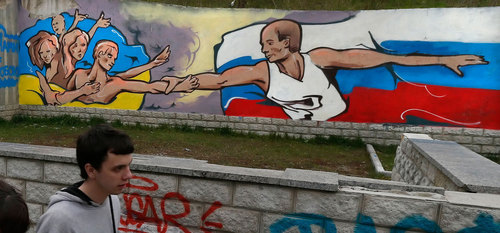
Exit polls show Crimea votes for secession

Russian media says exit polls show 93 percent of voters elected to join Russia, in a move the West deems illegal.

See on www.aljazeera.com

Exit polls show Crimea votes for secession

Russian media says exit polls show 93 percent of voters elected to join Russia, in a move the West deems illegal.

See on www.aljazeera.com

Where Each City’s Uninsured Live

Insured people are all alike, but uninsured people are uninsured for their own reasons.

It can be tempting to think of ‘the uninsured’ as the poorest of the poor. But that’s not entirely the case. While people living below the poverty line are the most likely to be without health insurance, 28 percent of people who make between 100 and 200 percent of poverty level (up to about $23,340) lack coverage, as do 15 percent of those who make between 200 and 400 percent (up to about $46,700).

These maps, created by Kevin Johnson and used here with permission, show where people not covered by either private or public insurance live in each city. Johnson used the 2012 American Community Survey; higher uninsured rates are represented by red and orange colors.

See on www.theatlantic.com

How was the AIDS epidemic reversed?

“The breakthrough came in 1996, when a new class of antiretroviral drug called protease inhibitors was launched. These were used in combination with two older drugs that worked in different ways. The combination meant that evolving resistance required the simultaneous appearance of several beneficial (from the virus’s point of view) mutationswhich is improbable.  With a viable treatment available, political action became more realistic. AIDS had been a “political” disease from the beginning, because a lot of the early victims were middle-class gay Americans, a group already politically active. Activists were split between those who favoured treating people already infected and those who wanted to stop new infections. The latter were more concerned to preach the message of safe sex and make condoms widely available, so that people could practise what was preached. Gradually, however, activists on both sides realised that the drugs, by almost abolishing the virus from a sufferer’s body, also render him unlikely to pass it on. They are, in other words, a dual-use technology.”

Seth Dixon‘s insight:

See on www.economist.com

The Surprising Lessons of the ‘Muslim Hipsters’ Backlash

I made a music video to share my own story as a Muslim woman in America. In doing so, I was expected to share every other Muslim woman’s story, too.

Seth Dixon‘s insight:

This is one reason why I try to avoid terms like “the Geography of North America.”  The geography of North America for this author is not identical to mine even if we might be occupying the same spaces.  Our experiences and networks are shaped by ethnicity, class, gender and other markers of identity; we occupy overlaying and interrelated geographies.  This article is an interesting read about overlapping cultural identities as global lives continue to weave a fascinating cultural tapestry.  There isn’t one singular “Geography” with a capital G of any given place, but many geographies.  

Tags: gender, popular cultureUSA, globalization, culture, Islam.

See on www.theatlantic.com

Interactive Wind Map

Mesmerizing.

Seth Dixon‘s insight:

Earlier I shared a dynamic map of near-live wind data for the United States and a static rendering of global wind patterns.  This interactive combines the features of both of those resources to provide a mesmerizing digital globe.  Click on the ‘map to zoom in and to spin the globe.  In addition to this tremendous digital globe, this link offers 11 tangible examples of how to use this and the patterns that it reveals.

See on www.policymic.com

Wind

For Ukraine, Losing Crimea Might be No Loss

By the end of this month, it is likely that Vladimir Putin’s Russia will fully control Ukraine’s Crimean peninsula. And it is clear that he aspires to much more.

Seth Dixon‘s insight:

According to this article, Ukraine will be fine economically with Crimea being pinched off, but Crimea and Russia would suffer from an annexation

See on www.foreignaffairs.com

Create a free website or blog at WordPress.com.

Up ↑