Search

GEOGRAPHY EDUCATION

Supporting geography educators everywhere with current digital resources.

Category

Uncategorized

South Sudan factional fighting leaves hundreds feared dead

“Two days of street battles between rival factions in South Sudan‘s army left parts of the capital in ruins and prompted fears of a bloodbath in the world’s youngest country.

UN officials in New York said they had received reports from local sources indicating that between 400 and 500 people had been killed and up to 800 wounded. More than 16,000 people were seeking refuge at UN facilities. What began on Sunday night as an alleged coup attempt now threatens to widen deep ethnic divisions in a country awash with weapons and still recovering from a devastating war that led to its secession from the north in 2011.”

Seth Dixon‘s insight:

Earlier in the semester we discussed how difficult it is to establish a new country in a region with political and economic instabilty.  This is only further complicated by the presence of factional rivalries.  It’s a tragedy that these problems are being played out.  

Tags: South Sudanpolitical, Africa, states.

See on www.theguardian.com

In Florida, A Turf War Blooms Over Front-Yard Vegetable Gardening

A woman in Miami Shores is suing after her town insisted she remove vegetables from her garden.

Seth Dixon‘s insight:

This podcast highlights the political governance issues surrounding urban agriculture. 

See on www.npr.org

Rare snow storm hits Middle East

A rare snow storm hit the Middle East last week, producing record snows and extreme conditions for Syrian refugees.

Seth Dixon‘s insight:

Jerusalem recorded 15-20 inched of snow, while Cairo received it’s first snow in 112 years.  Just because something is rare or unlikely doesn’t mean that it can’t happen.  See this snowstorm as documented by satellite imagery here.    

See on earthsky.org

IsraelSnow

Geographic Midpoint Calculator, Find Your Personal Center of Gravity

Finds the exact point that lies halfway between two or more places. Find your personal center of gravity–the geographic average location for all of the places you have lived in.

Seth Dixon‘s insight:

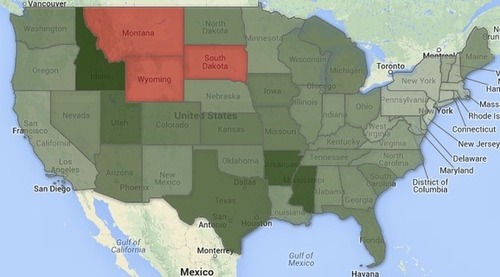
This is a fun tool to make geographic analysis very personal.  You can also weight the importance of the locations based on the number of years stayed at a location.   For example, the map above is unweighted, but the map below reflects that most of my life was in the Western part of the United States.

See on www.geomidpoint.com

Updated

Concentrations of Wealth and Poverty

Seth Dixon‘s insight:

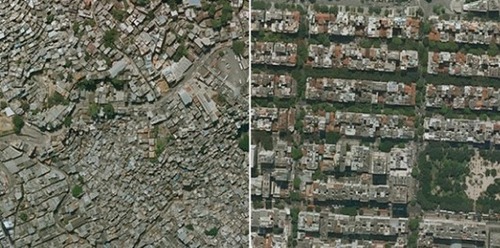
In this map, all Zip codes with more than 500 people are ranked from 0 to 99 based on household income and education.  The ‘Super Zips’ rank 95 or higher. The map at the top shows the highest concentration of the nation’s 650 Super Zips. The typical household income in a Super Zip is $120,272, and 68 percent of adults hold college degrees. That compares with $53,962 and 27 percent in the other zips mapped.  Washington D.C. shows a powerful bifurcation: One-third of Zip codes in the D.C. area are considered ‘Super Zips’ for wealth and education and large swaths of the metropolitan area are considered food deserts.

This weekend I had the privilege essentially flying from Boston to Washington DC at night and was mesmerized by the vast urban expanse beneath me.  It was the greatest concentration of wealth in the United States as well as the some of the most blighted regions of the country.  What explains the spatial patterns of highly concentrated wealth and poverty in the biggest cities?  Are cities a causal factor in wealth and poverty creation?  What does this zip code data tell us? What accounts for the spatial patterns in your region?    

Tags: Washington DC, urban, unit 7 cities.housing, economic, povertyplace, socioeconomic, neighborhood.

See on www.washingtonpost.com

All the Countries That Contribute to a Single Jar of Nutella

nutella-mapTurkish hazelnuts, Malaysian palm oil, Nigerian cocoa, Brazilian sugar, French vanilla…

Some 250,000 tons of Nutella are now sold across 75 countries around the world every year, according to the OECD. Nutella is a perfect example of what globalization has meant for popular foodstuffs: Not only is it sold everywhere, but its ingredients are sourced from all over the place too.

See on www.theatlantic.com

Landsat Satellite Looks Back at El Paso, Forward to a New Mission

“Landsat has seen a lot in its day. In one spot of desert, where the Rio Grande marks the border between the United States and Mexico, the satellite program captured hundreds of images of fields turning green with the season, new developments expanding from El Paso, Texas, and clouds moving over the neighboring mountains.”

Seth Dixon‘s insight:

Since I have family on both sides of this line, I’ve always be fascinated by the U.S.-Mexico border as a cultural, political and economic phenomenon.  Ciudad Juárez/El Paso are examples of ‘twin cities’ that form along the border and in many ways are one metropolitan area that has been brought together by the interactions available at the border; at the same time this regions is highly divided by spatial governance policies.  Click here to download high resolution images El Paso/Ciudad Juárez.

See on www.youtube.com

elpaso_oli_2013141

The Container that Moves the Global Economy

The unsung hero of the global economy: the shipping container.

Seth Dixon‘s insight:

NPR’s Planet Money has produced an 8-part series following the commodity chain of the T-Shirt.  This series explores cotton production, textile mills, sweatshops, outsourcing and in this podcast, the transportation infrastructure that moves goods globally.  This podcast touches on the same topic as one of my favorite TED talks, how containerization enabled globalization.


Tagstransportation, industry, economic, globalization, technology, podcast.

See on www.npr.org

Ukraine: To Face Europe or Russia?

“This map illustrates the country’s deep division – and why the protests might not be what you think. Ukraine has been wracked by protests for two-plus weeks over President Viktor Yanukovych’s decision to reject a deal for closer integration with the European Union. Russian President Vladimir Putin had been pressuring Yanukovych to quit the EU deal and join with a Moscow-led trade union of former Soviet states instead. Will Ukraine’s future be with Russia or with Europe?”

Seth Dixon‘s insight:

The country of Ukraine is both ethnically and linguistically divided and since the fall of the Soviet Union, the partisan politics have mirrored these divisions.  The northwestern portion of the country is primarily ethnic Ukrainian and with the majority speaking Ukrainian.  This section of the country that is hoping to strengthen economic and political ties with the EU and face Europe; those that aren’t as bullish on the EU here at least want to explore other options so they aren’t overpowered by Moscow’s shadow.  The southeastern portion of Ukraine primarily speaks Russian with sizeable ethnic Russian populations (although many ethnic Ukrainians speak Russian here); not surprisingly, this is the part of the country that  would rather join in a economic union with Russia and other former Soviet Republics, or at least not turn their backs on Moscow. 


Questions to Ponder: Why are language and ethnicity often tied to political orientation?  Why might trading with all economic partners not be as viable an option?

See on www.washingtonpost.com

Create a free website or blog at WordPress.com.

Up ↑