Search

GEOGRAPHY EDUCATION

Supporting geography educators everywhere with current digital resources.

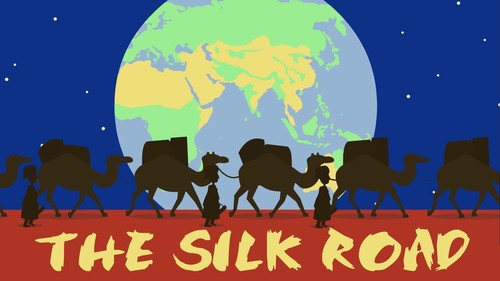
The Silk Road: Connecting the ancient world through trade

See on Scoop.itGeography Education

“With modern technology, a global exchange of goods and ideas can happen at the click of a button. But what about 2,000 years ago? Shannon Harris Castelo unfolds the history of the 5,000-mile Silk Road, a network of multiple routes that used the common language of commerce to connect the world’s major settlements, thread by thread.”

Seth Dixon‘s insight:

This TED-ED lesson was produced in part by an AP Human Geography teacher and the strands of geographic thought in this video are evident.  More geographers should make their own TED ED lessons; thanks for blazing the trail Shannon! 


Tags: TED, worldwide, transportation, globalization, diffusion, historical, and video.

See on www.youtube.com
The Putin Factor: Russia, America and the Geopolitics of Ukraine

See on Scoop.itGeography Education

“President Obama came into office promising a ‘reset’ in U.S.-Russia relations. Six years later, the reset, for all intents and purposes, is dead.”

Seth Dixon‘s insight:

A more informed, globally aware citizenry helps to strengthen U.S. foreign policy and diplomatic efforts; we need citizens with a spatial framework within which to organize political, environmental, cultural and economic information.  This interview with political science professor Michael McFaul is a great introduction to understanding Russia, Putin and today’s most pressing geopolitical issue.    


Tags: Russia, Ukraine, geopoliticspolitical.

See on www.pbs.org

Urbanization and the evolution of cities across 10,000 years


See on Scoop.itGeography Education

“About 10,000 years ago, hunter-gatherers, aided by rudimentary agriculture, moved to semi-permanent villages and never looked back. With further developments came food surpluses, leading to commerce, specialization and, many years later with the Industrial Revolution, the modern city. Vance Kite plots our urban past and how we can expect future cities to adapt to our growing populations.”

Seth Dixon‘s insight:

This TED-ED lesson briefly summarizes the history of urban development and the technological advances that enable it.  Towards the end of the video they offer some suggestions that would make cities more sustainable as urban populations continue to grow.  What do you think of these suggestions?  

Tags: historical, urban, planning, TED

See on www.youtube.com

Disruptive Demographics

Disruptive Demographics (James H. Johnson Jr, June 2013) from National Entrepreneur Center on Vimeo.

  Last night I had the pleasure of attending a tremendously entertaining and incredibly informative professional development evening at the APHG reading (that isn’t an easy combination to pull of either, and he did marvelously). Dr. James Johnson is a trained geographer teaching in the School of Business at the University of North Carolina.  His talk, entitled “Disruptive Demographics: Implications for Global Competitiveness” (PDF file available here) follows in a tradition of superb presentation at the reading; in 2012, Roger Downs gave a great professional development presentation on geographic expertise


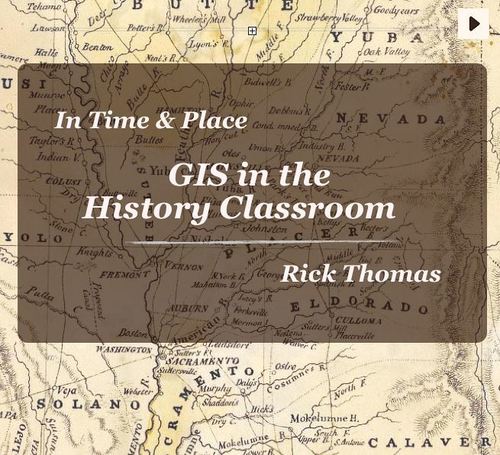
GIS in the History Classroom

See on Scoop.itGeography Education

“I have had a number of requests for copies of GIS in the History Classroom in a format other than iBooks. I have just completed an internet version of the book that works on Safari, Firefox, Chrome, and Internet Explorer.”

Seth Dixon‘s insight:

GIS is not just for geography classes; spatial thinking and spatial data management can help students learn a variety of subjects including history.  This free ebook will help history teachers to see how to unlock the power of Geographic Information Systems. 

Tagsmappinghistorical, GIS, geospatial, edtech.

See on www.intimeandplace.org

National Parks: America’s Greatest Classrooms

See on Scoop.itGeography Education

“The National Park Service has a new website, designed just for educators.  This short video showcases how teachers can use this website in the classroom.”  www.nps.gov/teachers

Seth Dixon‘s insight:

Field Trips in a National Park can be an incredible experience in a outstanding learning environment.  The National Park Service has produced many lesson plans, videos, distant learning programs, and resources for teachers to give them opportunities to experience the National Parks online.  These resources are available for a wide range of subjects and grade levels.  Where is the nearest U.S. National Park to your community?     

See on www.youtube.com

Colorado River Reaches the Sea of Cortez

See on Scoop.itGeography Education

“When the Minute 319 ‘pulse flow’ began in March 2014, it was not clear whether the effort would be enough to reconnect the Colorado River with the Sea of Cortez. Some hydrologists thought there might be just enough water; others were less optimistic. It turns out the optimists were right, though just barely. For the first time in sixteen years, the Colorado River was reunited with the Sea of Cortez on May 15, 2014.”

Seth Dixon‘s insight:

California has had three consecutive years of below average rainfall and most reservoirs are far below their designed capacity; amid a drought this severe and wildfires, it is startling to hear of a project to restore some of the Colorado River Basin’s natural patterns and ecology.  


Tags: physicalremote sensing, California, water, environmenturban ecology.

See on earthobservatory.nasa.gov

APHG Reading Newsletters

Newsletter Banner

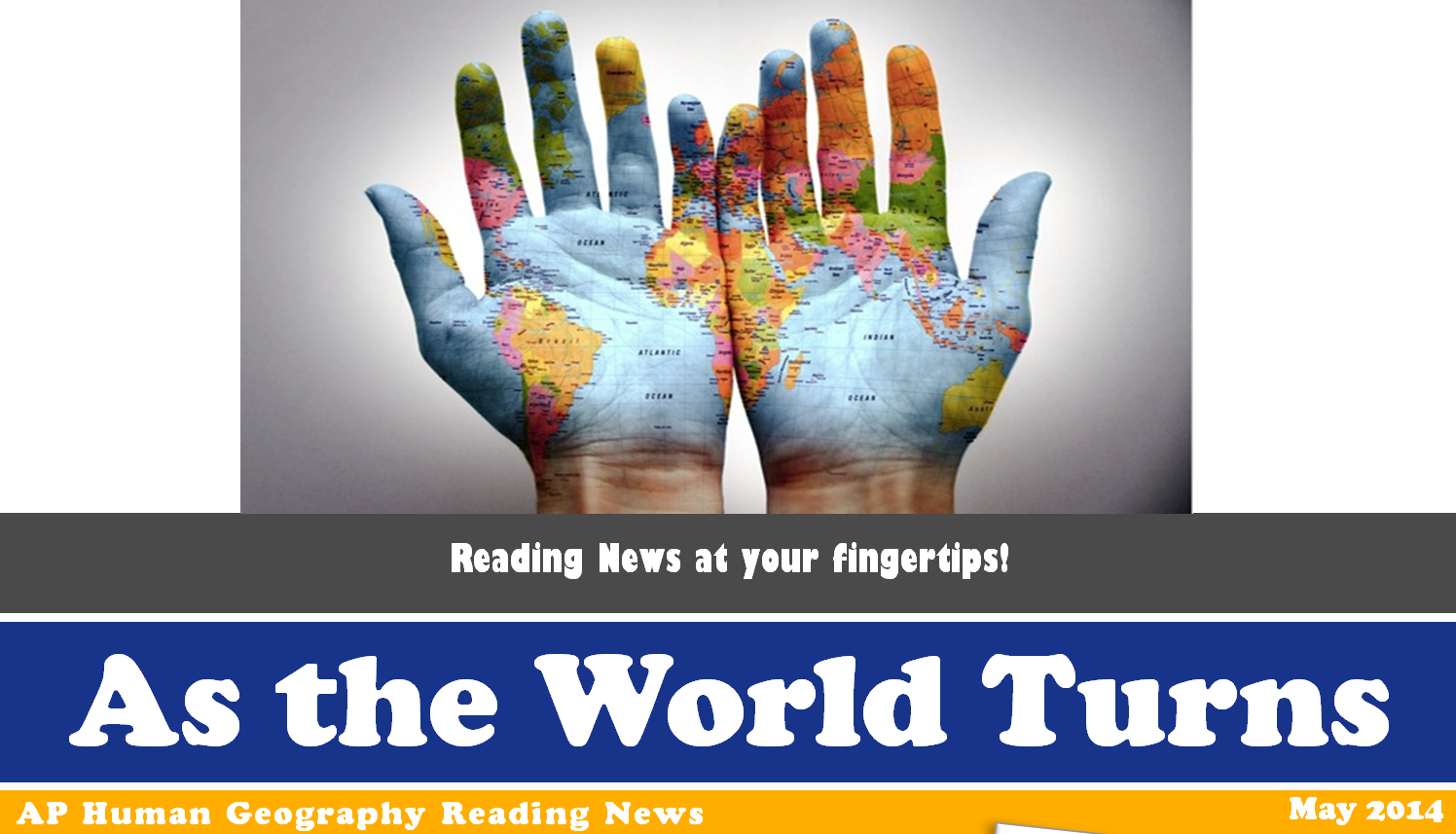
This week I am in Cincinnati, OH, scoring the AP Human Geography exams.  Many gathered together and shared some of their favorite classroom resources (Reader Resources:this 4-page document is a compilation of these suggestions).  Also you can find copies of the digital newsletters that are intended for the AP readers to know about the upcoming events.  

I also am teaching in Elmhurst College’s Graduate Certificate Program in Human Geography for AP.  They have recently announced some changes that will make it much more accessible and applicable for teachers.  They have added a Master’s Program in Applied Geospatial Sciences with Concentration in Human Geography as well as a non-credit (read, cheaper) option for the courses in the program as well.  Look into it!

Earthview APHG newsletter


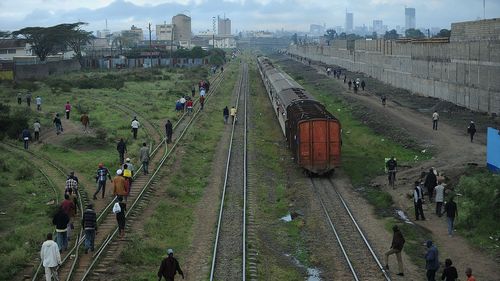
China Turns To Africa For Resources, Jobs And Future Customers

See on Scoop.itGeography Education

In China’s Second Continent, Howard French explores the Chinese presence in 15 African countries. The relationship goes beyond economics: more than a million Chinese citizens have migrated to Africa.

He says there’s a debate about the long-term consequences of China’s push into the African continent: Will it create development and prosperity, or will it lead to exploitation reminiscent of 19th-century European colonialism?


Tags: Africa, development, China, industry, economic, podcast.

Seth Dixon‘s insight:

This is an excellent podcast with many geographic strands running through it. 

See on www.npr.org

Blog at WordPress.com.

Up ↑