Search

GEOGRAPHY EDUCATION

Supporting geography educators everywhere with current digital resources.

San Diego

WELCOME HOME TIMELAPSE from Michael Shainblum on Vimeo.

Ever since I was a kid, I have always been mesmerized by extraordinary beauty of my hometown, San Diego. The city has many hidden treasures that have always captivated…

Seth Dixon‘s insight:

While there are wildfires raging in northern San Diego county (see interactive map), my heart goes out to family and friends there.  The recent drought in California makes the condition perfect for wildfires to spread.  This video is a nice glimpse of San Diego during better times.  

Tags:  weather and climate, California, water, environment, urban ecology.

See on vimeo.com

Brazilian Geography Lessons

“The thing about football – the important thing about football -is that it is not just about football.”

Seth Dixon‘s insight:

They eyes of the world will be turning to Brazil next month as the World Cup will be played in this South American country.  This is a perfect opportunity to pounce on student interest and teach them about Brazil, the urban geography and politics of hosting a major event such as this.  Follow the link for some lessons bound to garner student interest.  


Tags: sport, Brazil, South America.

See on www.geographypods.com

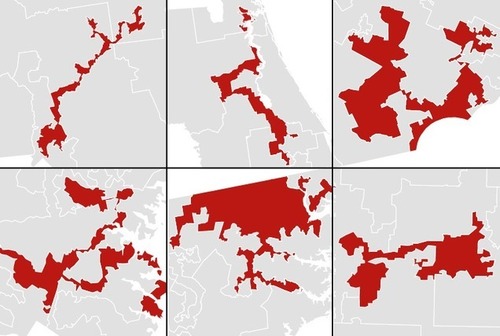
America’s most gerrymandered congressional districts

A brief overview of crimes against geography in the 113th Congress.

Seth Dixon‘s insight:

Redistricting today has become a common tool in American politics.  Every ten years with the new census, political parties seize the opportunity to maximize their political influence by trying to minimize the ‘demographic and spatial limitations’ of their particular voting bloc.      


Tags: gerrymandering, political, mapping, census, unit 4 political.

See on www.washingtonpost.com

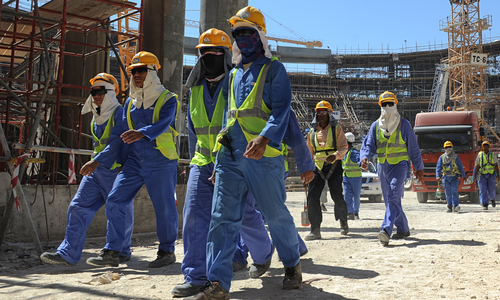
Qatar government admits almost 1,000 fatalities among migrant workers

Report details deaths of 964 workers from Nepal, India and Bangladesh from cardiac arrests, falls and suicide


Seth Dixon‘s insight:

Qatar’s population pyramid has a very distinct shape that you will only find in places with high migrant worker populations.  This type of demographic influx is now common in oil-rich gulf states as the forces of globalization draw in pools of labor so countries like Qatar can now ‘import’ the low-wage workers needed to keep their economy rolling.  The economic, cultural and political power imbalance  between the classes leads to many migrant workers being exploited, leading to the social problems listed in this article.     


Tags: Middle East, Qatar, globalization, migration, economic, labor.

See on www.theguardian.com

The Habitable Planet

“The Habitable Planet is a multimedia course for high school teachers and adult learners interested in studying environmental science. The Web site provides access to course content and activities developed by leading scientists and researchers in the field.”

Seth Dixon‘s insight:

Much like the Power of Place resources were created by Annenberg Learner to share World Regional Geography videos, the Habitable Planet has diverse resources for Physical Geography and Environmental Science.  In essence, it is an excellent free online textbook.   

Tags: textbook, environment, physical.

See on www.learner.org

Geographic Perspective Matters in Policy Debates

“The American policymaking sphere has long been dominated by political scientists and economists. While I have nothing against these disciplines, and acknowledge that they have made important contributions to our public discourse, I am also concerned that we have not always heard the full range of perspectives on important questions of the day.  Geography has a different perspective to offer, and our public discourse is impoverished without it.“

Seth Dixon‘s insight:

Spatial thinking needs to be infused into many of our public conversations, and geographers collectively need to find ways to be a part of them.

See on mn2020.org

France to redraw nation’s map to save money

“France’s administrative regions — Normandy, Alsace, Burgundy, etc. — have long been part of the identity of citizens of this diverse country. Now, merging some of them is seen as a logical way to save money on bureaucracy, and the French support it — as long as it’s someone else’s turf.”

Seth Dixon‘s insight:

This is an interesting concept that shows the divergence between national and regional identities.  68% of French citizens recognize that consolidating regional administration will be economically more efficient at the national level; however 77% don’t want to see the elimination of their own local region.   The formation of place-based identities operate an multiple scales.  How would you feel if your state was absorbed by a neighboring state?  How come? 

Tags: community, place, governance, France.

See on bigstory.ap.org

Alluvial Fans

See on Scoop.it – Geography Education

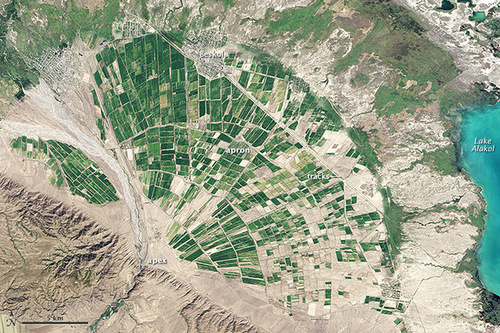
When streams emerge from mountains, they often spread out and deposit sediment in a distinctive pattern known as an alluvial fan.

Seth Dixon‘s insight:

In dry areas of interior drainage (such as Central Asia and the Great Basin in the U.S.), the human settlements are often clustered along the foothills of the mountains near landforms called alluvial fans.  Take time to analyze this image (and this one as well); in alluvial fans and the agricultural patterns that people create on them, we can see some striking geometric and spatial configurations that show how human settlements are highly dependent of the physical environment.   


Tags: spatial, remote sensing, geospatial, Kazakhstan, Central Asia, landscape.

See on earthobservatory.nasa.gov

Territorial Disputes in the Waters Near China

See on Scoop.it – Geography Education

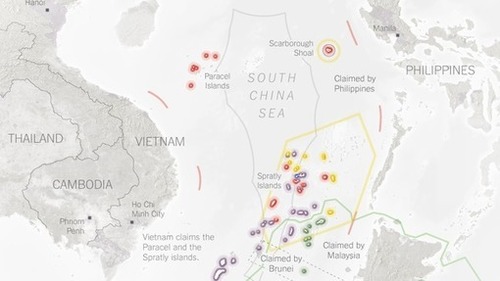
China has recently increased its pursuit of territorial claims in nearby seas, leading to tense exchanges with neighboring countries. A map of some of the most notable disputes.

Seth Dixon‘s insight:

Many of the geopolitical conflicts in the East Pacific have their roots in the territorial disputes over islands that at first glance seem as if they wouldn’t be worth the trouble.  However, since the the UNCLOS agreement gives countries 200 nautical miles off their coasts to be an Exclusive Economic Zone, that greatly enhanced the strategic value of controlling these islands.  This interactive map briefly highlights some of the details behind the conflicts with links for further readings.  


Questions to Ponder: Why do countries care so much about some minor islands?  Why would other countries not want to accept China’s territorial assertions?  Experts are saying that Chinese-Japanese relations are as bad as they’ve been since the end of World War II–Why all the commotion? 


Tags: borders, political, conflict, China, East Asia.

See on www.nytimes.com

Blog at WordPress.com.

Up ↑