Search

GEOGRAPHY EDUCATION

Supporting geography educators everywhere with current digital resources.

Louisiana in Tough Shape

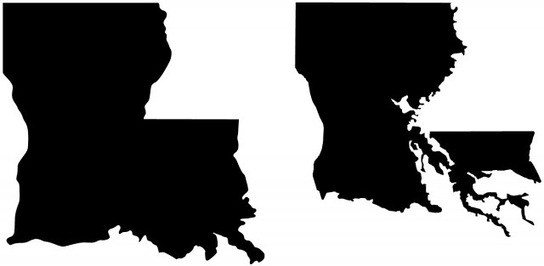
Unlike the many maps we have seen that show what Florida, Boston, or some other coastal location would look like with higher sea levels, the figure above compares the iconic outline of Louisiana with the present-day outline of its dry land. An important caveat is that some of the removed areas are wetlands, meaning they are not under water all the time, but those lands are not available for most human uses (aside from fishing), so this outline warrants attention.

Source: environmentalgeography.blogspot.com

Last month I was in New Orleans, Louisiana and I’m so disheartened to know that thousands have their homes under water.  As stated in this article, “the boot is at best an inaccurate approximation of Louisiana’s true shape and, at worst, an irresponsible lie.”  To explore the issue yourself, this gorgeous interactive map pulls together some high quality source materials on a wide range of issues to look at this environmental issues of this region in a holistic manner.


Tags: environmentweather and climatecoastal, water, disasters

Ethiopian runner makes protest sign as he crosses line in Rio

Feyisa Lilesa crosses his arms as he wins a silver medal – a gesture used by his Oromo people at home to protest against the government.

Source: www.bbc.com

The Olympics can bring to interesting cultural and political issues to a larger international audience.  The Oromo people in Ethiopia are off our collective radar, but this marathoner made the world pay attention and start to ask questions about a part of the world that rarely gets global attention.  Some other examples of how you can link students’ interest in the Olympics to expand their understanding about the world include:

What was your favorite ‘teaching moment’ from the Olympics?

Tags:  political, conflict, sport.

The rise of the Asian megacity (and why ‘metacities’ are the next big thing)

“Asia’s rapid urbanisation is changing the very shape and nature of what we think of as a city.  It’s not just the rapid increase in their numbers or their sheer size that makes these megacities fascinating. They look, feel and behave differently, too.”

Source: www.scmp.com

The term megacity (a city with a population greater than 10 million) has been around for a while and there wasn’t much linguistic need to describe something bigger.  Today, most megacities are more like Lagos and Mumbai, places of extreme wealth asymmetries than the global cities of New York City and London.  Some are now using the term metacity to describe cities with populations of 20 million.  Asian metacities are a good place to start thinking about the largest urban regions that are increasingly dominating economic, political and cultural affairs.      


Tags: urbanmegacitiesEast Asia.

Interactive Climate Map

“Obsessed as we are with cartography we in Staridas Geography perceive any aspect of the actual 3D World as a constant opportunity for another pretty map creation!”

Source: staridasgeo.maps.arcgis.com

This is a great interactive map of the world’s climate zones. 


Tags: ESRIStoryMapedtech, GIS, mapping, cartographyphysical.

Do You Know The Outline of These Countries?

Can you spot the real outline from the fake?..

Source: www.buzzfeed.com

This is just for fun…The borders/coastlines of these 14 countries are slightly photoshopped in one of the two images, and you have to remember from your mental maps which one is correct.  And yes, of course I got a 14. 


Tagsmapping, trivia, funborders, cartography.

How over 2 feet of rain caused historic flooding in Louisiana in less than 72 hours

All-told, over 20 inches of rain fell in less than 72 hours around Baton Rouge.

Source: www.washingtonpost.com

Last month I was in New Orleans, and it rained for about 2 hours…it was staggering to see how many issues stemmed from that drainage in such a flat floodplain.  This is so much worse.  This article focuses on the weather/environmental situation, and this one on the political/human impact.


Tags: urban ecology, environmentweather and climate, water, disasters

No America, You can’t claim Monica Puig’s Puerto Rico gold medal win as your own

“Like many boricuas on Saturday, Aug. 13, I celebrated when tennis player Monica Puig won gold in the single women’s division and became both Puerto Rico’s first gold win and a woman’s first gold win for the island. It was an overall historic moment that everyone back in the island basked in with full pride. I’ve noticed a trend on social media regarding the Olympics: multiple posts and tweets about how Puerto Rico shouldn’t compete independently, confused as to why Puerto Rico is competing in the first place or that a victory for Puerto Rico supposedly ‘counts’ because it’s a U.S. commonwealth.”

Source: medium.com

This is good article showing the distinct nationalism of Puerto Rico and its political ties with the United States.  This is but one of the many example of how you can link students’ interest in the Olympics to expand their understanding about the world.  Also, this protest of Iran’s gendered spaces is another poignant article.


Tags: Puerto Rico, political, autonomysport, popular culture.


The Subtle Design Features That Make Cities Feel More Hostile

Think your city doesn’t like you? You’re right.

Source: www.atlasobscura.com

Geography explores more than just what countries control a certain territory and what landforms are there.  Geography explores the spatial manifestations of power and how place is crafted to fit a particular vision.  Homeless people are essentially always ‘out of place.’  These articles from the Society Pages, Atlas Obscura, the Atlantic and this one from the Guardian share similar things: that urban planners actively design places that will discourage loitering, skate boarding, and homelessness, which are all undesirable to local businesses.  This gallery shows various defensive architectural tactics to make certain people feel ‘out of place.’  Just to show that not all urban designs are anti-homeless, this bench is one that is designed to help the homeless (and here is an ingenious plan to curb public urination).  


Tags: urbanplanning, architecture, landscape, place, poverty.

How To Get A Country To Trust Its Banks

“It’s something you can see on every block in most major cities. You probably see one every day and never give give it a second thought. But in Yangon, Myanmar in 2013, an ATM was a small miracle. For decades, Myanmar was cut off from the rest of the world. There were international sanctions, and no one from the U.S. or Europe did business there.”

Source: www.npr.org

We often assume that one form of technology, a system, institute should work equally well where ever it is.  But the nuances of cultural geography mediate how societies interact with technological innovations, and as demonstrated in this Planet Money podcast, “People in Myanmar (Burma) were reluctant to use ATMs because they didn’t trust the banks. They weren’t sure that the machines would actually give them their money.”  


Tags: Burma, Southeast Asia, poverty, development, economicpodcast.

Blog at WordPress.com.

Up ↑