Search

GEOGRAPHY EDUCATION

Supporting geography educators everywhere with current digital resources.

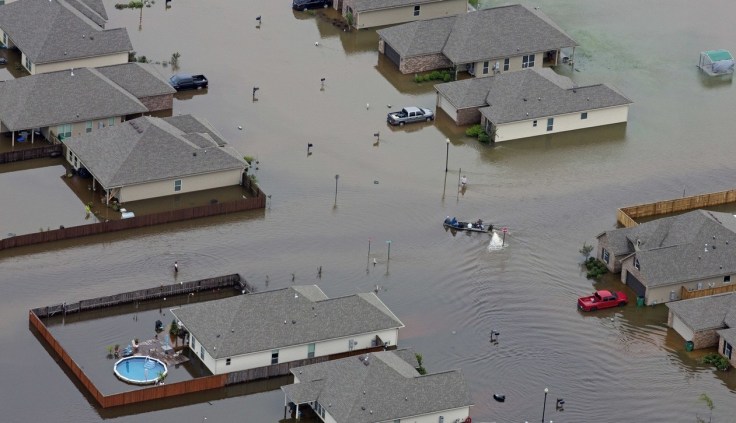
How over 2 feet of rain caused historic flooding in Louisiana in less than 72 hours

All-told, over 20 inches of rain fell in less than 72 hours around Baton Rouge.

Source: www.washingtonpost.com

Last month I was in New Orleans, and it rained for about 2 hours…it was staggering to see how many issues stemmed from that drainage in such a flat floodplain.  This is so much worse.  This article focuses on the weather/environmental situation, and this one on the political/human impact.


Tags: urban ecology, environmentweather and climate, water, disasters

No America, You can’t claim Monica Puig’s Puerto Rico gold medal win as your own

“Like many boricuas on Saturday, Aug. 13, I celebrated when tennis player Monica Puig won gold in the single women’s division and became both Puerto Rico’s first gold win and a woman’s first gold win for the island. It was an overall historic moment that everyone back in the island basked in with full pride. I’ve noticed a trend on social media regarding the Olympics: multiple posts and tweets about how Puerto Rico shouldn’t compete independently, confused as to why Puerto Rico is competing in the first place or that a victory for Puerto Rico supposedly ‘counts’ because it’s a U.S. commonwealth.”

Source: medium.com

This is good article showing the distinct nationalism of Puerto Rico and its political ties with the United States.  This is but one of the many example of how you can link students’ interest in the Olympics to expand their understanding about the world.  Also, this protest of Iran’s gendered spaces is another poignant article.


Tags: Puerto Rico, political, autonomysport, popular culture.


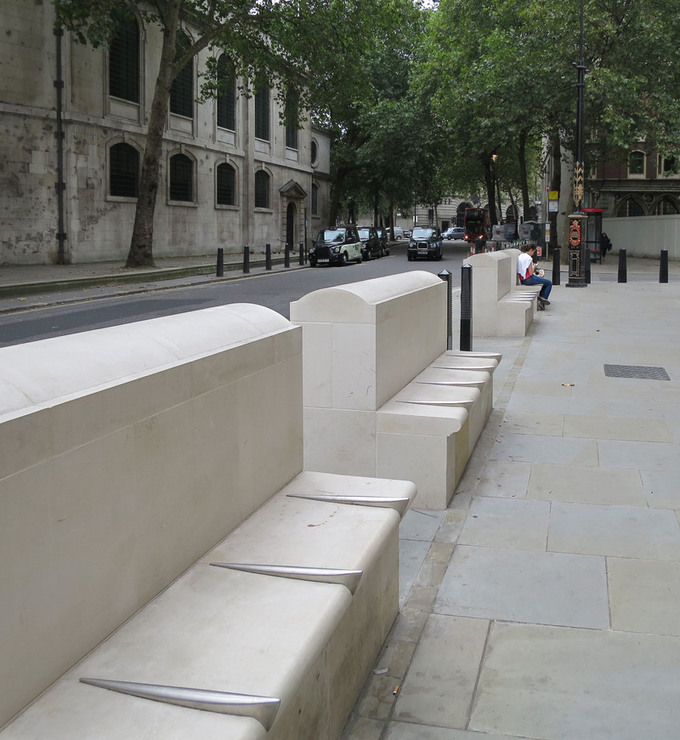
The Subtle Design Features That Make Cities Feel More Hostile

Think your city doesn’t like you? You’re right.

Source: www.atlasobscura.com

Geography explores more than just what countries control a certain territory and what landforms are there.  Geography explores the spatial manifestations of power and how place is crafted to fit a particular vision.  Homeless people are essentially always ‘out of place.’  These articles from the Society Pages, Atlas Obscura, the Atlantic and this one from the Guardian share similar things: that urban planners actively design places that will discourage loitering, skate boarding, and homelessness, which are all undesirable to local businesses.  This gallery shows various defensive architectural tactics to make certain people feel ‘out of place.’  Just to show that not all urban designs are anti-homeless, this bench is one that is designed to help the homeless (and here is an ingenious plan to curb public urination).  


Tags: urbanplanning, architecture, landscape, place, poverty.

How To Get A Country To Trust Its Banks

“It’s something you can see on every block in most major cities. You probably see one every day and never give give it a second thought. But in Yangon, Myanmar in 2013, an ATM was a small miracle. For decades, Myanmar was cut off from the rest of the world. There were international sanctions, and no one from the U.S. or Europe did business there.”

Source: www.npr.org

We often assume that one form of technology, a system, institute should work equally well where ever it is.  But the nuances of cultural geography mediate how societies interact with technological innovations, and as demonstrated in this Planet Money podcast, “People in Myanmar (Burma) were reluctant to use ATMs because they didn’t trust the banks. They weren’t sure that the machines would actually give them their money.”  


Tags: Burma, Southeast Asia, poverty, development, economicpodcast.

A Proposed New AP Course–AP GIS & T

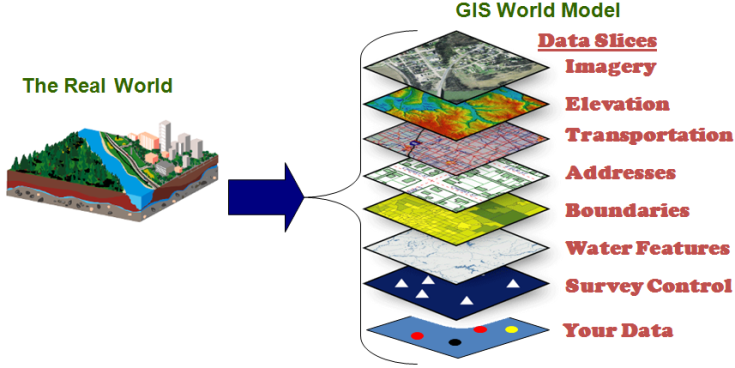
There is a proposal for a new Advanced Placement course in Geographic Information Science and Technology (AP GIS&T). All U.S. high schools, colleges, and universities are invited to review the proposal by visiting www.apgist.org

AP GIS&T is designed to introduce high school students to the fundamentals of geographic information science and applications of powerful geospatial technologies for spatial analysis and problem solving. 

The AP GIS&T course proposal has attracted broad support from prominent scientific and educational organizations.  For AP GIS&T to become a reality, the AAG needs to collect attestations from 250 U.S. high schools that confirm they have the interest and capacity to offer the course. Similar assurances are needed from 100 colleges and universities that they would be willing to offer some form of credit to students who demonstrate proficiency on the AP GIS&T exam.

High school principals and academic department chairpersons are invited to consider adding their institution to the list of AP GIS&T supporters by completing the brief attestation form at www.apgist.org. Please consider submitting an attestation by October 1, 2016.

Have questions about AP GIS&T? Contact the AAG at ap_gist@aag.org.

Source: apgist.org

Japan’s Emperor Akihito fears age could impact ability to rule

“In a rare televised speech, Japan’s Emperor Akihito has addressed his people directly about his declining health. A Japanese monarch has not stepped down in about 200 years.

Once revered as a living God, the Japanese emperor became a ceremonial figure in Japan’s constitutional monarchy after World War II. Occupying forces seized much of the imperial family’s wealth and today Parliament controls the household’s annual budget and allowances, which total well over $100 million.”

Source: www.cnn.com

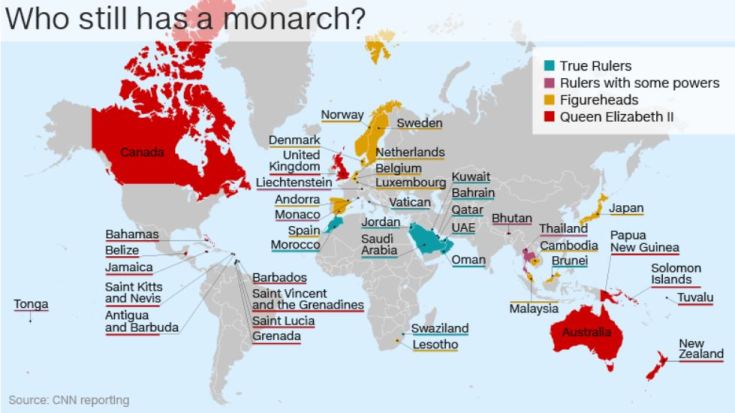
It’s amazing to think that this is only the 3rd public message from an Emperor since the invention of TV and the radio.  (1-Surrender to end WWII, 1945. 2-Fukushima nuclear disaster, 2011, 3-Emperor’s Declining health, 2016).  This news though, brings up the questions of how many monarchs still rule today, and with what amount of power do they actually have?  The map accompanying this gives the quick run-down.  


Tags: Japan, political.

More young adults are living with their parents

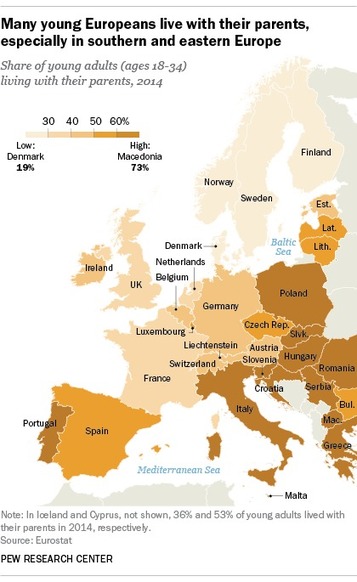
Across much of the developed world, researchers have found that more young adults are living at their parents’ home for longer periods of time.


Across the European Union’s 28 member nations, nearly half (48.1%) of 18- to 34-year-olds were living with their parents in 2014, according to the EU statistical agency Eurostat.  The Scandinavian countries have the lowest rates, with Denmark coming in at 18.6%. Southern and eastern European countries tend to have higher rates, led by the former Yugoslav republic of Macedonia: 72.5% of 18- to 34-year-olds reportedly were living with their parents.

Source: www.pewresearch.org

This isn’t news because this trend gradually became a new part of the economic and cultural norms of the developed world–but the impact is enormous.  In the United States, more young adults live with parents than partners (for the first time in the 130 years that the statistic has been collected).  The world isn’t what it was in 1880.  

32.1% of young adults in the U.S live with parents, and 48.1% of young adults in the European Union Union live with parents.   


Questions to Ponder: What are some contributing factors to this trend in the United States and Europe?  What does this say about housing costs, economic, and cultural conditions? 


Tags: socioeconomic, housingstatisticspopulation, cultural norms, culture.

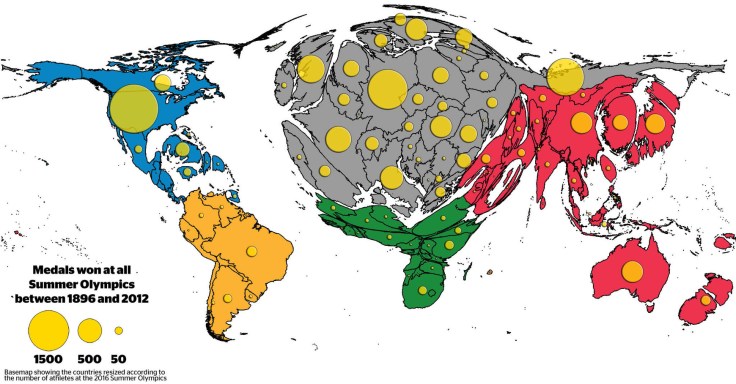
Cartograms of the Olympic Games

The distribution of medals shows the existing Olympic inequalities: The overall patterns are a reflection of wealth distribution in the world, raising the question whether money can buy sporting success. Besides investment in sports by those countries who can afford it, the medal tables also reflect a battle for global supremacy in political terms.


Tags: sport, popular culture, mapping, historical, cartography.

Source: geographical.co.uk

The Arctic Suicides: It’s Not The Dark That Kills You

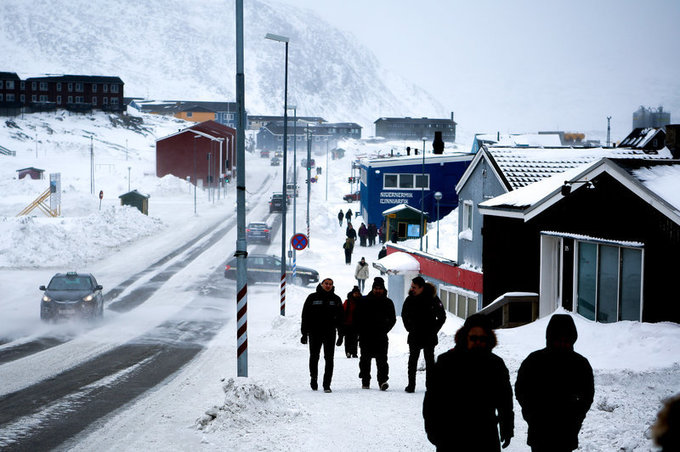
Greenland has the world’s highest suicide rate. And teen boys are at the highest risk.


Like native people all around the Arctic — and all over the world — Greenlanders were seeing the deadly effects of rapid modernization and unprecedented cultural interference. American Indians and Alaska Natives (many of whom share Inuit roots with Greenlanders) had already seen many of their communities buckle under the same pressures.

Source: www.npr.org

This is an incredibly tragic story; if I could add one word to the sub-title, it would read, “It’s not JUST the dark the kills you.”  I’m not an environmental determinist, but we can’t pretend that the climate/darkness don’t play some role in Greenland having 6x the suicide rates of the United States.  See also this article/photo gallery about a similar suicide problem in the indigenous far north of Canada.    


Tags: Greenland, Arctic, genderpodcast, indigenous.

Blog at WordPress.com.

Up ↑