I never thought that I would be so emotionally invested in people dancing to Germans rapping tongue-twisters, but that is the modern era of cultural production and the amazing impacts of cultural diffusion. Barbara’s Rhubarb Bar–it sounds silly, and it is, but that doesn’t mean it’s simple. In fact, the deeper you go, the more delightfully complex this cultural phenomenon becomes.
This particular online story of why the dance became a viral sensation in 2024 isn’t Earth-changing, but it so perfectly shows the cultural patterns and processes in the modern online ecosystem. I was in the midst of compiling videos to help explain this when my favorite German Youtuber living in the U.S. who explains Germany for Americas (very niche, I know, but that’s want makes the internet fun) explained it far more comprehensively than I ever could because I don’t get all the references, play on words, and allusions to other styles—or in other words—the cultural context. Culture matters, even when we aren’t fully getting it.
This explains probably more context than you ever wanted…and I love it.
QUESTIONS TO PONDER:
What made this funny/fun for Germans? Americans?
What about the German language makes this distinct?
How did social media make this “a thing?”
How do other music, dance, or literary cultural traits play a role in this?
“The news that the world has America, not Italy, to thank for the tomato base on pizza has gone down about as well as putting cream in carbonara among Italian gastro-nationalists. In a new book called La Cucina Italiana Non Esiste (literally “Italian Cuisine Does Not Exist”), food historian Alberto Grandi claims, among other things, that Italians only discovered tomato sauce when they emigrated to the Americas, where tomatoes are native, in the 19th century.” SOURCE: The Independent
A food historian has kicked up controversy after claiming that there is ‘no such thing’ as Italian cuisine, sparking debate over the origins and ownership of food. But perhaps we should reconsider our ideas about so-called ‘national dishes.’
This article highlights great, everyday examples that shows how cultural patterns and processes change and why they matter. Places and cultures are proud of what they see as their accomplishments that are foundational to their heritage. Interestingly though, many communities jealously guard what they see as their contributions as dislike hearing that their other communities may have had a hand in that contribution.
In an analogous example to those given in the article, Mexicans are very proud of their cuisine, but must remember that nothing is created in cultural or geographic isolation. Street tacos made with meat cooked on a rotating spit (al pastor) came to Mexican after WWI and the collapse of the Ottoman Empire. Migrant from what are now the countries of Syria, Lebanon, Israel, and Turkey brought the Middle Eastern traditional manner of cooking meat and it became a new thing when it can to Mexico. So, is it “authentically” Mexican? Of course it’s still authentic, but there is a tendency in some circles to judge something to be less authentic when the origins are more diffused. I think we should resist the temptation though, to judge the value of a culture or a cultural trait based on it’s perceived “authenticity” or “purity.” Cultures all over the world have their own regional variants of flatbread—partly as a result of stimulus diffusion from other places and partly bringing their own local flavor and customs. Cultures are delightfully intermixed, and the diffusion of cultural practices is what leads to continual human progress that shapes our modern world.
Towards the end of the article, they say: “does it really matter who invented tomato sauce on pizza? Or where your croissant is from? To acknowledge that one country might have had an impact on the food of another isn’t to be complicit in cultural appropriation. Point to any dish on a menu and you’ll have a hard time finding one that hasn’t got war, politics, economics, emigration or poverty to thank for its place there.” In essence, geographic processes can be seen everywhere you look.
“Indonesian lawmakersunanimously passed a sweeping new criminal code on Tuesday that criminalizes sex outside marriage, as part of a tranche of changes that critics say threaten human rights and freedoms in the Southeast Asian country.” SOURCE: BBC
Classical liberal values (free speech, rights for minority groups, fair elections, freedom of press, etc.) have grown in most places in most times, but that isn’t a guarantee that it will always be so or that it will in all places it will be maintained. Indonesia is the world’s largest Muslim majority population with a diverse set of religious traditions emmeshed. Indonesia, with thousands of islands, is also home to great array of linguistic diversity.
Indonesia, at the end of 2022, outlawed sexual interactions outside of those legally recognized marriages. The government framed the old laws as vestiges of an old colonial legacy that will allow them to return to traditional cultural values of the country, while others feel that this is conflating what is considered sinful with the criminal. This with likely impact the tourism industry as those traveling abroad that are not in marital unions will likely head to other tropical Southeast Asian destinations. A week after the law was passed, the governor of Bali (a noted travel destination for Australians and Europeans) went on record that tourists would not be investigated under this law.
Languages of even small countries can have very regionally specific accents. Accents help give cultures their place-based charm, and a hyper-regionalized sense of place.
In the embedded video above with comedian/actor Fred Armisen (of “Portlandia” fame), he demonstrates how he performs a variety of accents in the United States (and at the tail end of the video you get the difference between Mexican and Cuban Spanish as a bonus). Super strong accents are quite rare, and although they can be emblematic of a place, most people in a place have some elements, but not elements of a regionally distinctive accent.
For Fun, two “bonus” accent clips: first, Fred Armisen again doing accents around the world.
“Bread is known to be convenient, nutritious, and, of course, delicious. From naan in India to the French baguette, we take a look at 29 types of bread around the world.” SOURCE: Insider Food
Of course geographers love videos that highlight places around that world that give you the feeling of leaving your homeland to travel to a different cultural context in new place. Videos like this that give a quick tour around the world so you can sample from the visual delights, even if the culinary ones are off the table. This Travel Insider video channel has a few great examples that show how distinct regional variations in food production create cultural distinct local customs. Food production is inherently cultural, and these videos show how local flavor creates a series of regional variations. Linked as well here is a great article showing the amazing diversity of breads around the world.
While I’m a fan of the “cheese around the world” video, I’ll include one other on the food theme–sandwiches from around the world–is embedded below.
Let’s first dispel some mistaken ideas about Taco Bell (Malcolm Gladwell’s excellent podcast, Revisionist History discussed Taco Bell extensively in an episode that was primarily about the concept of cultural appropriation in music and food).
Myth #1: The Bell represents the Spanish Mission of the Southwest. Fact: Glen Bell is the founder so the family name is the rationale for the iconic bell.
Myth #2: Taco Bell makes bad, cheap Mexican food. Taco Bell’s goal is not trying to make Mexican food, but to make an interpretation of Mexican food for a broader audience with a different palate. They search for the familiar in the unfamiliar and make it all seem new.
One of these “interpretations” of Mexican food is the Mexican Pizza (not a thing in Mexico). While the name doesn’t sound American, the creation of this is a distinctly American concoction. The cultural creation of this on the surface seems like a simple mash-up, but the cultural dynamics are a little more interesting than that. Yes, the fusion is of two familiar ideas, but the reaction to and how cultural innovations are received is culturally mediated. This may seem surprising, but South Asian immigrants to the United States especially love Mexican Pizza (NPR article) because it 1) it has a combination of flavors and spices that is reminiscent of South Asian traditional foods, 2) it can be made to be vegetarian which aligns with the religious customs of Hinduism, and 3) eating fast food with a friends of all backgrounds feels like an All-American activity for young immigrants and children of immigrants.
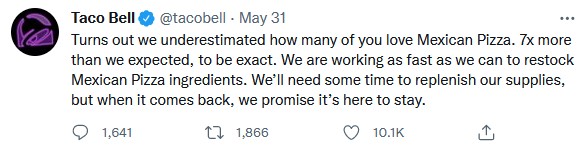
The cultural reception of the Mexican Pizza shocked Taco Bell executives since the planned for it to be a seasonal part of the menu, like the McRib is for McDonalds’. Sure, it was partly supply chain issues, but they drastically underestimated that this particular menu item would culturally resonate beyond their normal consumer base as demonstrated by this tweet below:
Turns out we underestimated how many of you love Mexican Pizza. 7x more than we expected, to be exact. We are working as fast as we can to restock Mexican Pizza ingredients. We’ll need some time to replenish our supplies, but when it comes back, we promise it’s here to stay.
The video I REALLY want you to watch is Video #3, but I need to explain a few things first because more than just the music and dance styles are getting mashed up, but cultural styles and influences are converging to create new forms of expression.
In the Punjab region (in India as well as Pakistan), the musical and dance tradition of bhangra is a deeply connection to local customs, religions, and traditions as they vary in different regions. The coming of spring, weddings, and ceremonies were known for large-scale bhangra dances which are tailor-made for audio-visual extravaganzas. In 2008, the song Aaja Ni Aaja was released and through online channels it became linked to a larger, global audience.
VIDEO #1: The Bhangra audio element of the mashup.
Decades earlier, Elvis Presley was the biggest name in Rock ‘n Roll and was becoming a cross-over star, appearing in movies with infused with some of his hits. The 1957 movie Jailhouse Rock made a hit song out of the song of the same title, infusing African-American blues and Southern Country.
VIDEO #2: The Elvis video component of the mashup.
Both of these bits of cultural context are necessary for understanding the following cultural production that is embedded in the video below (finally! the video I really wanted to share). It’s an ingenious mashup that combines the audio of a bhangra song with Elvis’ video. At the core of the mashup is the idea that incredibly distinct cultural productions are not so incredibly different after all and the commonalities in many cultural expressions exhibit universal impulses. Music and dance, like all cultural expressions, are not authentically pure representations for one place and time, but have many influences and can diffusion in so many ways. Enjoy the “If Elvis were Punjabi” video!! (And how did I find this? On social media of course).
VIDEO#3: The mashup in all it glory…cultural diffusion and cultural convergence at it’s finest.
BONUS CLIP: I did go down a few rabbit holes writing this post to get some of the cultural context that I was missing and it was helpful for me to understand the South Asian culture more. India’s movie industry, a.k.a. Bollywood, has been the perfect platform to make many local, folk cultures to become more prominent and accessible to a larger, and more geographically dispersed audience. Below is a video showing some of the differences between traditional bhangra dance moves with a more modernized Bollywood version.
VIDEO #4: Just because it’s good to see the “old school” vs. “new school” styles together.
For years I’ve enjoyed the clips on YouTube of “My First Errand” where it’s been running for decades in Japan. The very existence of the show demonstrates how we think about parenting and childhood are impacted by our cultural influences. Young kids go on their first unsupervised errand, but with an army of cameramen and shopkeepers prepared for the situation. Japanese parenting is designed to build resilience, trust in the community, and independence. Given that Japan’s culture this is perfectly reasonable, but now that the show is on Netflix as “Old Enough!”, American parents that parents quite differently, has more than a few parents watching this nervously and scared that it might even be dangerous.
Personally, I love that they are teaching children that they can develop some independence, resilience, and competence. We often assume we are the norm, and this is one case that shows American parenting culture in 21st century suburbs, does not represent the what has been normal throughout history, nor in other places. Some like Greg Lukianoff and Jonathan Haidt have argued that “the Coddling of the American Mind” has had some negative consequences as children who never were allowed to grow and experiment then reach college campuses (I highly recommend the book since this 1-sentence synopsis doesn’t do it justice).
The Daily Show even bit a bit saying that the show “divides parents.” (5:48-9:00 in the clip below)
“Divorce—though originally sanctioned more than 1,400 years ago by Islamic law—is still widely viewed in Muslim societies as a subversive act that breaks up the family. Women who seek divorce can often find themselves ostracized and treated as immoral. Despite such taboos and restrictions, however, divorce rates are rising across Islamic countries, even in ultra-conservative places like Afghanistan.” SOURCE: NY Book Review
This is a difficult subject to discuss in the classroom, but it hits as many of the important cultural norms that surround social interactions that are gender-based. Cultural norms explore more than just the legal rights that people many have, but they also look at the cultural expectations, and the communal/family responsibilities that they are seen to have in their society. Divorce is legal in Turkey, but because it was heavily stigmatized, it was quite rare. Today, modern cultural influences from outside the region, (i.e.-the cultural affects of globalization) are promoting and changing traditional cultural norms of the region. This is a very insightful look into the lived-experience of divorce in the Middle East that gives a sense of the cultural impacts of gendered norms.








 GEOGRAPHY EDUCATION