Search

GEOGRAPHY EDUCATION

Supporting geography educators everywhere with current digital resources.

Author

sethdixon

I am a geography professor at Rhode Island College.

No, a nation’s geography is not its destiny

Via Scoop.itGeography Education
One of the most widely accepted alternative theories of world inequality is the geography hypothesis, which claims that the great divide between rich and poor countries is created by geographical differences.

This article is an excerpt of the forthcoming book “Why Nations Fail” that should serve as an ideological counterweight to the book “Guns, Germs and Steel.”  The authors argue that the wealth of a country is most closely correlated with the degree to which the average person shares in the overall growth of its economy, meaning that political institutions are more relevant to economic success and development than physical geographic resources.

For more on this upcoming book and it’s hypothesis see this New York Times review.

Via blogs.reuters.com

Cathedral Valley Night Timelapse

Via Scoop.itGeography Education

Cathedral Valley is a remote area of Capitol Reef National park in Utah. These pictures were taken 3/16/2012 Taken with a D700 Pictures edited in Lightroom s…

This is just a beautiful depiction of a beautiful place from notable photographer,  Scott Jarvie.

Via www.youtube.com

Santorum Sees Divide Between Rural and Urban America

Via Scoop.itGeography Education

Rick Santorum, by taking on “blue” big cities, is also criticizing the Republicans, his own party.

The 2012 election are showing again some of the cultural, political and economic divides that exist in the United States.  This above map portrays the 2008 presidential election, with counties that voted for McCain in red and Obama in blue.  Rick Santorum has said, in reference the political map of the United States today, “Think about it, look at the map of the United States…it’s almost all red except around the big cities.”  Santorum has dismissed GOP candidates successes as less meaningful because these victories took place in major cities.  This political portray is an attempt to accentuate the difference between rural and urban America to hit his key demographic, but it also begs for further analysis into the electoral geography of the United States.  The next map is a cartogram that shows the same counties, but weights the size of the county by population instead of territory.

As social media critic Jesse Lasler has retorted, “It’s all blue except where nobody lives.”  Each perspective biases one region, as more quintessentially American, than the other.  Do you see Urban America as mainstream America, or Rural America as the Heartland and the soul of what it means to be an American?  What accounts for the sharp political differences between these two core components of the United States?  For more maps, see this collection of 2008 election maps that shed light on the spatial voting patterns.

This graphic, via Andy Baker, highlights these demographic patterns.  However, it shows that while ‘swing states’ will be the key talking points as the election gets closer, the more important ‘swing’ region in the polarized rural/urban dichotomy, will probably be the suburbs as stated in this political geography blog.

Via www.nytimes.com

Interactive Map: Economic Stress Index

Via Scoop.itGeography Education

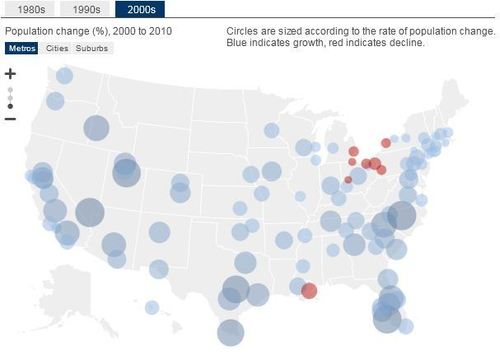
This is a great interactive feature focusing on the differential impacts of the economic downturn on particular places.  You can zoom in, see county-level data, and slide the time bar at the bottom to get spatiotemporal data.    

Via hosted.ap.org

America’s Real Homeless Hotspots

Via Scoop.itGeography Education

“An estimated 600,000 Americans are homeless, but the spread isn’t uniform. Some cities have been hit harder than others.”

When I teach cultural geography, I discuss the idea that some thing are “in place” and others are “out of place” based on the cultural norms that change from place to place.  Homelessness is almost always “out of place.”   What parts of the built environment in your city are purposefully uninviting to the homeless?  What is the connection between the city (and urbanization) and homelessness?  What could (or should) be done in major metropolitan areas with high rates of homelessness?  What is the spatial patterns evident in the geography of homelessness?  What accounts for these patterns?  What surprises are in the data from the article?

Via www.theatlanticcities.com

GPS technology maps land rights for Africa’s ‘forest people’

Via Scoop.itGeography Education

In the lush rainforests of Africa’s Congo Basin, hundreds of thousands of indigenous people live as hunter gatherers, depending on the forest’s natural resources for their survival.

The “Mapping for Rights” program trains people in the Congo to map the land they live on using GPS and other geospatial technologies.  This can assist the to produce documents to politically protect their land from encroachment and preserve their access to the forest.  Globalization can blur many of the modern/traditional narratives as the world becomes interconnected in complex ways.

Via edition.cnn.com

Erosion: The White Cliffs of Dover

Via Scoop.itGeography Education

Thousands of tons of chalk from the famous White Cliffs of Dover have collapsed into the sea following a huge rockfall.

An excellent example of erosion and the processes that have shaped an iconic landscape.  The accompanying article has numerous pictures from a variety of angles that truly tell the story.

Via www.dailymail.co.uk

Mapping the Anthropocene

Via Scoop.itGeography Education

As follow-up to an earlier post about how we have enter the age of the Anthropocene, this stunning map is a fantastic visual representation of the forces that merit the dawning of a new geologic age.  This map depicts the lights at night, major roads, railways power lines, oversea cables, airline routes and shipping lanes.  It also expands the areas according to population size.  For more on the production of this map, see the Globaia website.

Spotted on Living GeographyVia www.viewsoftheworld.net

QGIS

Via Scoop.itGeography Education

Do you want to use GIS but don’t have the budgetary support to install expensive software?  Don’t know where to start?  QGIS is a free, open-source GIS that is a nice option for schools operating on a limited budget that still want a full GIS platform.

For GIS novices, here is an excellent set of video screencasts that are an introduction to what GIS is, using the QGIS software. This site also provides sample data, tutorials and worksheets.

Another excellent tutorial for novices to GIS is found here.   This tutorial was especially designed for journalists creating maps, and walks you through the installation process as well as some of the basics of the user interface.

Many small city governments without the budget to run proprietary GIS software use QGIS and here is a repository of QGIS resources including blogs, forums, tutorials and user manuals.  An excellent blog with QGIS tutorials is: http://qgis.spatialthoughts.com/

Via qgis.org

Create a free website or blog at WordPress.com.

Up ↑