Search

GEOGRAPHY EDUCATION

Supporting geography educators everywhere with current digital resources.

Category

Uncategorized

Mapping Density in the U.S.

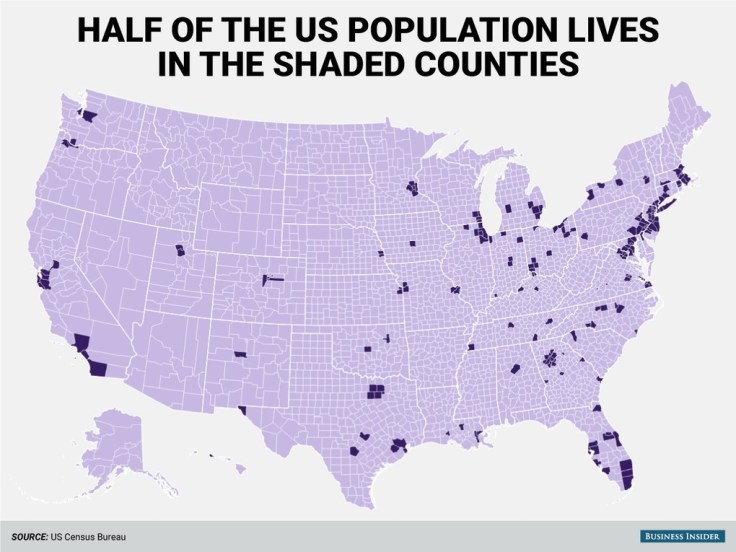
Population density in the US varies wildly from place to place.

Source: www.businessinsider.com

I thought I shared this map or something very similiar a while back in 2013 when it was widely being shared but I couldn’t find it.  Many countries have highly concentrated population distributions (like Canada and Australia) and the United States has pockets of extreme density interspersed throughout the country.  On the flip side, vast swaths of the countries are considered empty in terms of population such as this map that shows 1% of the total U.S. population in 42% of the area. and this one of the world that shows uneven patterns.


Tags: population, density, mapping, visualization.

Human impact has pushed Earth into the Anthropocene, scientists say

New study provides one of the strongest cases yet that the planet has entered a new geological epoch


Tags: Anthropocenedevelopment,  land use, environment, environment modify.  

Source: www.theguardian.com

What Borders Mean to Europe

Europe today is a continent of borders. The second-smallest continent in the world has more than 50 distinct, sovereign nation-states. Many of these are part of the European Union. At the core of the EU project is an effort to reduce the power and significance of these borders without actually abolishing them — in theory, an achievable goal. But history is not kind to theoretical solutions.

Today, Europe faces three converging crises that are ultimately about national borders, what they mean and who controls them. These crises appear distinct: Immigration from the Islamic world, the Greek economic predicament, and the conflict in Ukraine would seem to have little to do with each other. But in fact they all derive, in different ways, from the question of what borders mean.

Tags: borders, political, geopolitics, Ukraine, Greece.

Source: www.stratfor.com

Os Retornados

My final project for Dr. Dixon’s Geography 200 course at Rhode Island College.

Source: www.youtube.com

When discussing decolonization in Africa, I’ve always thought exclusively about the impact of the colonized country, or maybe the country that was losing grasp on its former empire.  Until this student project, I have never considered the global lives of those who worked for the colonial governments and had their whole worlds upended.  This isn’t to say that colonialism should have continued, but it shows that any change will have unintended consequences as it disrupts the status quo. 


Tags: Africa, Angola, historical, colonialismmigration.

EU deal gives UK special status, says PM

David Cameron says a deal with EU counterparts is enough for him to recommend the UK stays in the union, and he will present it to his cabinet on Saturday.

Source: www.bbc.com

The European Union at one time seemed as though it would continue to further and further integrate European politics and economics; Many still see  great value in EU membership but critics fear that enhanced cooperation was going to head down the road to the formation of a European superstate and further entanglements.  With talk of possibly leaving the EU and a referendum on whether the UK should stay in the EU or not, the EU was offered some extra special exemptions for the UK.  This is a very interesting developing story, one that might impact many regional supranational organizations.  

Tags: Europe, supranationalism, economic, political.

Rural US disappearing? Population share hits low

“Rural America now accounts for just 16 percent of the nation’s population, the lowest ever. The latest 2010 census numbers hint at an emerging America where, by mid-century, city boundaries become indistinct and rural areas grow ever less relevant. Many communities could shrink to virtual ghost towns as they shutter businesses and close down schools, demographers say.”

Source: www.foxnews.com

1910: 72% of USA rural

2010: 16% of USA rural


This is an old article, but it highlights the stark reversal that has profoundly reshaped our society.  The patterns noted in Peirce Lewis’s 1972 classic article “Small Town in Pennsylvania” have just continued and accelerated. 


Question to Ponder: What forces are driving the change?  What other parts of society are impacted by this shift?


Tag: rural, migration, USA, census.

OTL: The promise Rio couldn’t keep

Rio de Janeiro’s bid for the Summer Games featured an official commitment to cleaner waters. But with less than six months to go, trash and contamination continue to lurk.

Source: espn.go.com

ESPN is covering this topic only because of the upcoming Olympics, but underneath the veneer of a sports article are some weighty geographic issues that loom large for Brazil.  


Tags: pollution, economic, BrazilSouth America, urban ecology.

Simplified City Map

Cartoons by John Atkinson. ©John Atkinson, Wrong Hands (by Wrong Hands)

Source: wronghands1.com

Maybe this is not the next geographic model that will transform the discipline, but it is fun. 


Tags: urban, economic, urban models, funart.

EXPIRED? Food Waste in America

In response to this challenge, we are working on a call for a uniform, federal standard for date label language that is easily comprehended by consumers, and differentiates between food quality and food safety. We believe EXPIRED is central to this effort, and will be a powerful catalyst for change, offering a visual and visceral understanding of the problem, raising awareness about ways to combat it, and engaging key stakeholders in the issue.

Source: vimeo.com

The new 5 minute mini-documentary Expired: Food Waste in America explores why there is so much confusion as to what these expiration dates actually mean and how that leads to massive food waste.

Some states (such as the Montana example from this video) require that all milk cartons need to be marked with a date of 12 days after pasteurization, but the dairy industry standard is that milk should stay freshness for at least three weeks. Stores can’t sell or donate that milk after 12 days and toss it. Consumers at home tend to do the same. 90 percent of consumers feel that food past the ‘sell by’ date is unsafe. This fear and uncertainty lead to food waste (some estimate that about 40 percent of all food produced in the U.S. goes to waste).


Tags: food, agriculture, consumption, sustainability,video, unit 5 agriculture, food waste.

Blog at WordPress.com.

Up ↑