Search

GEOGRAPHY EDUCATION

Supporting geography educators everywhere with current digital resources.

Spotify data shows how music preferences change with latitude

"The farther from the equator, the greater the seasonal swings."

Source: arstechnica.com

I’m not posting this in spite of its controversial nature—I am sharing this precisely because it raises eyebrows.  Many have read this and see elements of environmental determinism while simultaneous recognizing some of its core assumptions.  Arctic communities have devastatingly high suicide rates that most agree is in part impacted by the cold weather, the lack of sunshine, or in other words, the physical environment.


Questions to Ponder: How much environmental determinism actually is in this research and its assumptions?  How much does latitude impact the human condition?  How much of a factor is the environment in shaping cultural patterns?  How would you adapt to the physical environment if you lived north of the the Arctic Circle? 


GeoEd Tags: environment, musicArcticenvironment adapt, unit 1 geoprinciples.

Scoop.it Tags: environment, musicArctic, environment adapt, unit 1 GeoPrinciples.

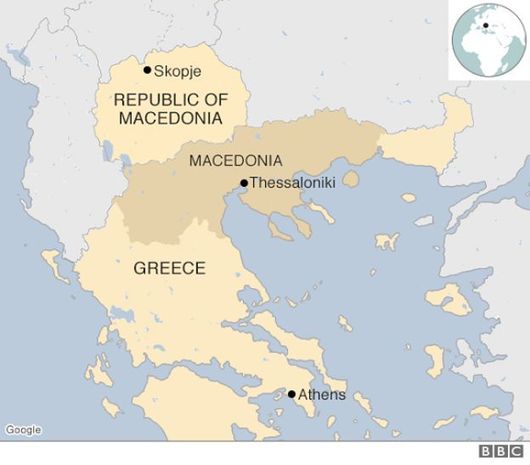
Macedonia signs NATO accession agreement

This comes after Greece backed a deal to rename its neighbour North Macedonia, ending a long row.

Source: www.bbc.com

Oh, what’s in a name?  National pride, fear of irredentist dreams, border disputes and supranational exclusion…that’s all.  Ever since the collapse of Yugoslavia, Greece has opposed an independent neighbor using the name "Macedonia" when they have an adjacent region of the same name.  This has be a point of contention, in part, over the historic memory of Alexander the Great and Hellenic grandeur which Greece feels have been wrongfully appropriated.  It is also regarding expansionist ambitions of a "greater Macedonia" so Greece has blocked Macedonia’s entry to NATO and the EU.  To appease Greece, lessen international strife, and gain greater access to the global community Macedonia approved this change, but this move has lead to internal strife as many Macedonians feel that this name change is unfair.           

GeoEd Tags: culture, Political, place, toponyms, historical.

Tagsculturepolitical, placetoponyms, historical.

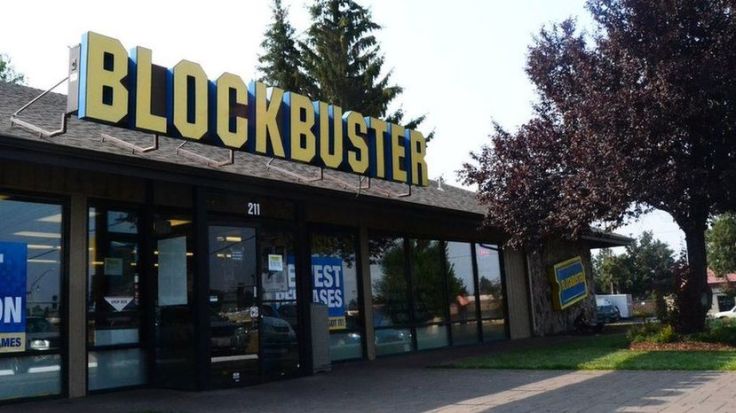
The last Blockbuster: ‘I’m proud that we’ve survived’

“The company was founded in 1985 in Dallas, Texas, and it was worth billions of dollars at its peak, employing dozens of thousands of people. It was so popular across the US that, in 1989, a new store was opening every 17 hours. The rapid rise of digital services such as Netflix, which launched in 1999, and online retailers, like Amazon, made Blockbuster’s video and DVD business model practically obsolete.”

Source: www.bbc.co.uk

In my neighborhood, as in neighborhoods around America, there is an old Blockbuster building that is used to sell fireworks before the 4th of July and Halloween paraphernalia in October.  Most of the year however the property is a vacant lot where you might find police officers filling out their paperwork in the parking lot.  If video killed the radio star, Netflix killed the Blockbuster store.  Creative destruction leaves littered industries that, because of technological innovations, are no longer viable (if you want a deep dive into the demise of Blockbuster that goes beyond the obvious rise of streaming technology, this article by Retail Dive is solid).  

In addition to technological changes, some product shifts hint at societal and demographic changes (see this witty article about the demise of mayo). 

GeoEd TAGS: globalization, industry, economic.

Scoop.it Tags: globalizationindustry, economic.

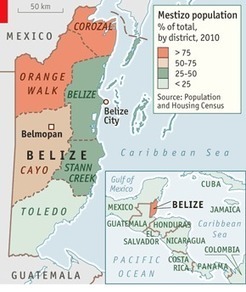
Belize: A Spanish Accent in an English-Speaking Country

"BELIZE has long been a country of immigrants. British timber-cutters imported African slaves in the 18th century, and in the 1840s Mexican Mayans fled a civil war."

Source: www.economist.com

This is an older article (2012), but the pattern mentioned here is all the more relevant.  Belize has a much higher Human Development Index ranking that its Central American neighbors such as Guatemala.  That fact alone makes Belize a likely destination for migrants.  Given that Belize was ‘British Honduras’ during colonial times, English is (still) the official language, but that is changing as increasingly Spanish-speaking immigrants are changing the cultural profile of Belize.      

Petition calls for U.S. to give Northwest Angle to Canada

"There’s a petition that calls for the United States government to adjust the border near Manitoba to give Canada the geographic oddity known as the Northwest Angle."

Source: www.cbc.ca

Enclaves and exclaves are often bizarre examples that test the normal rules regarding the political organization of space.  Historical quirks, landform oddities, competing national goals, and irregular demographic patterns mean that the world is filled strange little case studies about places that seem to defy our normal expectations.  However, the most enduring rule seems to be this: never voluntarily give up territory that you can easily control. 


GeoEd TAGS: borders, politicalterritoriality, USA, Canada.

Scoop.it Tags: borders, politicalterritoriality, USACanada.

Beautiful Maps of the World’s Watersheds

Nothing is more fundamental to life than water – so see the world’s watersheds like never before with these colorful and absolutely stunning maps.

Source: www.visualcapitalist.com

I love the cartographic design of these three maps that shows the importance of river basins. In this one in particular, highlights the Danube and Volga river basins as the most extensive river basins in their regions. For countries in the Danube basin without a coastline, these fluvial connections are critical. The Volga river basin is enormous, but the fact that it flows into the Caspian Sea limits the natural advantage of this river system (this shows exactly why the Volga-Don Canal was such a massive project during the Soviet era).

Often we focus on political boundaries to define regions, but watersheds are natural ecological regions that shape transportation and trade connections.    


Scoop.it Tags: water, mapping, physical, fluvial, regions.

WordPress TAGS: water, mapping, physical, fluvial, regions.

U.S.-Mexico border: An interactive look at the barriers that divide these two countries

"What is along the nearly 2,000 miles of border that divides the U.S. from Mexico?"

Source: www.washingtonpost.com

This interactive map allows users to fly over the length of the U.S.-Mexico border.  At key locations you can see how the border is part of communities and an integral part of the economic and social of these cities.  Borders, while on the surface may seem to only divide, often unite people together.  All borders are semi-permeable and this interactive highlights some of the connections across this particular border that is perpetually under intense political scrutiny.   


GeoEd Tags: Mexico, Political, borders, North America.

Scoop.it Tags: Mexico, borders, politicalNorth America.   

Language shapes the way we think

“There are about 7,000 languages spoken around the world — and they all have different sounds, vocabularies and structures. But do they shape the way we think? Cognitive scientist Lera Boroditsky shares examples of language — from an Aboriginal community in Australia that uses cardinal directions instead of left and right to the multiple words for blue in Russian — that suggest the answer is a resounding yes. ‘The beauty of linguistic diversity is that it reveals to us just how ingenious and how flexible the human mind is,’ Broditsky says. Human minds have invented not one cognitive universe, but 7,000.”

Source: www.youtube.com

Sense of direction, numerical concepts, gendered traits, even the colors that we perceive with our own eyes…all these are shaped by the language(s) we speak.  If language shapes how an individual shapes their own worldview, a cultural group’s worldview is also powerfully impacted by the language that frames how they think. 

Scoop.it Tags: languagecultureTED, video.
WordPress TAGS: language, culture, TED, video.

Manila Times Gives China The Finger With Its Own “Nine Dash Line” Map

"The Philippines’ oldest newspaper recently made what could be considered a provocative gesture towards China regarding its notorious nine-dash-line."

Source: saigoneer.com

I’ve shared some more substantial resources about maritime claims in the South China Sea than this flippant political cartoon.  Still, this cartoon beautifully illustrates a geopolitical perspective quite powerfully.  As always, use your own discretion when sharing resources in your own classroom (my college students love this). 


GeoEd Tags: borders, Political, conflict, water, Philippines, China.

Scoop.it Tags: borders, political, conflict, water, PhilippinesChina.


Create a free website or blog at WordPress.com.

Up ↑