Search

GEOGRAPHY EDUCATION

Supporting geography educators everywhere with current digital resources.

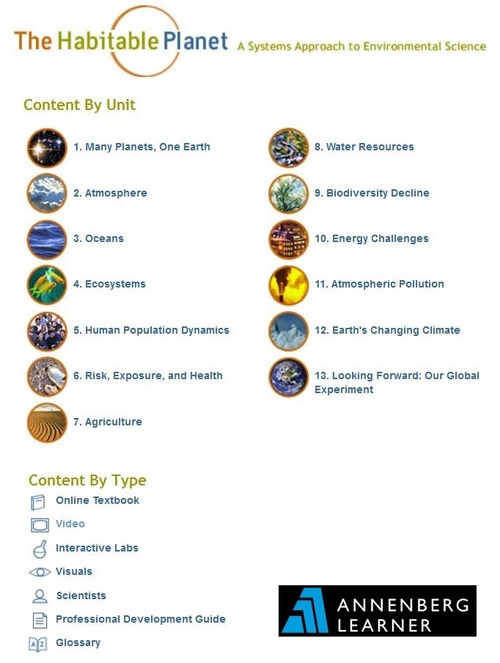
The Habitable Planet

“The Habitable Planet is a multimedia course for high school teachers and adult learners interested in studying environmental science. The Web site provides access to course content and activities developed by leading scientists and researchers in the field.”

Seth Dixon‘s insight:

Much like the Power of Place resources were created by Annenberg Learner to share World Regional Geography videos, the Habitable Planet has diverse resources for Physical Geography and Environmental Science.  In essence, it is an excellent free online textbook.   

Tags: textbook, environment, physical.

See on www.learner.org

Geographic Perspective Matters in Policy Debates

“The American policymaking sphere has long been dominated by political scientists and economists. While I have nothing against these disciplines, and acknowledge that they have made important contributions to our public discourse, I am also concerned that we have not always heard the full range of perspectives on important questions of the day.  Geography has a different perspective to offer, and our public discourse is impoverished without it.

Seth Dixon‘s insight:

Spatial thinking needs to be infused into many of our public conversations, and geographers collectively need to find ways to be a part of them.

See on mn2020.org

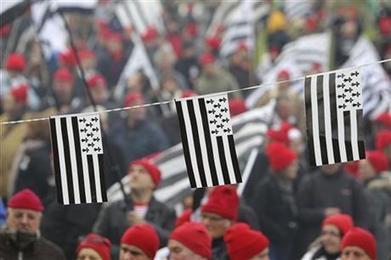
France to redraw nation’s map to save money

“France’s administrative regions — Normandy, Alsace, Burgundy, etc. — have long been part of the identity of citizens of this diverse country. Now, merging some of them is seen as a logical way to save money on bureaucracy, and the French support it — as long as it’s someone else’s turf.”

Seth Dixon‘s insight:

This is an interesting concept that shows the divergence between national and regional identities.  68% of French citizens recognize that consolidating regional administration will be economically more efficient at the national level; however 77% don’t want to see the elimination of their own local region.   The formation of place-based identities operate an multiple scales.  How would you feel if your state was absorbed by a neighboring state?  How come? 

Tags: communityplacegovernance, France.

See on bigstory.ap.org

Alluvial Fans

See on Scoop.itGeography Education

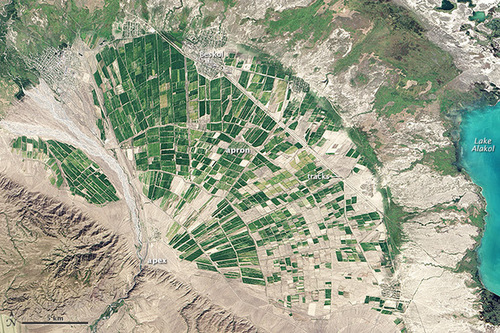
When streams emerge from mountains, they often spread out and deposit sediment in a distinctive pattern known as an alluvial fan.

Seth Dixon‘s insight:

In dry areas of interior drainage (such as Central Asia and the Great Basin in the U.S.), the human settlements are often clustered along the foothills of the mountains near landforms called alluvial fans.  Take time to analyze this image (and this one as well); in alluvial fans and the agricultural patterns that people create on them, we can see some striking geometric and spatial configurations that show how human settlements are highly dependent of the physical environment.   


Tags: spatial, remote sensing, geospatial, Kazakhstan, Central Asialandscape.

See on earthobservatory.nasa.gov

Territorial Disputes in the Waters Near China

See on Scoop.itGeography Education

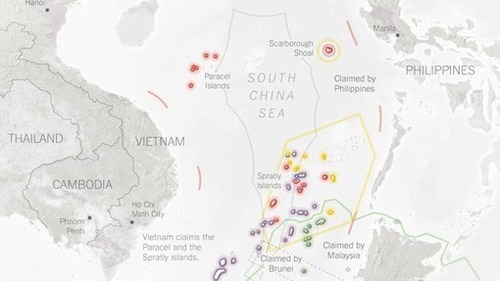
China has recently increased its pursuit of territorial claims in nearby seas, leading to tense exchanges with neighboring countries. A map of some of the most notable disputes.

Seth Dixon‘s insight:

Many of the geopolitical conflicts in the East Pacific have their roots in the territorial disputes over islands that at first glance seem as if they wouldn’t be worth the trouble.  However, since the the UNCLOS agreement gives countries 200 nautical miles off their coasts to be an Exclusive Economic Zone, that greatly enhanced the strategic value of controlling these islands.  This interactive map briefly highlights some of the details behind the conflicts with links for further readings.  


Questions to Ponder: Why do countries care so much about some minor islands?  Why would other countries not want to accept China’s territorial assertions?  Experts are saying that Chinese-Japanese relations are as bad as they’ve been since the end of World War II–Why all the commotion? 


Tags: borders, political, conflict, China, East Asia.

See on www.nytimes.com

Healthy Economies Need Healthy Oceans

See on Scoop.itGeography Education

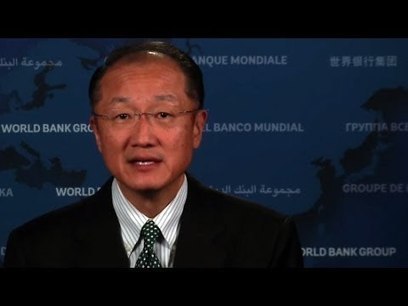
“More than 60 percent of the world’s economic output takes place near our coastlines. Yet our oceans are in danger from over fishing, pollution and global warming. World Bank Group President Jim Yong Kim explains how good business practices can improve marine life, as well as human livelihoods.  Oceans are essential to the systems that produce the water we drink & food we grow.  Healthy oceans are vital to healthy economies and promote global food security.”

Seth Dixon‘s insight:

Recently there was a summit on protecting the world’s oceans attending by representatives of most countries.  Overfishing is but one of the many issues that are plaguing our oceans. We can’t pretend that the oceans are external to our national ecosystems; the World is a closed system and oceanic pollution and degradation impacts the entire system. You can also explore more using these ESRI StoryMaps with over 25 interactives on a variety of topics about our Oceans.   


Tags: environment modify, consumption, water, physicalindustry, economic, pollution, industrysustainability, urban ecology.

See on www.youtube.com

Will American Pot Farmers Put the Cartels out of Business?

See on Scoop.itGeography Education

They’ve driven prices so low that Mexican growers are giving up.

For the first time ever, many of the farmers who supply Mexican drug cartels have stopped planting marijuana, reports the Washington Post. “It’s not worth it anymore,” said Rodrigo Silla, a lifelong cannabis farmer from central Mexico. “I wish the Americans would stop with this legalization.”  Facing stiff competition from pot grown legally and illegally north of the border, the price for a kilogram of Mexican schwag has plummeted by 75 percent, from $100 to $25.

Seth Dixon‘s insight:

Events that we think of as local (Washington and Colorado legalizing marijuana use) have national and global implications, especially in a globalized economy.  This article is but one example of why geographers try to approach every issue at a variety of scales to more fully comprehend the ramifications and ripple effects of any given phenomenon. 

Tags: Mexiconarcoticsscale

See on www.motherjones.com

The Great Green Wall

See on Scoop.itGeography Education

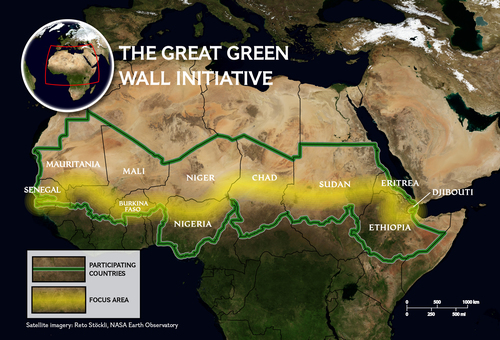
The Great Green Wall initiative uses an integrated approach to restore a diversity of ecosystems to the North African landscape.

Seth Dixon‘s insight:

The Great Green Wall initiative is composed of 11 countries that are cooperating together to combat the physical and human geographic characteristics that make the Sahel one of the more vulnerable ecosystems in the world.  This swath running through Africa is the transition zone where tropical Africa meets the Sahara.  The Sahel is susceptible to drought, overgrazing, land degradation and desertification.  These issues of resource management and land use transcend international borders so this “Green Wall” was created with the intent to protect the environment, landscapes and people of the Sahel from desert encroachment (as an aside, the Green Wall spatially corresponds nicely with the apocryphal Mountains of Kong). 

Tags: Africa, development, environment, waterbiogeography, ecology, environment depend, physical, weather and climate, supranationalism, political ecology.

See on education.nationalgeographic.com

What is halal meat?

See on Scoop.itGeography Education

“There have been calls for clearer labelling of halal products in shops, restaurants and takeaways. But what is halal food? And why are campaigners so concerned?”

Seth Dixon‘s insight:

I know just enough Arabic to read the word Halal (حلال) and know that it means permissible, the opposite of Haram (حَرَام‎) which means forbidden or illegal.  In the context of meat, it means meat that has been prepared in accordance with Islamic traditions and is therefore permissible for an observant Muslim to eat (very similar to Kosher for Jewish people).  Today, Halal is becoming an important issue within the European Union for two main reasons: 1) more Muslims are migrating to Europe and 2) Europeans are searching for less artificial food products.  Some Europeans, however, feel that the Halal labeling and marketing is a change to the cultural landscape that they are not comfortable with, and don’t want to see it become more mainstream.  Other meat companies try to present their products as Halal, but don’t adhere to all of the customs according to some more strict Muslims.  Halal, then is a lightning rod, in either direction right now in Europe.  If you want to see the inner workings of a Halal slaughterhouse in New York, this video will show you what it is like.   

See on www.bbc.com

Blog at WordPress.com.

Up ↑