Search

GEOGRAPHY EDUCATION

Supporting geography educators everywhere with current digital resources.

Los Lakers know their Hispanic fan base

“With timely assists from the Spanish-speaking skills of players and executives, the Lakers have cultivated Hispanic support in their community.”


Julio Manteiga, associate director of media monitoring and Latin America communications for the NBA, provided ESPN information stating Hispanic fan attendance for Lakers games was 42 percent. In the 2015 U.S. Census, the Hispanic population of Los Angeles County was measured at 48.4 percent. The Lakers have benefited from taking the initiative to make their games accessible to a Latino audience, starting with broadcasting games in Spanish.


Tags: culture, economic, California, Los Angeles, ethnicity, sport, popular culture,

Source: www.espn.com

The Flogsta Scream

“Have you ever felt so stressed out or anxious that you just want to open your window and scream at the top of your lungs?

Well, students in Flogsta, a residential area in the Swedish university town of Uppsala, do just that when the exam pressure gets too overwhelming.  Every night at 10pm Swedish students open their windows and scream for several minutes.”

Source: www.youtube.com

This is an strange a cultural trait as anything you’ll ever see and it is delightfully enjoyable.   Like so many great traditions, no one knows exactly how or when this phenomenon started.


Questions to Ponder:  How does this activity diffuse in Flogsta at night?  How did this activity diffuse to other college towns in Europe?  Why is this a thing?    


Tags: culture, Swedendiffusion.  

Nine Nations of North America, 30 Years Later

“Back in the ’70s, almost a hundred reporters around the country – Washington Post bureau chiefs, rovers, freelancers and me, their desk-bound editor – were trying to get our arms around how North America worked, really. Not how it should work. But how it did work. Forget those nice neat rectangles in the middle of the U.S. Let’s be real: The mountains of western Colorado are totally alien from the wheat fields of eastern Colorado. And Miami is part not of Florida, but its own watery Caribbean realm. And what a terrible idea is ‘California.’ It behaves as if it covers three warring civilizations. The result was my 1981 book, ‘The Nine Nations of North America.’ The reader reaction was astonishing. This map – drawn to anticipate the news – revealed something much deeper. It turned out to be a map of culture and values, which have nothing to do with our perversely drawn state and national boundaries.”

Source: www.nytimes.com

Question to Ponder: How would you divide up North America?  What would be some differences from this map?  What reasons do you have for making these different regional groupings?  What are the main criteria for what constitutes a region?

Tags: regionsNorth America.

Human Population Through Time

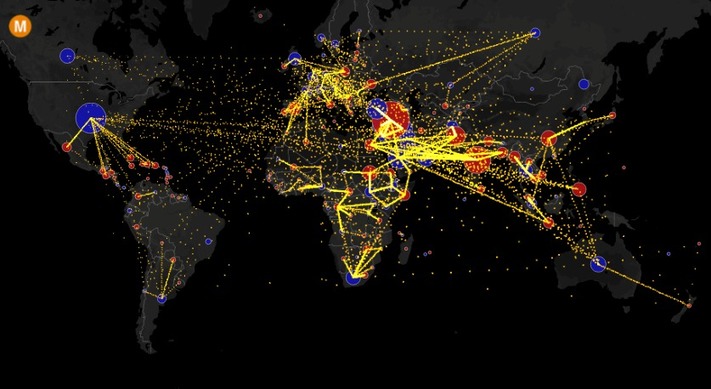
It took 200,000 years for our human population to reach 1 billion—and only 200 years to reach 7 billion. But growth has begun slowing, as women have fewer babies on average. When will our global population peak? And how can we minimize our impact on Earth’s resources, even as we approach 11 billion?

Source: www.youtube.com

As stated in a Vox article, “The video above, from the American Museum of Natural History, shows essentially all of human history in just six minutes. It shows humanity spreading across the world over a few hundred thousand years — even as our population remained under 1 million. After that came the rise and fall of many empires and civilizations, plagues, wars, and so on — all the way to our current population of around 7 billion.”  Admittedly, the video is a bit “slow” in the middle, but that is a major part of the story of human population growth, and only serves to show how dramatic the population growth is at the end.  This video brings up more questions than it has answers.


Tags: demographicsmappingmigration, populationhistorical, unit 2 population 

America’s Wealth Is Staggeringly Concentrated in the Northeast Corridor

“At the county level, America is a tremendously unequal place.”

Source: www.citylab.com

The concentration of wealth within U.S. cities is one of the most powerful geographic patterns in North America (and remains of of the key geographic stories of the 2016 presidential election). NYC served as a hub for the import/export of primary economic resources during the 18th and 19th centuries as the Erie Canal opened up the interior of the United States to become part of NYC’s hinterland.  NYC expanded as a hub for the manufacturing of consumer products and then began to transition to a more tertiary based economy. “There are more than 3,000 counties in the U.S. Of the 75 with the highest incomes, 44 are located in the Northeast, including Maryland and Virginia. The corridor of metropolitan statistical areas that runs from Washington, D.C., through Baltimore, Philadelphia, New York and Boston includes 37 of these top-earning counties (where the median family takes home at least $75,000 a year).”


Tags: urbanindustrymanufacturinglabor, economic, NYC, Washington DC. Boston.

How to Create an Interactive Map with Visme

A step-by-step tutorial on how to create an interactive map with Visme, a free online infographic and presentation tool.

Source: blog.visme.co

If you have students use Piktochart to create infographics, then this is a new tool that you should consider.  In addition to creating infographics, this allows users to create and embed interactive maps in those infographics.  This is a both a baby-step into the world of GIS as well as a way to create student projects that are richly informative.


TagsAPHG, infographic, visualization, mapping, GIS, edtech.

Belgium and the Netherlands Swap Land, and Remain Friends

The discovery of a headless corpse in the Netherlands helped Belgium and its bigger Dutch neighbor resolve a property squabble that began in 1961.


In a region that has long known geopolitical and linguistic squabbles, and where Belgium has lived in the shadow of its neighbor, the land swap was anything but inevitable. In 1961, when the Meuse was reconfigured to aid navigation, it had the side effect of pushing three pieces of land onto the wrong side of the river. The uninhabited area subsequently gained a reputation for lawlessness, wild parties and prostitution.


Tags: borders, political, territoriality, BelgiumNetherlands, unit 4 political, Europe.

Source: www.nytimes.com

Labor unrest in Cameroon after clashes over language discrimination

In Cameroon, unrest in minority English-speaking regions over discrimination by majority French speakers is still simmering after violent clashes with police claimed at least four lives.


English-speakers have been protesting since Monday (11/21/2016) against what they see as their “second-class citizen status” and attempts to marginalize them in the west African nation. Eight of Cameroon’s ten regions are largely Francophone, but two regions, North West and South West Cameroon are English-speaking. English-speaking teachers complain that French-speaking counterparts are being increasingly deployed in English schools, despite differences in the curricula and teaching systems.


Tags: language, CameroonAfrica, culture.

Source: www.dw.com

‘Crimetown’ podcasts on Providence No. 1 on iTunes charts

“Providence, once the heart of the New England mafia, was chosen for the first season. The approximately 17 to 20 episodes will follow the patterns of corruption in Rhode Island up through the banking crisis of RISDIC, the impeachment of a Supreme Court justice, and City Hall corruption in Operation Plunder Dome.”

Source: www.providencejournal.com

This is not just a fascinating local story of my new hometown; this is a riveting portrayal of the urban social geographies of organized crime, corruption, and the cosa nostra.  With only three episode to date, they with entertain and inform listeners with delving into the inner working of the mob (and just a heads up–the language will be crass and actual crimes will be discussed–don’t say I didn’t warn you).  To be honest, of course season one of Crimetown dad to been about Providence, and it is all the more compelling knowing the neighborhoods that are being shaped in this historical portrayal of Rhode Island.    


Tagsurban, crime, Rhode Island, neighborhood, socioeconomic, poverty, podcast.


Blog at WordPress.com.

Up ↑