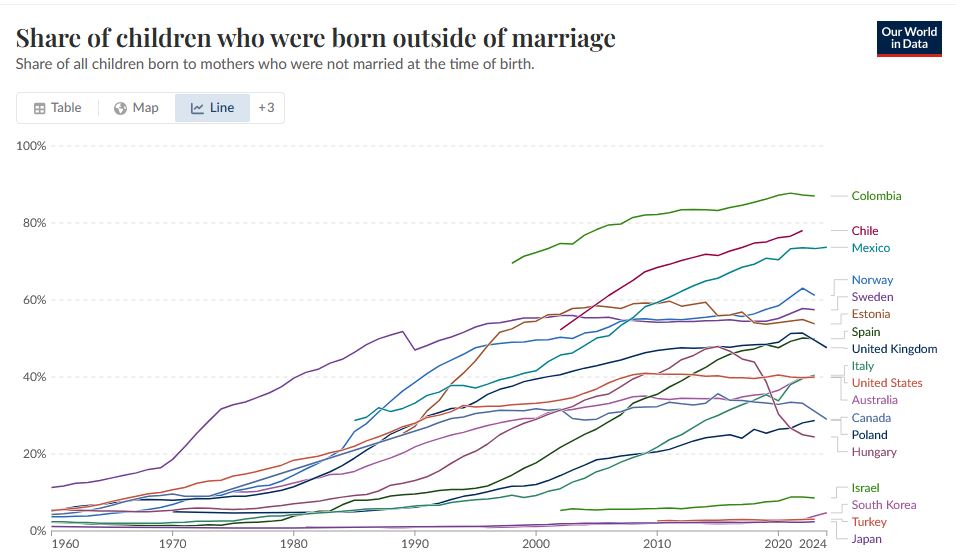
This caught my eye because my son lives in Colombia, but as I dug into the data, there’s some really good population geography to be seen in this chart since family formation is a vitally connected with population growth and decline.
The data change represents huge political, cultural, and technological shifts in many societies. Traditionally religious societies have become more secularized as birth control technologies have become universally widespread; together those have radically changed norms around family formation. Latin American countries are less Catholic, both by membership and religiosity metrics, than they were in the 60’s and 70’s, and marriage as an institution is not as central as in once was daily life. Many in Central and South America consider themselves in a married, fully committed relationship, sometimes for decades, but either don’t see the need for the legal proceedings or find it too cost prohibitive.
Secular Scandinavian countries (Norway and Sweden) have the highest rates in Europe and they have culturally promoted delaying family formation and with more liberal cultural values. Eastern European (Poland and Hungary) countries that have had conservative governments on the other hand, have implemented policies to heavily promote and incentivize marriage. These are a few of my cursory observations in my initial analysis of the data but there are so many other stories that can be told. What do you see in this dataset from Our World in Data? As a resource, you can make customizable chart and maps with the incredibly robust data at this site.
LIMITATIONS: This is not a truly global dataset (no data for most Asian and African countries), but the few countries from the Middle East (Turkey and Israel) and East Asia (South Korea and Japan) stand in sharp contrast to the majority of the countries that collect such data…that is worth unpacking for sure.




Leave a Reply