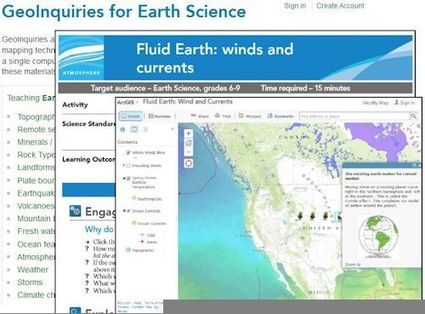
“The 2015 Earth Science Week theme is ‘Visualizing Earth Systems.’ Esri’s Earth Science GeoInquiries help educators show and explore critical content in earth science.”
Tags: physical, mapping, geospatial, ESRI.
Source: blogs.esri.com
“The 2015 Earth Science Week theme is ‘Visualizing Earth Systems.’ Esri’s Earth Science GeoInquiries help educators show and explore critical content in earth science.”
Tags: physical, mapping, geospatial, ESRI.
Source: blogs.esri.com
“French is currently ranked sixth among world languages, after Mandarin Chinese, English, Spanish, Hindi and Arabic. But it is gaining speakers quickly and, the study reports, will be spoken by 750 million in 2050, up from 220 million today. A demographic boom in French-speaking African states could bump the percentage of global French speakers from 3 percent to 8 percent by 2050, but some skeptics think the predictions are overrated.”
Source: www.ozy.com
I can’t verify the projections in the article, but the thought exercise is a great exploration into future global geographies. As some populations are shrinking, others and still growing very quickly and it is clear that the future has the distinct possibility that the linguistic composition of the world might be very different from today.
Questions to Ponder: Considering current trends, what do you think the world will be like in the future? What will be better? What will be worse?
Tags: language, culture, demographics.
How do the Palestinian and Israeli (Arab and Jewish) education systems teach the history of their nations? The film follows several Israeli and Palestinian teachers over one academic year. Observing their exchanges and confrontations with students, debates with the ministries curriculum and its restrictions, the viewers obtain an intimate glimpse into the profound and long lasting effect that the Israeli/Palestinian conflict transmits onto the next generation.
Tags: Israel, Palestine, conflict, borders, territoriality, political, Middle East.
Source: www.youtube.com
“My 2015 NESTVAL presentation in an APHG session on the geography of food.”
Source: www.slideshare.net
In this presentation (PPTx file here), I’ll share some of my favorite resources for teaching the content as well as some pedagogical tips. Some of these resources are found in an article I wrote for National Geographic or shared on this site earlier. Here are some pedagogical tips to APHG students about food systems:
Tags: food, economic, food production, agribusiness, agriculture, APHG.
“What we call Chinese food (including the fortune-filled cookies) has become an integral part of the American culture and cuisine, with a complex history that dates back to the 19th Century.”
Source: 99percentinvisible.org
This 99 Percent Invisible podcast explores the fascinating story of the Americanization of Chinese food, and the icon of Chinese food in the States, the fortune cookie (no, that is decidedly NOT from China). This is yet another podcast from 99 Percent Invisible that is rich in geographic content.
That first podcast is reminiscent of a second podcast from NPR about an American-style Chinese restaurant that opened in Shanghai to cater to Americans living in China who miss ‘Chinese food’ as it’s made back home. What’s the name of the restaurant? Fortune Cookie, of course.
Tags: food, globalization, culture, California, podcast, historical.
I’m always disappointed that my urban acquaintances know very little of the suburbs surrounding their city. But I’m never more disappointed than when urbanites spout clichéd opinions about suburban living.
Source: www.startribune.com
This is a interesting op-ed that defends suburban living when many critics of routinely argue that the suburbs symbolize what’s wrong with American urbanism.
Tags: neighborhood, suburbs, op-ed.
“Examinations, tests, assessments—whatever the nomenclature, it’s hard to imagine schooling without them. Testing is the most popular method of quantifying individuals’ knowledge, often with the intention of objectively measuring aptitude and ability. Test-taking is a dreaded experience that the country’s kids and young adults share with their counterparts across the globe. The ritual at its core doesn’t vary much: Students sit at a table or a computer desk (or sometimes, as shown below, on the floor), pencil and/or mouse in hand, the clock ticking away mercilessly.”
Source: www.theatlantic.com
I am torn on how to teach these two ideas about cultures and societies all around the world:
Cultural practices are often so similar, are done in slight different fashion. This photo gallery can create opportunities for our students to ‘see’ themselves in other cultures while at the same time seeing the richness of global cultural practices.
“There has been an intense wave of Russian air strikes in two areas of Syria, activists say. Moscow says it is targeting jihadist groups like Islamic State in co-ordination with Syria’s government. But NATO is worried some of the attacks are hitting rebel groups opposed to President Bashar al-Assad – some of whom are backed by the West. So just who is fighting whom in Syria?”
Source: www.youtube.com
Following the old adage, “an enemy of an enemy is a friend” can make for a very complicated geopolitical situation in a hurry. This video is a nice overview of the complexity without being complicated.
Tags: Syria, war, conflict, political, geopolitics.
“The new Pew interactive map covers 1850 to 2013.”
Source: www.citylab.com
The source of migrants today has changed the cultural composition of the United States from what is was 100 years ago. Cultures are not static and migration is one of the key drivers of change. These maps are produced by the Pew Research Center and show the main country of origin of each states’ foreign born population. Despite what media reports would have you believe, immigration into the United States is not on the dramatically on the rise, maps such as these can be construed to imagine that there is a massive flow of immigrants coming from south of the border. The reality is that percentage of foreign-born migrants in the United States from Mexico, and most Latin American countries, has steadily dropped since 2000.
Tags: migration, historical, USA, mapping, census, ethnicity.